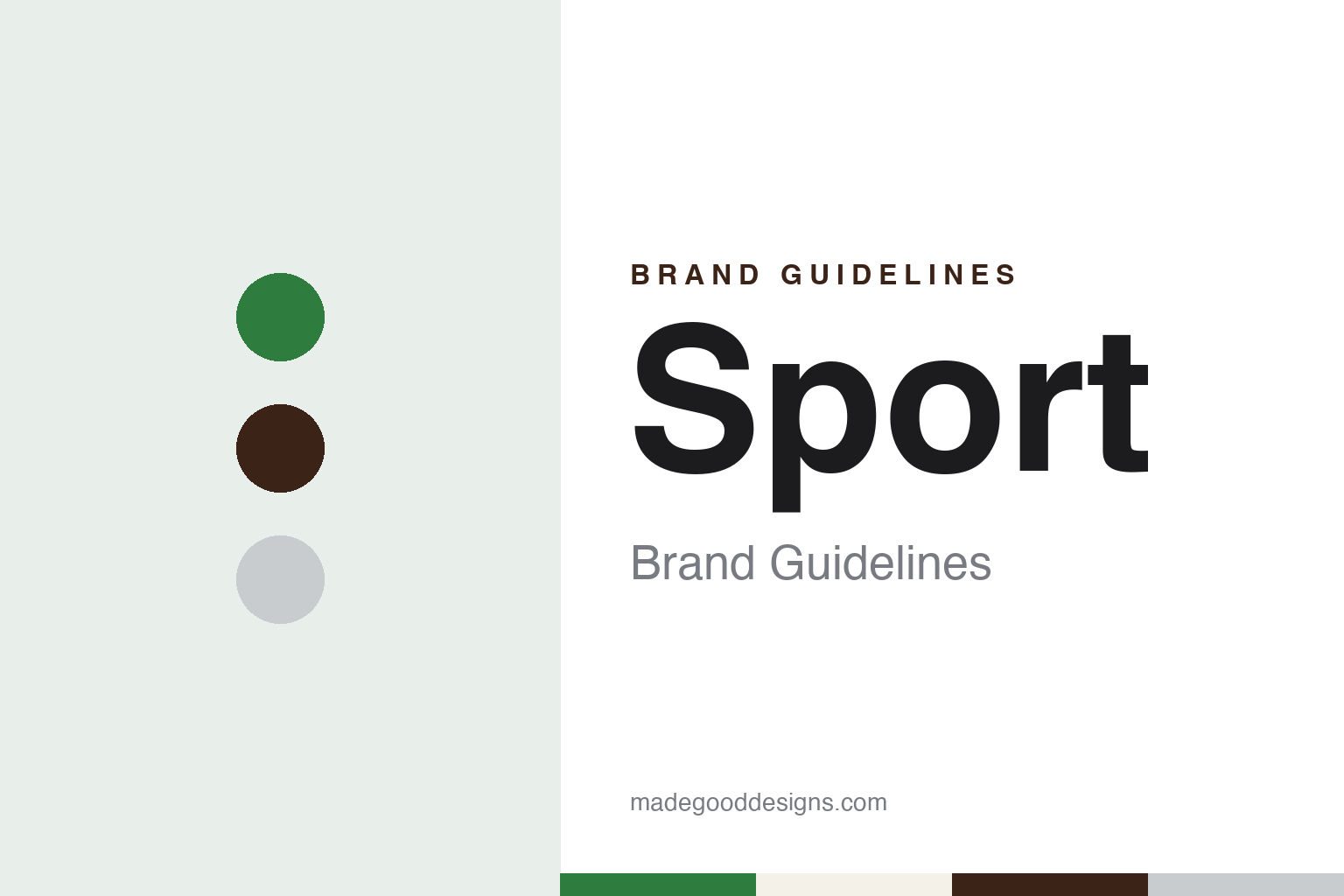
Sport Brand Guidelines
The rum-flavoured chocolate bar born at the Népstadion.
Aa
Two constants: a wrapper green, dark chocolate and foil silver palette and an athletic sans register. Abstract homage — not a Sport product or mark; no wrapper, logo or bar is reproduced.
A bar for a stadium
A state confectioner, a new stadium and a 25-gram bar.
Sport is a Hungarian chocolate bar with a rum-flavoured filling under a dark chocolate coating, and it was born with a stadium. Hungarian Wikipedia, citing the news site Index in 2006, says the first bars were made for the opening of Budapest’s Népstadion on 20 August 1953, by the state confectioner Csemege Édesipari Vállalat. The bar’s present-day owner tells the same story on its own website: the first Sport, a 25-gram “fusion” of rum and cocoa, was made by workers at Csemege for the stadium’s opening. Hungarians still call it the Sport szelet, the “Sport slice,” or simply Sport csoki.
The first bars were made largely by hand. Index reported in 2013, on the bar’s sixtieth birthday, that in the early days the cooled, smoothed sheets of filling were coated with chocolate and then cut with a wire cutter. Hungarian Wikipedia describes the filling as a cream fondant, softened with milk fat.
The name had a political edge at first. Hungarian Wikipedia, citing a 1962 book on trademarks by Sándor Vida, says the bar was originally sold as the MHK Sport szelet. MHK stood for “Munkára, harcra kész” — “Ready for work and combat” — the mass sports movement of the period, and its initials sat in the background of the wrapper. After the 1956 revolution, the same source says, production continued under the name MHSZ Sport szelet at the Budapesti Csokoládégyár, the Budapest Chocolate Factory, whose trademark it then was.
Colour
Green paper, silver foil and a discus thrower.
For most of its life Sport was recognised by its wrapper before its taste. Hungarian Wikipedia describes the original pack as a two-layer impregnated aluminium foil, covered on the outside with green paper printed with the figure of a discus thrower. The figure was modelled on József Szécsényi, a leading Hungarian discus thrower of the 1950s and 1960s, according to Hungarian Wikipedia, citing Index in 2006, and to an article on the Telex news site in 2024, which describes him as the first Hungarian to throw the discus beyond 60 metres. Hungarian Wikipedia records his best throw as 60.66 metres, in 1962, and a European Championship bronze medal in Bern in 1954.
The slogan grew up alongside the athlete. English Wikipedia, citing the 2013 academic collection Post-communist Nostalgia and the textbook Global Marketing, gives the bar’s slogan as “Az élet sport!” — “Life is sport!” In 2015, the company says, the line was extended to “Az élet Sport. Kell hozzá energia!” — “Life is Sport. You need energy for it!” — and the brand introduced “Az Edző,” The Coach, a mentor figure who helps people through life’s challenges in its advertising.
The bar’s look changed with its ownership. After the 1993 privatisation, Hungarian Wikipedia says, a larger standard bar was introduced, the original became the “small” Sport, an XL size appeared, and the athlete disappeared from the main pack. The company dates new green packaging for the standard bar to the same year. The small foil-wrapped bar with the discus thrower carried on alongside.
It finally ended in 2024. Telex reported on 1 August 2024, in an article published as paid partner content, that Mondelēz Hungária had stopped making the 25-gram discus-thrower bar in mid-May 2024, with stock expected to last until mid-August. The company said the traditional packaging was “neither modern nor environmentally friendly” any more; English Wikipedia says flow-wrapping was introduced on environmental grounds. Telex reported that examples of the old bar were to be given to the Budapest Retro Museum, and that the rum-and-cocoa flavour would continue in the wider Sport range.
Typography
Design and documentation.
The seven brands in this group all make food or drink, and all of them come from Hungary: Szamos, Tibi, Sport, Dreher, Borsodi, Unicum and Pöttyös. Hungarian food and drink brands in general sit at many different points in the trade, from family firms that still carry a founder’s surname to names that now belong to much larger food or drinks groups, and a single brand can be sold everywhere from a corner shop to a supermarket shelf.
A food or drink brand’s identity is usually carried less by a single product than by a pack, a name and the treat or the drink it promises, because the company behind the name may have changed hands, moved its factory or grown far beyond the town where it started. That makes the questions behind each name worth asking plainly: who started it, who owns it now, and where its products are actually made and packed.
Each guide separates what independent sources record from what the company says about itself — its founding story, its owners over time, where its products are made and how its packaging has changed — and marks plainly what rests only on the company’s own word.
Aa
An athletic sans for a bar named after sport. (Specimen set in Exo 2, a sans STAND-IN; NOT the Sport logo.)
Sport
From a state confectioner to Kraft and Mondelēz.
Sport passed from state industry into an international group soon after the end of communism. Hungarian Wikipedia says that in 1993, during privatisation, Kraft Jacobs Suchard bought the former state company, and the brand’s own website says Kraft Jacobs Suchard acquired Csemege that year. English Wikipedia says Kraft Foods bought the rights to Sport after the political change of 1989 and kept the bar’s distinctive half-century-old packaging. The brand’s website now names Mondelēz International as its owner, and the bar is made and distributed in Hungary by Mondelēz Hungária, according to Telex in 2024.
Under its international owners the range grew. Hungarian Wikipedia and the company list larger XL and XXL bars from the late 1990s and early 2000s, caramel and hazelnut flavours, a milk chocolate XXL in 2002 and later white chocolate versions, and, from 2005, a Sport ice cream. The company also lists a coconut “duo” bar and Sport Érem, smaller medal-shaped treats.
The bar remains a fixture of Hungarian shops. In 2013, Hungarian Wikipedia says, citing the news site Origo, Mondelēz Hungária told the press that around 46 million Sport bars were sold each year, and Index reported that year that Hungarians ate a little under 1,800 tonnes of it annually. The sixtieth birthday that August was marked with a special run on Budapest’s Cogwheel Railway, Index reported.
Its television advertising in the 2000s also travelled. Hungarian Wikipedia says a series of spots featuring a dreadlocked Jamaican character played by the actor Victor Romero Evans, who “helps” a tired motorist, was originally made for the Scandinavian Japp bar, with only the final frames changed for Sport. English Wikipedia’s account of the bar draws on two books: Post-communist Nostalgia, edited by Maria Todorova and Zsuzsa Gille, and in Kate Gillespie and H. David Hennessey’s textbook Global Marketing.
For a design guide, Sport shows how a wrapper colour and an athlete drawn for a 1953 stadium opening can carry a chocolate bar through state industry, privatisation and a global owner. Compare Tibi, another Budapest chocolate classic, and Szamos, the Hungarian marzipan maker. For this guide we use a wrapper green, dark chocolate and foil silver with an athletic sans, an unofficial interpretation; no product or logo is reproduced.
Explore & save
Keep Sport’s identity on hand — save it to a board in the Made Good inspiration library.
Sport identity set
Pin the Sport wrapper green, dark chocolate and foil silver palette and the athletic sans register to your own board.