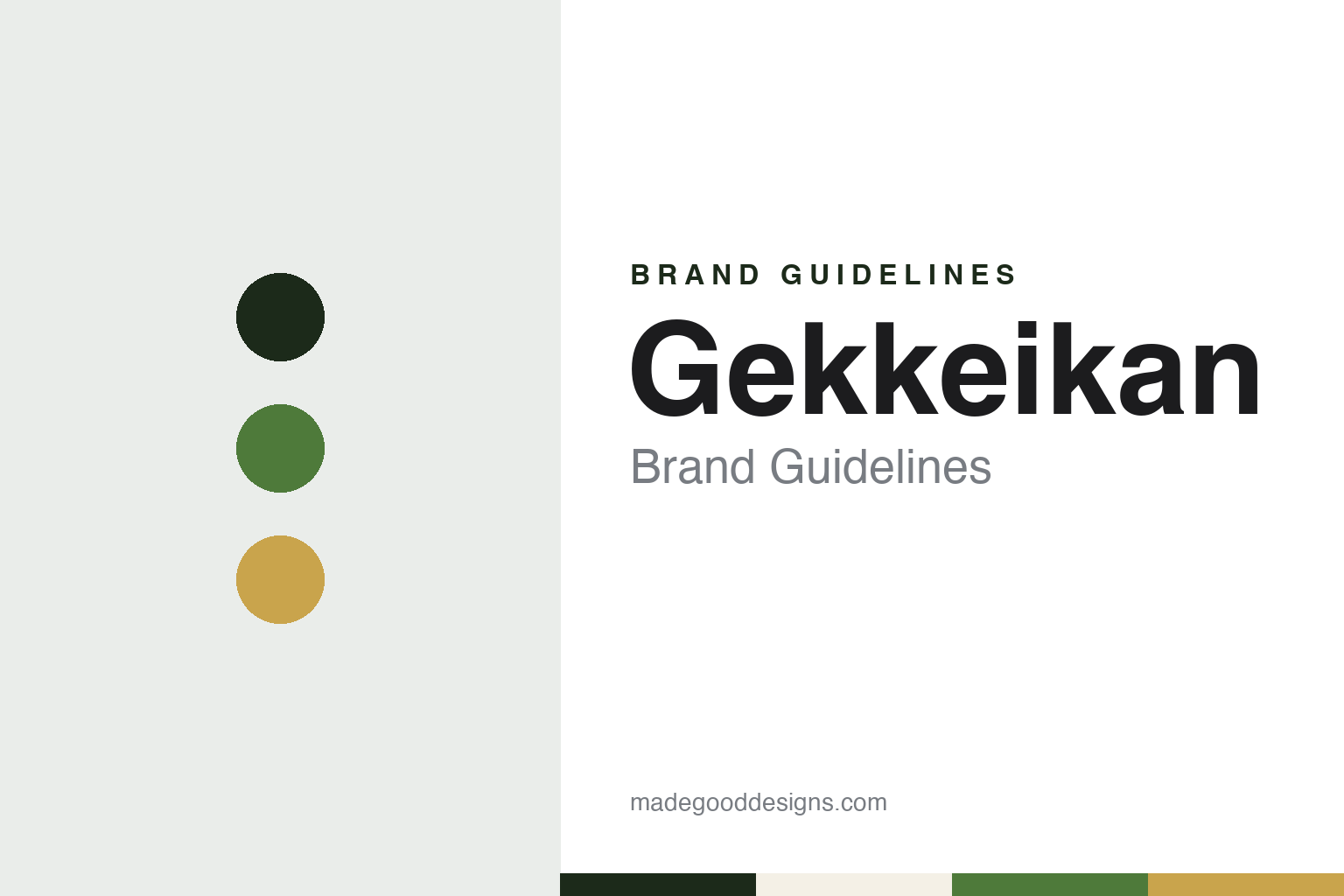
Gekkeikan Brand Guidelines
The Fushimi sake house of 1637 and its laurel crown.
Aa
Two constants: a laurel green, crown gold and rice white palette and a brush-and-Mincho serif register. Abstract homage — not a Gekkeikan product or mark; no bottle, label or logo is reproduced.
Kasagiya
A sake shop in Fushimi and a borrowed laurel.
Gekkeikan began in Fushimi, the river-port district on the southern edge of Kyoto, in 1637. The company’s chronology says its first head, Jiemon Okura, opened a sake shop there that year under the house name Kasagiya and sold his sake as Tamanoizumi; Japanese Wikipedia says the house name came from Kasagi, the founder’s home town in what is now Kyoto Prefecture. For more than two centuries it stayed small. The company says Kasagiya made only a few hundred koku a year in the Edo period, a koku being about 180 litres, and that in 1868, when the Battle of Toba–Fushimi set the neighbourhood alight, the Okura family house and brewery escaped the fire. The family house, built in 1840, still stands.
The modern company is the work of the eleventh head, Tsunekichi Okura, who took over the family business at 13. In 1905 he registered the name Gekkeikan as a trademark. The word means “laurel crown” — the wreath given to victors — and the company says it had only recently been coined in Japanese as a translation of “laurel wreath,” and that Okura chose it to signal an ambition to make Fushimi sake the best in the country. The company had registered another sake name, Horin Masamune, in 1897.
The other changes of Tsunekichi’s time were about method. In 1909 the company founded the Okura Sake Research Institute, which it describes as the first research laboratory in the sake industry and which survives as the Gekkeikan Research Institute. That year it also opened a bottling plant, in an era when sake was sold mostly from casks, and in 1911 it began selling bottled sake sealed with a promise of “no preservatives.” The family business was incorporated on 15 May 1927 as Okura Tsunekichi Shoten, renamed Okura Shuzo in 1944, and took the name Gekkeikan Sake Company on 1 April 1987, the 350th year after Kasagiya opened.
Colour
Station sake, cup caps and a year-round brewery.
Much of Gekkeikan’s reputation was built on how it packaged sake. In 1909, the company says, the national railways named Gekkeikan a station-sale sake, and in 1910 it launched a small bottle topped with its own drinking cup, which it credits with spreading the Gekkeikan name across Japan. A dark brown, European-style bottle went to the San Francisco exposition of 1915, and a brown 1.8-litre bottle followed in 1928. Later formats kept the idea of sake that could be drunk on the move: the CapAce, a 180-millilitre container with a cup cap, in 1969; paper-cup and carton sake in 1980; and The Cup in 1987, with a 200-millilitre version in 1995 that the trade paper Nihon Shokuryo Shimbun reported at the time as the first of its size in the industry.
On the brewing side, the company says it completed a reinforced-concrete, air-conditioned brewery in 1927 and, in 1961, the seven-storey Ote brewery, which it describes as the first in Japan built to brew all year round rather than only in winter. In 1981 it stopped adding brewing sugars to its sake, and in 1984 it launched a nama, or unpasteurised, sake that could be shipped at room temperature, which it calls a first for the industry. Its premium label, Horin, revived the older house name in 1978. Japanese Wikipedia says Gekkeikan was the country’s largest sake maker for decades until Hakutsuru of Nada overtook it in 2002, and that the brush lettering of its product name is the work of the Meiji-era calligrapher Kusakabe Meikaku.
Gekkeikan went abroad early. The company says it shipped sake to Honolulu in 1902 and to California in 1906. In 1989 it set up Gekkeikan Sake (USA), Inc. in Folsom, California, near Sacramento; its Japanese chronology says the US office and brewery were built in 1990 and that the plant held its grand opening and began shipping in 1991. A 2008 company page, cited by English Wikipedia, put Gekkeikan’s share of the American sake market at about 25%.
Typography
Design and documentation.
The seven brands in this group are all wine and sake names: Yellow Tail, Jacob’s Creek, Penfolds, Casillero del Diablo, Concha y Toro, Barefoot and Gekkeikan. Wine and sake brands in general sit at many different points in the trade, from family houses that still carry a founder’s name to labels that now belong to much larger drinks groups, and a single brand can be sold everywhere from a corner shop to a restaurant list.
A wine or sake brand’s identity is usually carried less by a single bottle than by a label, a name and the place it promises, because the company behind the name may have changed hands, moved its production or grown far beyond the place where it started. That makes the questions behind each name worth asking plainly: who started it, who owns it now, and where its wine or sake is actually made and bottled.
Each guide separates what independent sources record from what the company says about itself — its founding story, its owners over time, where its wine or sake is made and how its labels have changed — and marks plainly what rests only on the company’s own word.
月桂冠
A brush-and-Mincho serif for a sake house whose name means “laurel crown.” (Specimen set in Shippori Mincho, a serif STAND-IN; NOT the Gekkeikan logo or its brush lettering.)
Gekkeikan
A family company, a museum and an old brewing quarter.
Gekkeikan is still a private, family-run company. Japanese Wikipedia says it is unlisted and that its presidents have been drawn from the Okura family; the company’s chronology records the installation of Haruhiko Okura as president in September 1997, and Japanese Wikipedia still names him as president. Its head office and main breweries remain in Fushimi, where a new head office was completed in 1993. Gekkeikan joined Les Hénokiens, the Paris-based association of family firms at least 200 years old, in 1984, Japanese Wikipedia says; English Wikipedia lists it among the world’s oldest companies.
The family’s old brewing quarter is also its public face. In 1982 the company opened the Gekkeikan Okura Sake Museum (Okura Kinenkan) in Fushimi; in 1985, it says, 6,120 Fushimi sake-brewing tools from its collection were designated tangible folk cultural property by the city of Kyoto. Not every old building survived. The Kyoto Shimbun reported in August 2014 that Gekkeikan was demolishing Meiji-era wooden breweries and the former Okura Sake Research Institute building, a listed Heritage of Industrial Modernization, to redevelop its Kitagura site; Japanese Wikipedia says brewing there had stopped in 2003.
Beyond sake, the company makes plum wine, liqueurs and sparkling sake, imports German beer and French wine, and since 2014 has owned Kinrei, a frozen-noodle food business it took over from the earlier company of that name, Japanese Wikipedia says. In 1996 it set up a Korean subsidiary, and in 2011 a sales company in Shanghai. Its corporate symbol and the slogan “For Your Lifestyle Taste” date from 2002, according to the company.
For a design guide, Gekkeikan shows how a single borrowed word — a Western laurel crown, rendered in Japanese brush lettering — can carry a 17th-century Kyoto brewer from the railway platform to a brewery in California; see also our note on the Gekkeikan font. Compare Kikkoman, the Noda soy sauce maker, and Yamasa, the Choshi soy sauce house founded in 1645. For this guide we use a laurel green, a crown gold and a rice white with a Mincho-style serif, an unofficial interpretation; no product or logo is reproduced.
Explore & save
Keep Gekkeikan’s identity on hand — save it to a board in the Made Good inspiration library.
Gekkeikan identity set
Pin the Gekkeikan laurel green, crown gold and rice white palette and the brush-and-Mincho serif register to your own board.