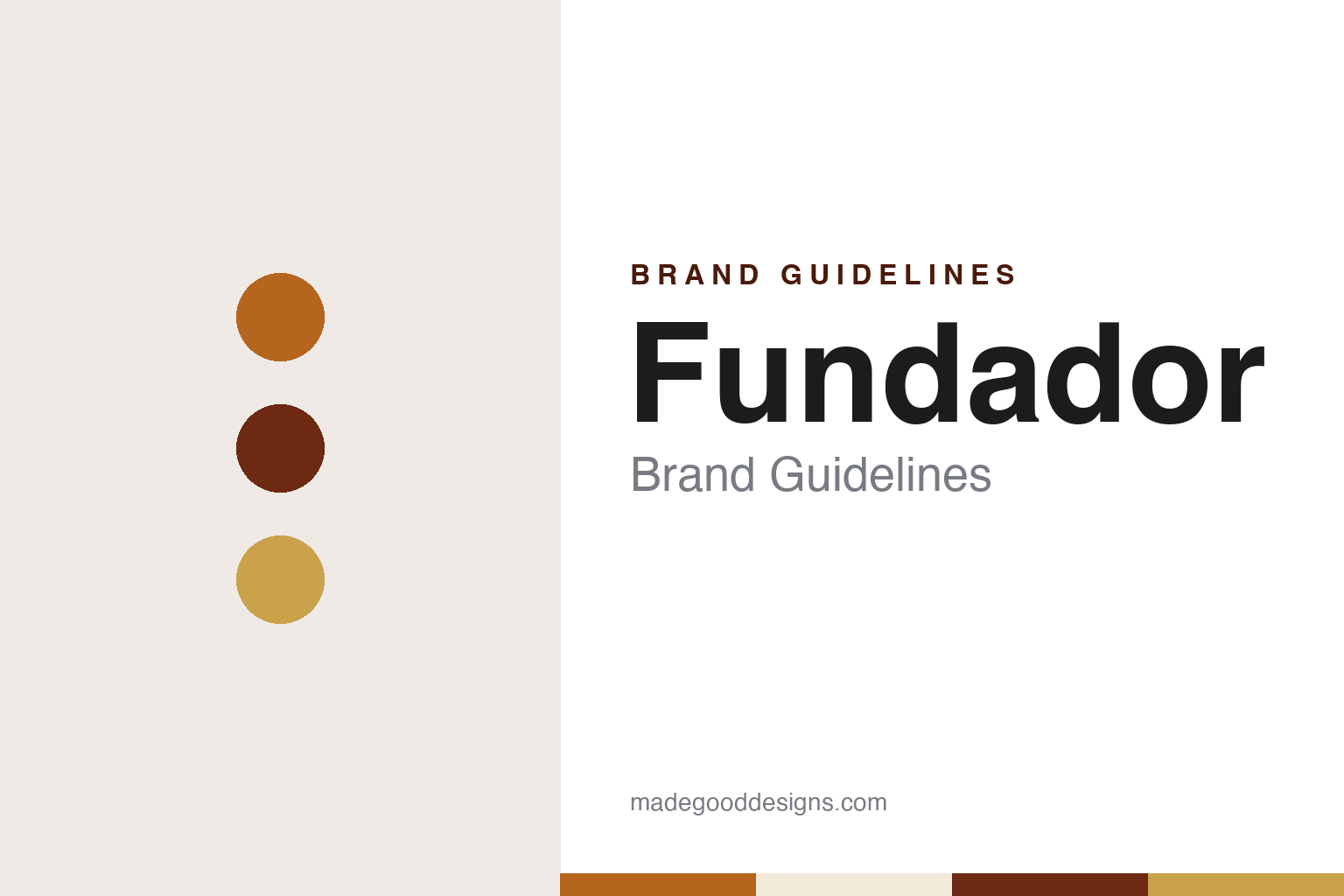
Fundador Brand Guidelines
The Jerez brandy first sold under its name in 1874.
Aa
Two constants: a brandy amber, solera oak and Jerez gold palette and a high-contrast Garalde serif register. Abstract homage — not a Fundador product or mark; no label, logo or bottle is reproduced.
A Jerez house older than its brandy
An Irish merchant’s bodega, a French family and a name first used around 1874.
Fundador is a Brandy de Jerez, made in Jerez de la Frontera in Andalusia, and its maker is older than the brandy itself. Spanish Wikipedia’s history of Bodegas Fundador, citing the wine historians Julian Jeffs and Javier Maldonado Rosso, dates the business to 1730, when the Irish merchant Patrick Murphy set up a bodega in Jerez. His neighbour Jean Haurie helped run it and inherited part of it, and in 1791 the firm traded as Juan Haurie y Sobrinos.
The name that would carry the brandy arrived in 1822, when Pedro Domecq Lembeye, a merchant from the French Basque country, took over the firm and renamed it Pedro Domecq, Spanish Wikipedia says. His nephew Pedro Domecq Loustau joined the family business in 1848 and took charge of it in 1869, running it with his cousin Juan Pedro Aladro, according to the Spanish Wikipedia article on him, which cites the historian Alberto Ramos Santana and the Diario de Jerez.
It was under Domecq Loustau that the brandy got its name. Around 1874, the same article says, he began selling the first brandy made in Jerez, and in Spain, under the brand FUNDADOR — “founder” in Spanish. Bodegas Fundador still makes the claim to be the first Spanish brandy, and the International Wine & Spirit Competition’s profile of the producer repeats it. House tradition tells of an order of spirit that was cancelled and never collected, so that the casks stayed in the Domecq cellars for years and turned into something new; Spanish Wikipedia presents this as legend and notes competing versions of the story.
The brandy is aged in the solera system familiar from sherry, with casks that once held sherry. In 1880, Spanish Wikipedia says, the company built a distillery at Tomelloso in La Mancha, and in 1974 it opened the Bodega La Mezquita in Jerez to mark a hundred years of Fundador.
Colour
From a family company to three multinational owners, then a Philippine one.
Pedro Domecq became a public limited company, Pedro Domecq S.A., in 1941, and for most of the twentieth century it stayed in the hands of the Domecq family. In 1994 the British group Allied Lyons acquired it, creating Allied Domecq, English Wikipedia says. In 1995, Spanish Wikipedia adds, the sherry house Harveys was folded into the Domecq operation in Jerez, the start of a pairing that has lasted through every change of owner since; today its best-known wine is Harveys Bristol Cream.
The next change came in 2005. Pernod Ricard completed its takeover of Allied Domecq on 26 July that year and sold overlapping spirits brands to Fortune Brands and Diageo, English Wikipedia says, citing Pernod Ricard’s announcement. Spanish Wikipedia records that Fortune Brands took about a third of the business, which became Beam Global, and Fundador was among the brands that passed to Beam. In 2014 the Japanese group Suntory bought Beam, and the brandy became part of Beam Suntory.
In November 2015 Beam Suntory announced the sale of its Jerez operation — the bodegas, the Tomelloso distillery and the Fundador, Tres Cepas, Terry and Harveys brands — to Emperador Distillers, the Philippine brandy maker controlled by Andrew Tan. The sale took effect on 1 March 2016, Spanish Wikipedia says, and the company was renamed Bodegas Fundador; the Philippine Daily Inquirer reported the deal’s completion at the time. In January 2017 Bodegas Fundador added the assets and brands of the Jerez house Garvey.
The link to the Philippines runs deeper than ownership. Reports in the Inquirer describe the Philippines as Fundador’s largest export market, where the brandy has been sold for decades.
Typography
Design and documentation.
The seven brands in this group are all wine and spirits names: Torres, Osborne, Fundador, Ypióca, Blandy’s, Brancott Estate and Villa Maria. Wine and spirits brands in general sit at many different points in the trade, from family houses that still carry a founder’s name to labels that now belong to much larger drinks groups, and a single brand can be sold everywhere from a corner shop to a restaurant list.
A wine or spirits brand’s identity is usually carried less by a single bottle than by a label, a name and the place it promises, because the company behind the name may have changed hands, moved its production or grown far beyond the place where it started. That makes the questions behind each name worth asking plainly: who started it, who owns it now, and where its wine or spirit is actually made and bottled.
Each guide separates what independent sources record from what the company says about itself — its founding story, its owners over time, where its wine or spirit is made and how its labels have changed — and marks plainly what rests only on the company’s own word.
Aa
A high-contrast Garalde serif for a Jerez brandy with a nineteenth-century name. (Specimen set in Cormorant Garamond, a serif STAND-IN; NOT the Fundador logo.)
Fundador
A heritage name, refreshed for new drinkers.
Under Emperador the brand has been reworked for younger drinkers without losing its date. Forbes España reported in October 2024 that Grupo Emperador had presented a repositioning campaign for Fundador, “¿Lo de siempre?” (“The usual?”), at the Torre Emperador in Madrid on 18 September. The campaign was designed by MIO One, part of the Spanish MIO Group, and was aimed at millennials and Generation Z; the magazine quoted Ángel Piña, Grupo Emperador’s chief commercial and marketing officer, and introduced two signature mixed drinks built on Fundador Sherry Cask Doble Madera and Fundador Supremo 12 Pedro Ximénez.
The packaging has been updated market by market. In the United States, Beverage Industry reported in 2022 that the importer González Byass USA had given Fundador Sherry Cask Solera Reserva a new label and bottle while keeping the liquid the same.
The producer has also been recognised as a whole. The International Wine & Spirit Competition named Bodegas Fundador its Fortified Wine Producer of the Year in 2019, an award that reflects the company’s sherries, Harveys among them, as much as its brandy.
The name needs care. “Fundador” is the ordinary Spanish and Portuguese word for founder, and it appears in many unrelated company names; the brandy is the one from Jerez.
For a design guide, Fundador shows how a brand can turn a date into its identity: a name that means “founder,” a claim to be first, and a Jerez house whose history runs back to 1730. Compare Osborne, the Puerto de Santa María house that bought the Carlos I and Carlos III brandies from Pernod Ricard in 2008, and Torres, the Catalan wine family that also makes brandy. For this guide we use brandy amber, solera oak and Jerez gold with a high-contrast serif, an unofficial interpretation; no product or logo is reproduced.
Explore & save
Keep Fundador’s identity on hand — save it to a board in the Made Good inspiration library.
Fundador identity set
Pin the Fundador brandy amber, solera oak and Jerez gold palette and the high-contrast Garalde serif register to your own board.