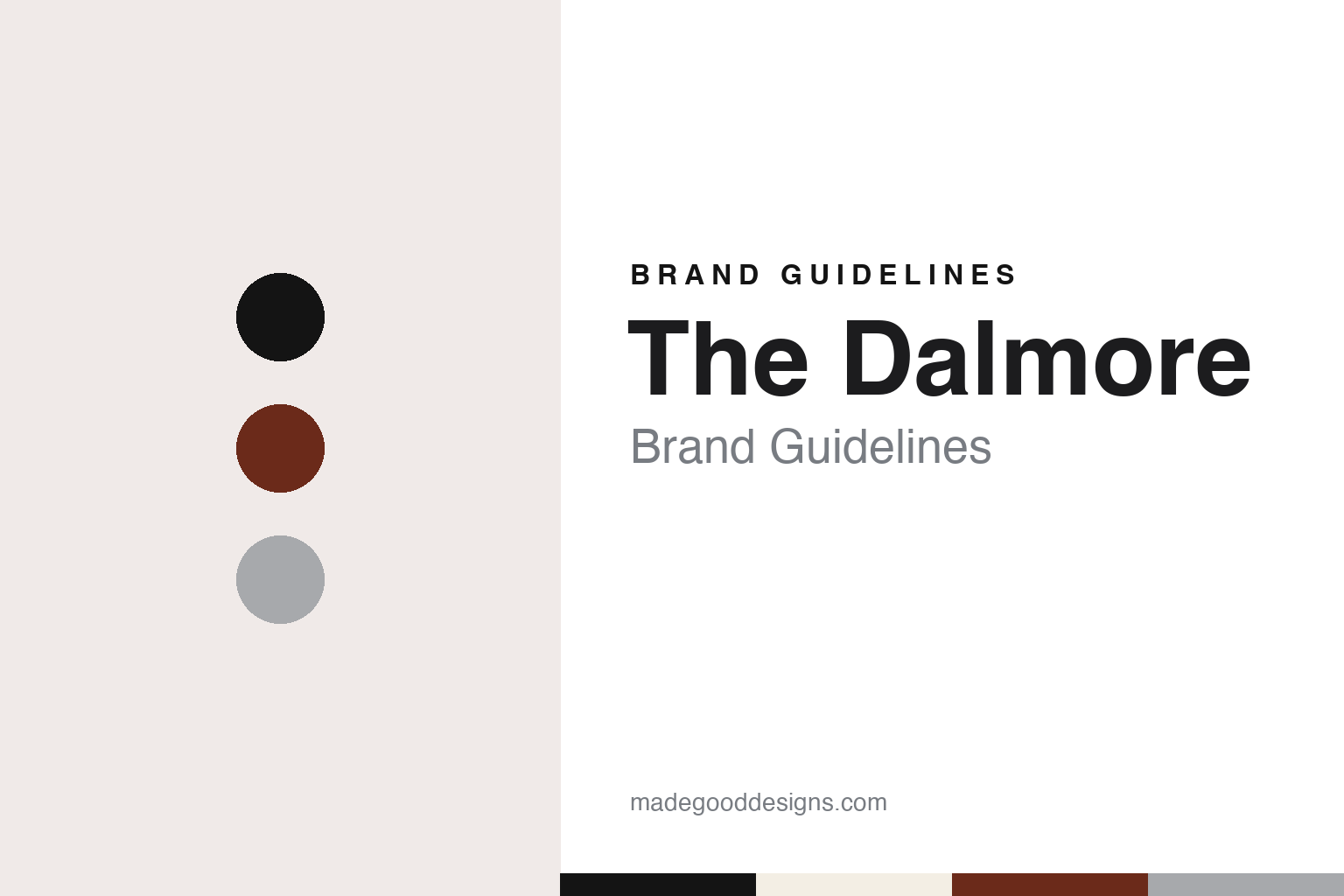
The Dalmore Brand Guidelines
The Alness single malt under the 12-point royal stag.
Aa
Two constants: a sherry mahogany, black and stag silver palette and an engraved serif register. Abstract homage — not a Dalmore product or mark; no bottle, stag or logo is reproduced.
Alness, 1839
A distillery on the Cromarty Firth, and the family that gave it a stag.
The Dalmore is a Highland single malt Scotch whisky distilled at Alness, on the north shore of the Cromarty Firth, about 20 miles north of Inverness, looking across to the Black Isle. The distillery was founded in 1839 by Alexander Matheson, according to Michael Jackson’s Malt Whisky Companion, as cited by English Wikipedia. Its water comes from the River Averon, which flows from Loch Morie.
In 1867 the distillery passed to the brothers Andrew and Charles Mackenzie, and with them came the emblem that still defines the brand: the 12-point royal stag. The company tells the story behind it. It says that in 1263 Colin of Kintail, first chief of Clan Mackenzie, saved King Alexander III of Scotland from a charging stag during a hunt, and that the king granted the family the right to bear a 12-point stag in their arms, along with the motto Luceo non uro, “I shine, not burn.” The Dalmore says one of the Mackenzies’ first changes was to put the stag on every bottle. The rescue itself is clan tradition rather than documented history, but it has a famous image: Benjamin West’s vast painting of the scene, commissioned by the Mackenzie chief Francis Mackenzie and dated 1786 by the National Galleries of Scotland, which bought it in 1987 and shows it in the Scottish National Gallery in Edinburgh.
The distillery’s own history was eventful. From 1917 the Royal Navy used the site and the adjoining firth for the production of deep-sea mines, and in 1920 an explosion and fire destroyed much of the distillery, Wikipedia says; Andrew Mackenzie’s legal dispute with the Navy that followed lasted more than five years and reached the House of Lords.
Colour
From the Mackenzies to Whyte & Mackay and Emperador.
The Dalmore stayed in family hands until 1960, when Whyte & Mackay, the Glasgow blender and one of its main customers, took control, Wikipedia says. Whyte & Mackay itself changed hands many times. English Wikipedia lists Hugh Fraser’s SUITS group from 1971; Lonrho from 1981; Brent Walker from 1988; American Brands, later Fortune Brands, from 1990; a management buyout in 2001; and India’s United Spirits from 2007. After Diageo took a controlling stake in United Spirits, regulators examined the overlap, and on 31 October 2014 United Spirits sold Whyte & Mackay to Emperador Inc., the spirits arm of the Philippines’ Alliance Global Group, which still owns it. Whyte & Mackay’s single malts now include The Dalmore, Jura, Fettercairn and Tamnavulin, with its blends and its Invergordon grain distillery nearby.
Whisky references describe the distillery as having four wash stills and four spirit stills in two sizes, the spirit stills fitted with unusual horizontal condensers. The whisky is matured in American white oak ex-bourbon casks and in aged sherry casks from the Jerez house González Byass, and the master distiller Richard Paterson is credited with selecting them. The core range is built on age statements — 12, 15, 18 and 25 Year Old — with expressions without an age statement and rare, very old releases above them. The 12 Year Old was for a long time the only single malt expression, Wikipedia says.
The brand has since moved firmly into luxury. Rare Dalmore bottlings, some assembled from casks filled in the nineteenth century, have been sold through luxury retailers and auction houses, and in 2025 Emperador said it was expanding the distillery at Alness to double the brand’s production capacity and add a new visitor experience, according to Philippine business press reports from June 2025.
Typography
Design and documentation.
The seven brands in this group are all Scotch single malts: Glenmorangie, Laphroaig, Lagavulin, Talisker, Ardbeg, The Dalmore and Highland Park. Single malt brands in general sit at many different points in the trade, from distilleries that still carry a founder’s name to labels that now belong to much larger drinks groups, and a single brand can be sold everywhere from a corner shop to a hotel bar.
A single malt brand’s identity is usually carried less by a single bottle than by a label, a name and the place it promises, because the company behind the name may have changed hands, rebuilt its distillery or grown far beyond the place where it started. That makes the questions behind each name worth asking plainly: who started it, who owns it now, and where its whisky is actually distilled, matured and bottled.
Each guide separates what independent sources record from what the company says about itself — its founding story, its owners over time, where its whisky is made and how its labels have changed — and marks plainly what rests only on the company’s own word.
Aa
An engraved serif for a stag-crested malt. (Specimen set in Cormorant Garamond, a serif STAND-IN; NOT the Dalmore logo.)
The Dalmore
A heraldic stag used as a mark of quality.
Few whisky brands lean as heavily on a single symbol. The 12-point royal stag, which the company says has been on every bottle since the Mackenzies took over in 1867, works as crest, logo and story at once: it ties the distillery to a clan, the clan to a king, and the whisky to an idea of Highland lineage. The brand name itself is styled with the definite article, The Dalmore, and at least one expression, King Alexander III, takes its name from the king of the stag legend.
That luxury positioning is the brand’s point of tension. The Dalmore’s rarest bottlings have repeatedly been reported in the press at auction and retail levels far beyond everyday whisky, which has made the name better known among collectors than among casual drinkers, and the company’s tradition-heavy storytelling rests partly on a legend rather than a record.
Behind the stag sits a distillery with a long working history on the Cromarty Firth: a nineteenth-century foundation, a wartime role in naval mine production, a fire, a long legal case and six decades as the flagship single malt of a Glasgow blending house that has itself passed through British, American, Indian and Philippine ownership.
For a design guide, The Dalmore shows how a single heraldic emblem, used consistently, can carry a brand’s whole claim to heritage. Compare Glenfiddich, another single malt that uses a stag, and The Macallan, a Speyside malt with a similar luxury register. For this guide we use sherry mahogany, black and stag silver with an engraved serif, an unofficial interpretation; no product or logo is reproduced.
Explore & save
Keep The Dalmore’s identity on hand — save it to a board in the Made Good inspiration library.
The Dalmore identity set
Pin The Dalmore sherry mahogany, black and stag silver palette and the engraved serif register to your own board.


