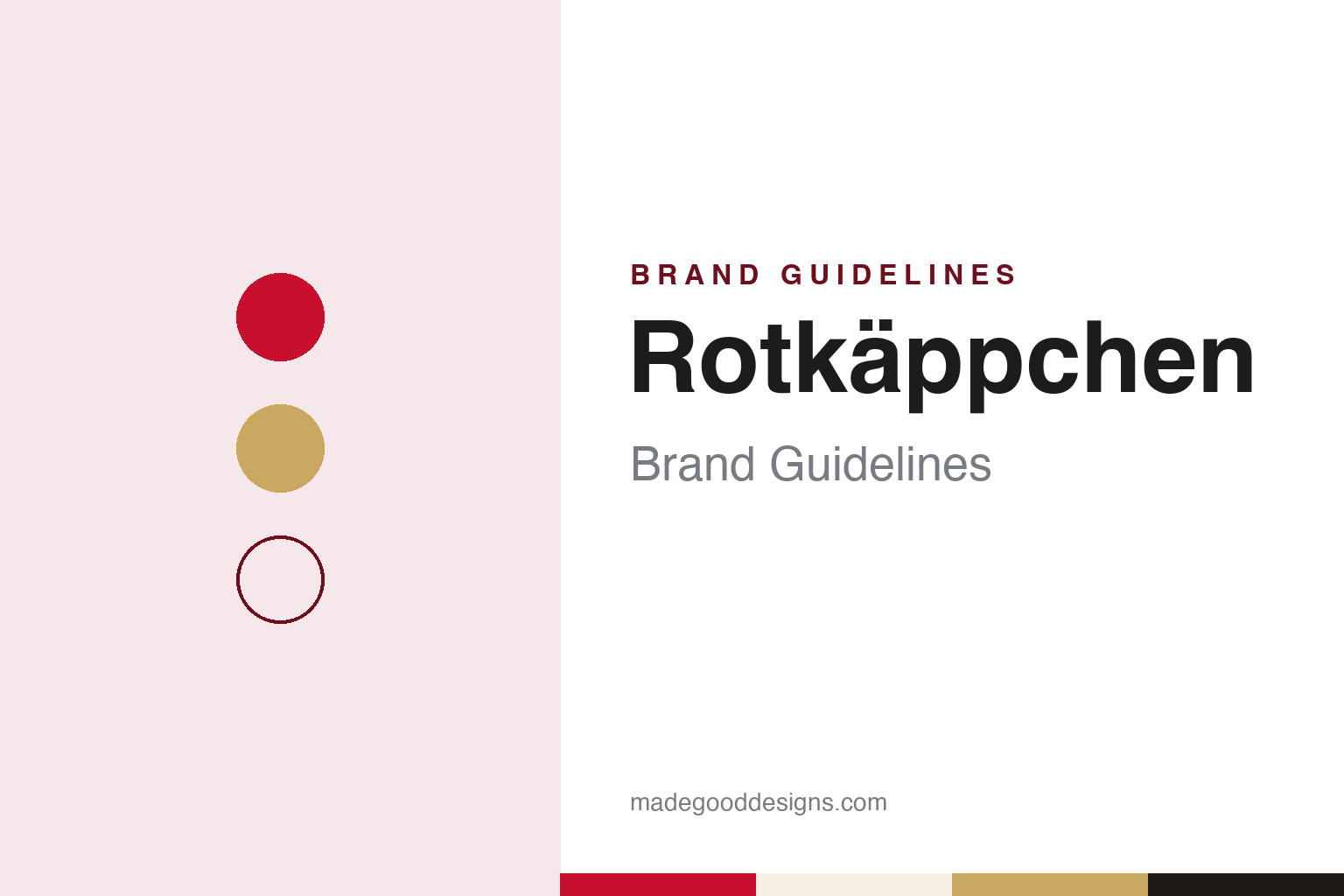
Rotkäppchen Brand Guidelines
The Freyburg Sekt named after a red foil capsule.
Aa
Two constants: a capsule red, foil gold and label cream palette and a display serif register. Abstract homage — not a Rotkäppchen product or mark; no label, logo or bottle is reproduced.
Kloss & Foerster
Two brothers, a friend and a back-house bottling room on the Unstrut.
Rotkäppchen comes from Freyburg, a small town on the Unstrut river in the Saale-Unstrut wine region of Saxony-Anhalt. On 26 September 1856 the brothers Moritz and Julius Kloss and their friend Carl Foerster founded a wine business there, Kloss & Foerster, according to Germany’s Patent and Trade Mark Office, the DPMA, which says the firm became a sparkling-wine maker using the champagne method in 1858. German Wikipedia says the first bottles were filled in a back building of the Kloss family home, and that the first bottle was opened at Julius Kloss’s wedding on 17 June 1858.
The firm grew by taking over a neighbour. A rival, the Freyburger Champagner-Fabrik, stopped work in the early 1860s, and in September 1866 its buildings were auctioned to Kloss & Foerster, German Wikipedia says. By 1867 local growers could no longer supply enough wine, and the company began buying must and wine from Württemberg and Baden. By 1904, the DPMA says, Kloss & Foerster was among the ten largest Sekt cellars in the German Empire.
German Wikipedia describes the cellars as an industrial monument and says the main building phase ran from 1880 to 1900, with an administration building of 1889 and a glass roof laid over the central light court in 1893, in neo-Renaissance and neo-Baroque forms. In 1896 a cuvée cask holding 120,000 litres was built from 25 oaks for the vaulted Domkeller; German Wikipedia calls it the largest in Germany.
Colour
How a lawsuit over “Monopol” produced a red cap.
The brand name came out of a legal dispute. Kloss & Foerster had sold its Sekt as “Monopol,” among other names, since it first showed its wines at a trade exhibition in Weimar in 1861. When Germany’s trademark law took effect in 1894, the Reims Champagne house Heidsieck & Co., which had used the name “Monopole” since 1846, went to court to protect it, and from 1 October 1894 Kloss & Foerster could no longer use “Monopol,” German Wikipedia says.
The company turned to the red foil capsule that already topped its bottles. The word mark “Rotkäppchen” — “little red cap,” the German name of the fairy-tale character Little Red Riding Hood — was filed on 20 February 1895, the DPMA says, and registered on 15 July 1895, according to German Wikipedia. The DPMA says the registration is still valid. The fairy-tale association is in the word, but the name was taken from the capsule.
The cellar’s twentieth century was shaped by politics. After the Second World War the Soviet Military Administration placed the business under forced administration in December 1945, and its expropriation was registered on 31 July 1948, German Wikipedia says; it became VEB Rotkäppchen-Sektkellerei Freyburg/Unstrut, a state-owned enterprise of East Germany. The founder’s grandson Günther Kloss re-established Kloss & Foerster in Rüdesheim, in West Germany, in 1952–53, the DPMA says. In 1957 Freyburg moved from bottle fermentation to the transfer method, developed together with the Kupferberg cellar in Mainz, German Wikipedia says. By 1987, the DPMA says, it sold 15 million bottles a year, and German Wikipedia calls Rotkäppchen the best-known Sekt brand in the GDR.
Typography
Design and documentation.
The seven brands in this group are all German, Indian and Chinese wine and Sekt producers: Dr. Loosen, Schloss Johannisberg, Henkell, Rotkäppchen, Sula Vineyards, Grover Zampa and Changyu. Wine and Sekt producers in general sit at many different points in the trade, from family estates that still carry a founder’s name to labels that now belong to much larger drinks groups, and a single brand can be sold everywhere from a corner shop to a restaurant list.
A wine or Sekt brand’s identity is usually carried less by a single bottle than by a label, a name and the place it promises, because the company behind the name may have changed hands, moved its production or grown far beyond the place where it started. That makes the questions behind each name worth asking plainly: who started it, who owns it now, and where its wine or Sekt is actually made and bottled.
Each guide separates what independent sources record from what the company says about itself — its founding story, its owners over time, where its wine or Sekt is made and how its labels have changed — and marks plainly what rests only on the company’s own word.
Aa
A display serif for a Sekt named after its capsule. (Specimen set in DM Serif Display, a serif STAND-IN; NOT the Rotkäppchen logo.)
Rotkäppchen
From the Treuhand to Rotkäppchen-Mumm.
After the fall of the Berlin Wall sales collapsed, the DPMA says; in June 1990, under the Treuhand privatisation agency, the cellar became Rotkäppchen Sektkellerei GmbH, and the staff was cut from 350 to 60, Focus reported in 2020. In 1992 it sold 5.7 million bottles. In 1993 four of its managers — Gunter Heise, Jutta Polomski, Lutz Lange and Ulrich Wiegel — bought the company from the Treuhand together with the entrepreneur Harald Eckes-Chantré and his daughters Petra Roller and Christina Oelbermann, German Wikipedia says.
By 1995 Rotkäppchen was the best-selling Sekt in eastern Germany, and from 2001 in the whole country, the DPMA says. On 16 January 2002 the company bought the German Sekt brands Mumm, Jules Mumm and MM Extra, with their cellars in Eltville and Hochheim, from Seagram, and the group became Rotkäppchen-Mumm Sektkellereien; these German Sekt brands are separate from the Reims Champagne house G.H. Mumm. Geldermann of Breisach followed in 2003, Eckes’s spirits and wine business in 2006, the French wine brand Blanchet in 2009, the Prosecco maker Ruggeri of Valdobbiadene in 2017 and the Bremen importer Eggers & Franke in 2018. In December 2005 the owners bought back the Kloss & Foerster name. German Wikipedia gives the ownership as 58 per cent with the Eckes-Chantré family and 42 per cent with the four managers of the 1993 buyout. Silvia Wiesner succeeded Christof Queisser as chair of the management board in 2025, the company announced.
German Wikipedia names the Freyburg company, Rotkäppchen Sektkellerei GmbH, as the maker of Rotkäppchen Sekt, and the group’s head office is in Freyburg; the company names Freyburg, Eltville, Breisach and Nordhausen as its Sekt and spirits plants. The range widened to still wine in 2006, alcohol-free Sekt in 2008 and the wine-based Fruchtsecco in 2014, German Wikipedia says, and the Getränke Zeitung put its share of the German Sekt market at about 36 per cent in 2021. The visitor centre at the historic cellars, the Rotkäppchen Erlebniswelt, opened on 13 May 2023 and won a German Design Award 2025 for architecture, the Mitteldeutsche Zeitung reported.
For a design guide, Rotkäppchen shows how one coloured detail — a red foil capsule — can become a brand name that outlasts a lawsuit, nationalisation and privatisation. Compare Henkell, its western German rival, and Dr. Loosen, a Mosel wine estate. For this guide we use capsule red, foil gold and label cream with a display serif, an unofficial interpretation; no product or logo is reproduced.
Explore & save
Keep Rotkäppchen’s identity on hand — save it to a board in the Made Good inspiration library.
Rotkäppchen identity set
Pin the Rotkäppchen capsule red, foil gold and label cream palette and the display serif register to your own board.