Château Cheval Blanc Brand Guidelines
The Saint-Émilion estate on the Pomerol border.
Aa
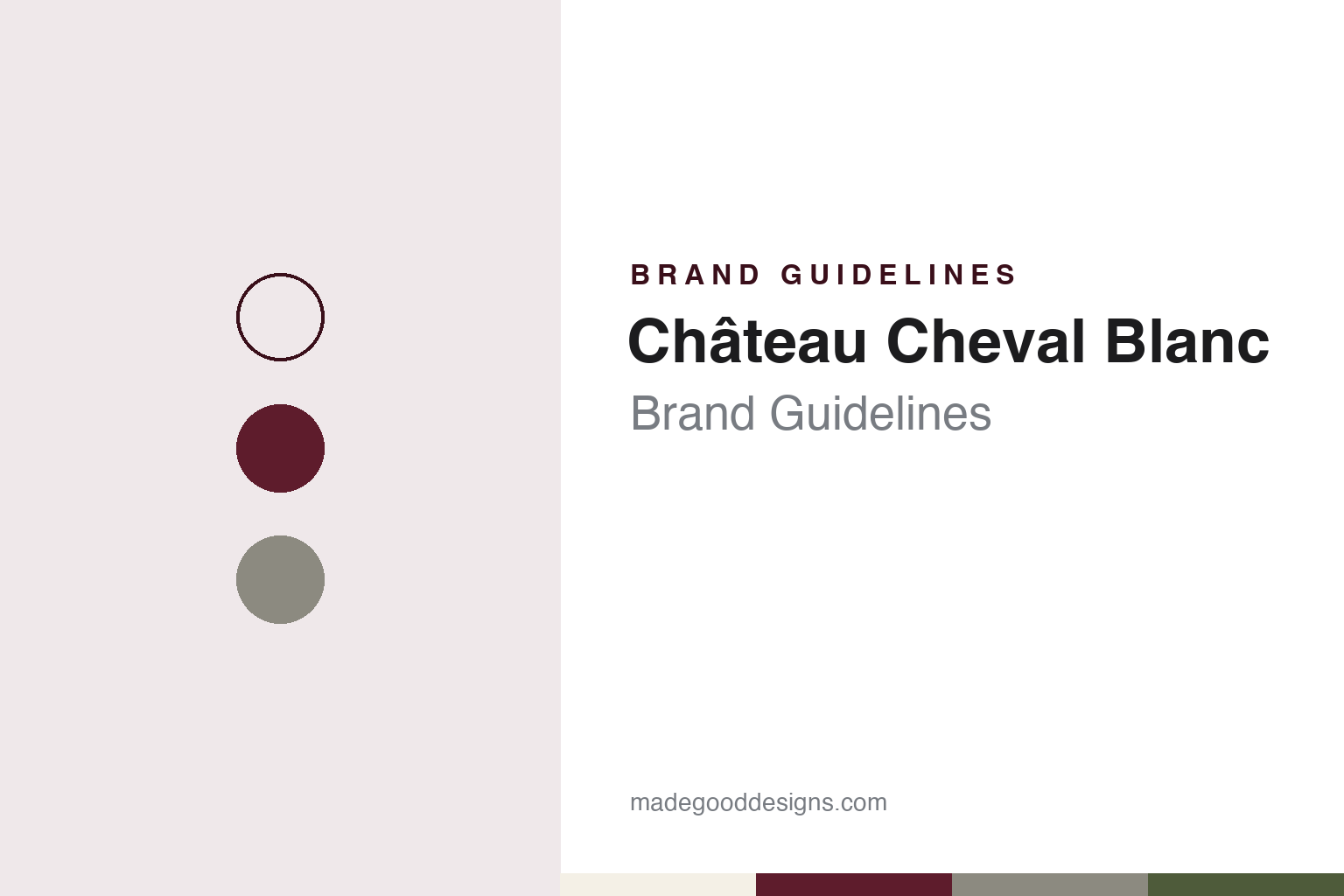
Two constants: a white horse ivory, claret and concrete grey palette and a high-contrast display serif register. Abstract homage — not a Château Cheval Blanc product or mark; no label, logo or bottle is reproduced.
From Figeac to Cheval Blanc
A Libourne judge, a wine merchant son-in-law and a gravel ridge.
Château Cheval Blanc lies in Saint-Émilion, on the Right Bank of Bordeaux, at the very edge of the appellation where it meets Pomerol. The estate says that while most of Saint-Émilion’s famous names sit on limestone, Cheval Blanc stands on the Quaternary alluvial deposits of the River Isle, the same kind of gravel and clay soils found under the leading estates of Pomerol; French Wikipedia likewise describes a high proportion of gravel over an alluvial subsoil.
Vines were here long before the name became famous. The estate says documents from 1546 show its vines being let to a tenant farmer, and that in the following century a farm called “Au Cheval-Blanc” — the White Horse — was sold by Bertrand de Gombaud. The estate in its present form was built up in the nineteenth century. In the estate’s account, the core was bought in 1832 by Jean-Jacques Ducasse, president of the court at Libourne, who added parcels from neighbouring Château Figeac over the next twenty years to make the vineyard of about 39 hectares that has barely changed since; English Wikipedia instead records Figeac selling 15 hectares in 1832 to a M. Laussac-Fourcaud.
The family name that ran Cheval Blanc for more than a century and a half arrived by marriage. The estate says Ducasse’s daughter Henriette married Jean Laussac-Fourcaud, a Libourne wine merchant, who laid drains in the vineyard and, from the mid-1860s, replanted part of it with an unusual mix of roughly half Merlot and half Cabernet Franc, a choice completed in 1871. From 1852, the estate says, the wine once sold as “vin de Figeac” was marketed for the first time under the name Cheval Blanc. Their son Albert reversed the surname to Fourcaud-Laussac, and French Wikipedia records the Fourcaud-Laussac family as owners for more than 150 years.
Colour
Two buyers in 1998, a luxury group in 2009, a new manager in 2023.
The family sold in autumn 1998. The buyers were Bernard Arnault, chairman of the luxury group LVMH, and the Belgian businessman Albert Frère, English Wikipedia and the estate both record; the wine site iDealwine reported in August 2009 that the pair had bought the shares of the Société Civile du Cheval Blanc. That month, iDealwine reported, LVMH acquired a 50% stake from a subsidiary of Groupe Arnault, Bernard Arnault’s own holding, together with half of the company that owns Château Quinault l’Enclos. Decanter described the estate’s joint owners in July 2023 as the Arnault and Frère families, and LVMH lists Château Cheval Blanc among the houses of its Wines & Spirits division.
Continuity in the cellar has been part of the story. Pierre Lurton became director in 1990 and stayed on as manager after the 1998 sale, later also running LVMH’s Château d’Yquem. On 11 July 2023 the estate announced that Pierre-Olivier Clouet, who arrived as an intern in 2004 and had been technical director since 2008, would become managing director, with Lurton moving up to chairman of the board, Decanter reported; the estate said the change would help the Arnault and Frère families pursue their long-term vision for the property.
The wine is made on the estate in Saint-Émilion. Its winery, designed by the architect Christian de Portzamparc, opened in June 2011. The estate describes it as a rise in the ground marked by two waves of white concrete, topped with a garden, holding concrete vats in fourteen sizes so that each vineyard parcel can be fermented on its own; it says the building received the International Architecture Award of the Chicago Athenaeum and the European Centre for Architecture, Art, Design and Urban Studies on 20 November 2013.
In July 2021 Cheval Blanc stepped out of the Saint-Émilion classification, in which it had held the top rank of Premier Grand Cru Classé “A” since the first edition in the 1950s. Chris Kissack wrote on Winedoctor on 10 July 2021 that neither Cheval Blanc nor Château Ausone had submitted a dossier by the 30 June deadline for the 2022 classification, news first reported by Terre de Vins; the estate says the evaluation criteria had moved too far from what it considers fundamental. Decanter noted in 2023 that Château Angélus also withdrew.
Typography
Design and documentation.
The seven brands in this group are all Bordeaux châteaux: Château Haut-Brion, Château Cheval Blanc, Château Ausone, Château Palmer, Château Lynch-Bages, Château Pichon Baron and Château Cos d’Estournel. Bordeaux estates in general sit at many different points in the trade, from properties still held by the families whose names they carry to estates that now belong to insurers, industrial groups or private investors, and a single estate’s wine can travel from its own cellar to merchants and restaurant lists around the world.
A Bordeaux château’s identity is usually carried less by a single bottle than by a label, a name and the place it promises, because the estate behind the name may have changed hands, been enlarged or been rebuilt many times since it began. That makes the questions behind each name worth asking plainly: who founded it, who owns it now, and where its wine is actually made and bottled.
Each guide separates what independent sources record from what the estate says about itself — its founding story, its owners over time, where its wine is made and how its labels and buildings have changed — and marks plainly what rests only on the estate’s own word.
Aa
A high-contrast display serif for a name taken from a farmhouse sign. (Specimen set in Playfair Display, a serif STAND-IN; NOT the Château Cheval Blanc logo or label lettering.)
Château Cheval Blanc
Exhibition medals on the label and a name that travels.
The label carries its own history. English Wikipedia says the medals the estate won at the international exhibitions of the 1860s are still prominent on its labels; the estate itself says the bronze medal from the 1862 London International Exhibition and a gold medal from the Paris Exposition Universelle of 1878 both remain on the bottle, and that the château building at the heart of the vineyard was put up in the 1880s.
The estate has added wines around the main one. Its second wine is Le Petit Cheval. In 2006, the estate says, it bought Château La Tour du Pin, began grafting Sauvignon Blanc there in 2008, and in September 2016 presented the first Petit Cheval Blanc white, the 2014 vintage. Under LVMH it also gave its name to Cheval des Andes, an Argentine red made with the group’s Terrazas de los Andes, which French Wikipedia dates to 1998. In 2021 the estate published a manifesto setting out its move towards agroforestry, with livestock, vegetable gardens, orchards and hives among the vines.
The name needs care online, because it travels well beyond the vineyard. French Wikipedia records that in 2012 Bernard Arnault created a luxury hotel brand under the same name; those Cheval Blanc hotels, beginning in Courchevel, are a separate LVMH business from the wine estate, whose own site is chateau-cheval-blanc.com. The wine also turns up in film: a 1961 bottle is a plot point in Sideways (2004), and the critic Anton Ego orders the 1947 in Pixar’s Ratatouille (2007).
For a design guide, Château Cheval Blanc shows how an estate can build its identity from a farmhouse name, a ridge of gravel and a row of nineteenth-century medals, then add a landmark of contemporary architecture without losing the thread. Compare Château Ausone, the fellow Saint-Émilion estate that left the classification at the same time, and Château d’Yquem, the Sauternes estate in the same LVMH stable. For this guide we use white horse ivory, claret and concrete grey with a serif, an unofficial interpretation; no product or logo is reproduced.
Explore & save
Keep Château Cheval Blanc’s identity on hand — save it to a board in the Made Good inspiration library.
Château Cheval Blanc identity set
Pin the Château Cheval Blanc white horse ivory, claret and concrete grey palette and the high-contrast display serif register to your own board.