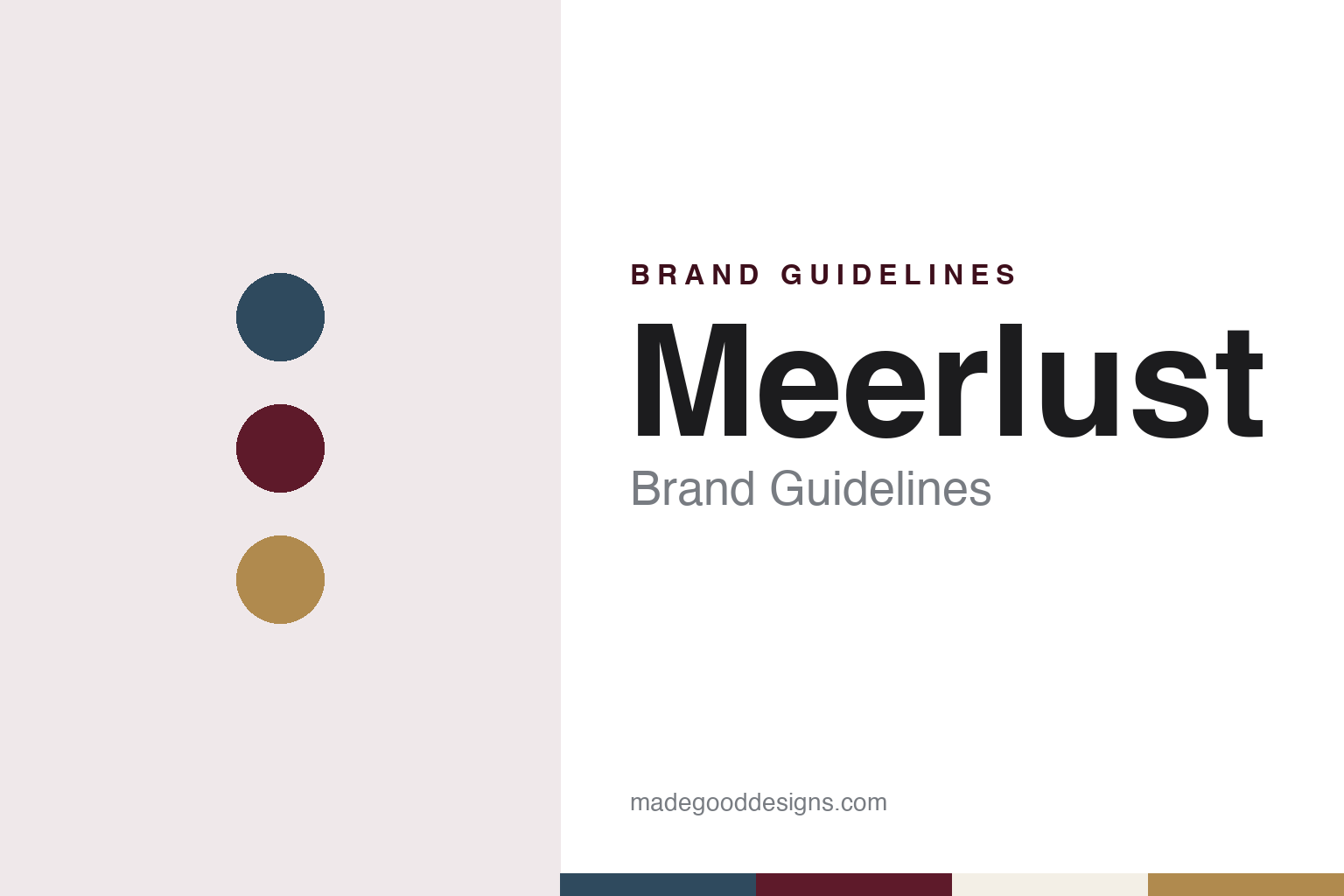
Meerlust Brand Guidelines
A 1693 farm near False Bay, a Cape Dutch manor house and the Rubicon blend.
Aa
Two constants: a False Bay blue, Rubicon claret and ochre palette and an old-style serif register. Abstract homage — not a Meerlust product or mark; no label, crest or bottle is reproduced.
Pleasure of the sea
A 1693 grant, a Cape Dutch house and eight generations.
Meerlust is a family wine estate outside Stellenbosch, about five kilometres from False Bay, The World of Fine Wine reported in 2026. Its story starts in 1693, when the farm was granted to Henning Huising, a German immigrant, who named it Meerlust, “pleasure of the sea,” the estate says. Meerlust dates the first part of its manor house and cellar to 1700, and says the first wine was made on the farm under Huising.
The Myburgh family bought the estate in 1756, Meerlust says, and Emile Joubert, author of the 2025 book Meerlust: Beyond the Rubicon, wrote in the Sunday Times that year that the first Myburgh arrived there in 1756. The family has held it for eight generations. The Myburghs added the front T-section of the Cape Dutch manor house, completed in 1776, to the back portion Huising had built; the estate says this two-phase build makes the shape of the house unique. The cellar complex was also built by 1776 and was restored in 1974 by the architect Revel Fox, and the tasting room was originally the dairy.
In 1987 the whole complex — manor house, dovecot, cellar and tasting room — was declared a national monument, according to the estate.
The modern era, as The World of Fine Wine put it, began in 1959, when Nico Myburgh inherited the estate. A holiday in Bordeaux in 1967 led him to replant: Chenin Blanc, Cinsaut and Semillon gave way to Cabernet Sauvignon, Merlot and Cabernet Franc, with Cabernet Franc planted in 1972 and Merlot in 1974. The first wine under the Meerlust label followed with the 1975 vintage, a Cabernet Sauvignon released in 1978, the magazine reported.
Colour
Rubicon, a point of no return.
Meerlust’s best-known wine is Rubicon, a Bordeaux-style red blend. Its story begins with an appointment. In 1978 Nico Myburgh brought in the Italian winemaker Giorgio Dalla Cia, who, The World of Fine Wine reported, came for a single season and stayed twenty-five years; the estate says the first experimental Rubicon blend was made that year. The first commercial vintage was 1980, released to the public in 1984.
The name was proposed by Dirk Opperman, a professor at Stellenbosch University, according to The World of Fine Wine, and it refers to the idea of a point of no return.
Other wines followed. Meerlust says it made its first Pinot Noir in 1980, alongside the first commercial Rubicon, a Merlot in 1984 and its first Chardonnay in 1995. The estate says its wines are all made exclusively from grapes grown on the estate.
The cellar has had few leaders. Dalla Cia ran it from 1978 to 2003, Joubert wrote, followed by Chris Williams from 2004 to 2019. Williams left at the end of 2019 to concentrate on his own label, The Foundry, and other projects, Winemag reported in November 2019; the 2020 vintage was to be handled by his assistant, Altus Treurnicht. Meerlust now lists Treurnicht as its winemaker; he studied at Elsenburg and rejoined the estate in that role in 2018, after earlier serving as Williams’s assistant, the estate says.
Typography
Design and documentation.
The seven brands in this group are all South African wine estates: Kanonkop, Meerlust, Sadie Family Wines, Boekenhoutskloof, Klein Constantia, Vergelegen and Hamilton Russell Vineyards. Wine estates in general sit at many different points in the trade, from family farms that still carry a founder’s name to properties that now belong to investors or much larger drinks groups, and a single estate’s wine can be sold everywhere from a cellar-door shop to a restaurant list.
A wine estate’s identity is usually carried less by a single bottle than by a label, a name and the place it promises, because the people behind the name may have changed, the farm may have changed hands, and the wine may be made from grapes grown well beyond the estate’s own boundary. That makes the questions behind each name worth asking plainly: who started it, who owns it now, and where its wine is actually grown, made and bottled.
Each guide separates what independent sources record from what the estate says about itself — its founding story, its owners over time, where its wine is made and how its labels have changed — and marks plainly what rests only on the estate’s own word.
Aa
An old-style serif for an estate that dates to 1693. (Specimen set in EB Garamond, a serif STAND-IN; NOT the Meerlust logo.)
Meerlust
An eighth-generation owner and a cellarmaster from KWV.
Meerlust is owned by the Myburgh family. Hannes Myburgh succeeded his father as the eighth-generation owner in 1988, the estate and The World of Fine Wine say. Meerlust says he took a BA in French and English at Stellenbosch in 1982, studied winemaking at Geisenheim in Germany, and worked at Château Lafite in France and at Von Oetinger in Germany.
In May 2020 the estate appointed Wim Truter as cellarmaster; Meerlust now lists him as cellarmaster and managing director. Winemag had reported in November 2019 that Truter, then chief winemaker at KWV, would leave in May 2020 to join Meerlust. The estate says Truter holds a Stellenbosch degree in chemistry, oenology and viticulture and an MSc from the Vintage programme in vine, wine and terroir management, with periods of study in France, Italy and Spain. The viticulturist Izak Basson joined in 2015 and works with Treurnicht, the estate says.
Meerlust also says that Compagniesdrift, set up in the 2000s as a joint venture of the Myburgh Family Trust and the Meerlust Farmworkers’ Trust, is built on land that formerly belonged to Meerlust. The estate also works with the Sustainability Institute, which it says began in 1999 as a centre where people from previously disadvantaged backgrounds could live and learn together, and it pays for employees’ children to travel to Lynedoch for school.
In November 2025 Joubert described Meerlust in the Sunday Times as one of the country’s older wine brands, and wrote that the current owner is the eighth generation of the family to preside over the farm.
For a design guide, Meerlust shows how a name from 1693, a Cape Dutch manor house and a blend named for a point of no return can carry a family estate through eight generations. Compare Kanonkop, another Stellenbosch family estate with a Bordeaux-style blend, and Nederburg, a Cape wine farm with an 18th-century gabled homestead. For this guide we use False Bay blue, Rubicon claret and thatch ochre with a serif, an unofficial interpretation; no product or logo is reproduced.
Explore & save
Keep Meerlust’s identity on hand — save it to a board in the Made Good inspiration library.
Meerlust identity set
Pin the Meerlust False Bay blue, Rubicon claret and ochre palette and the old-style serif register to your own board.