Inniskillin Brand Guidelines
The Niagara winery licensed in 1975 and known for icewine.
Aa
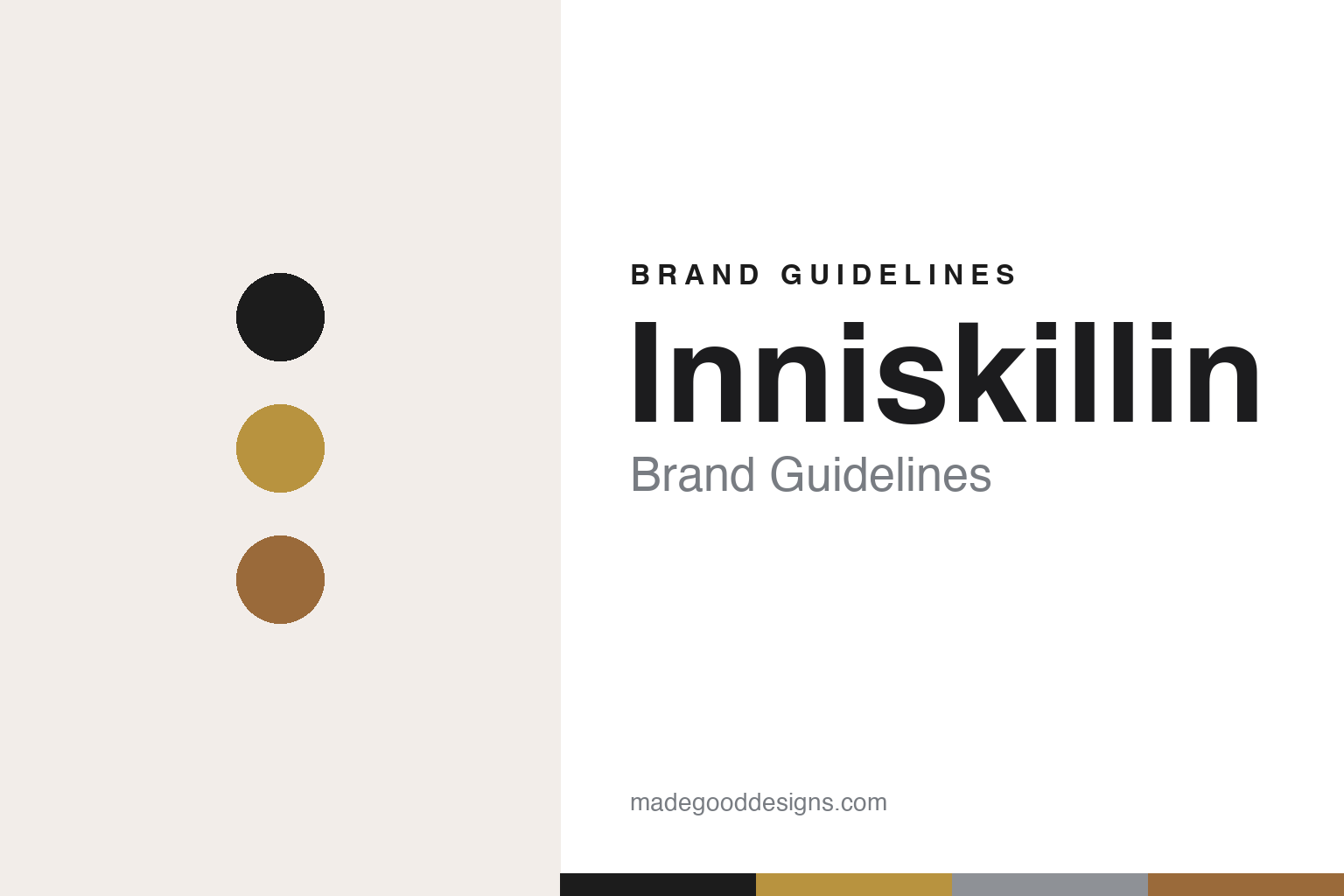
Two constants: a matte black with gold, pewter and copper palette and an arched classical serif register. Abstract homage — not an Inniskillin product or mark; no label, logo or bottle is reproduced.
A licence in 1975
A chemist, a nursery graduate and a converted packing shed.
Inniskillin began in Niagara with two people and a vine nursery. The winery’s own history page, as archived in 2008, describes Karl Kaiser as an Austrian-born chemist and Donald Ziraldo as a young Italian-Canadian agriculture graduate, and says the pair concluded in the early 1970s, while tasting Ontario wines, that the premium end of the market was empty. In 1974, the company says, Ziraldo planted a 32-acre vineyard of Riesling, Chardonnay and Gamay — vinifera grapes, the European family; English Wikipedia says Niagara’s five bulk wineries of the time grew American vines instead.
The company was incorporated on 31 July 1975. Inniskillin says it received the first winery licence granted in Ontario since 1929, and credits General George Kitching, then chairman of the Liquor Control Board of Ontario, with helping to secure it; English Wikipedia, citing the winery’s histories, describes it as the first post-Prohibition licence issued in the region. The first winery was a converted packing shed at the Ziraldo family nursery. In 1978 the business moved to the Brae Burn Estate near Niagara-on-the-Lake, where a barn built in the 1920s — thought, the winery says, to have been inspired by Frank Lloyd Wright — was restored as a shop and barrel cellar. In 2007, the company says, a renovation added a new entrance, a piazza and a Founders’ Hall for events, linked to the wine boutique in the Brae Burn barn.
The roles were split from the start: Kaiser handled the winemaking, and Ziraldo the marketing, as president. The company credits Ziraldo as founding chair of the Vintners Quality Alliance, the appellation system introduced in Ontario in 1989, and says Brock University’s Inniskillin Hall, home of its Cool Climate Oenology and Viticulture Institute, opened in June 1999 and was named in the founders’ honour.
Colour
Icewine, an arch and a vine-and-grape emblem.
Icewine made the name. It is pressed from grapes left to freeze on the vine. In 1983, Appellation America reported in 2007, Kaiser and three other Ontario wineries left grapes hanging for the purpose, and birds ate Inniskillin’s crop. In 1984, with nets over the vines, Kaiser made the winery’s first icewine from Vidal grapes grown at Brae Burn; the bottle was labelled “Eiswein,” the German term. The company says Kaiser added a sparkling icewine in 2000.
The look has been redrawn several times without losing its outline. In October 2012 Wines in Niagara reported a label makeover, the first in 15 years, by HKA Designs: the vine-and-grape icon reinterpreted from the original, embossed and printed in metallic gold, pewter and copper on a matte black ground, with the Inniskillin name kept in its historical arch but simplified. The first bottles in the new dress, for the Estate Collection tier, reached shops in September 2012, the report said, with new ultra-premium and luxury tiers to follow. A later refresh was led by the agency Jacknife, whose case study says it was asked to appeal to younger wine drinkers and to make the brand read as more premium and modern. It says it “modernized and simplified the mark through subtle tweaks,” reorganised a portfolio of six tiers of table wine and icewine, and used bold colour palettes and premium finishes to tell the tiers apart.
The same case study traces the name to the Irish regiment the Inniskilling Fusiliers. On its website in 2015 Inniskillin called itself “Canada’s Original Estate Winery.” An earlier project shows the founders’ own interest in labels: the company says the 1993 Alliance wines, a joint venture with the Burgundy house Jaffelin, carried a label designed by Kaiser’s son, Maximillian.
Typography
Design and documentation.
The seven brands in this group are all Canadian wineries: Inniskillin, Jackson-Triggs, Peller Estates and Cave Spring from Ontario’s Niagara Peninsula, and Mission Hill, Quails’ Gate and Burrowing Owl from British Columbia’s Okanagan Valley. Some still carry a founding family’s name or are run by that family; others now sit inside much larger wine companies, and two of the Niagara names reach into the Okanagan as well.
Ownership is the clearest dividing line. Inniskillin, founded by Donald Ziraldo and Karl Kaiser with a first planting in 1974, and Jackson-Triggs, launched in 1993 by the company Donald Triggs and Allan Jackson built from the old Cartier wines, both passed through Vincor and Constellation Brands and today trade under Arterra Wines Canada, the name the business took in 2017 after Constellation sold its Canadian wine arm, English Wikipedia says. Peller Estates belongs to Andrew Peller Ltd of Grimsby, Ontario, which agreed in June 2026 to be taken private by Fairfax Financial Holdings, Canadian Grocer reported. In the Okanagan, Anthony von Mandl bought the Mission Hill estate in West Kelowna in 1981; Quails’ Gate grew from land the Stewart family began planting in 1956 and relaunched as a winery in 1989; and Burrowing Owl, near Oliver, began when Jim Wyse bought vineyard land in 1993, with the winery itself built in 1998, the company says. Cave Spring’s first vintage came in 1986, from vines the Pennachetti family planted in 1978.
A Canadian wine brand’s identity is usually carried by a label, a place name and a story about the land, because the company behind the name may have merged, been sold or grown far beyond its first vineyard. Each guide separates what independent sources record from what the winery says about itself — its founding story, its owners over time, where its wine is grown and made, and how its labels and buildings present it — and marks plainly what rests only on the company’s own word.
Aa
An arched classical serif for a name set over a vine-and-grape emblem. (Specimen set in Cormorant Garamond, a serif STAND-IN; NOT the Inniskillin logo.)
Inniskillin
Two founders, two provinces and a change of owners.
Inniskillin did not stay independent for long. In 1992 it merged with Cartier Wines to form Cartier Inniskillin Vintners, and in 1993 that company merged with T.G. Bright & Co. as Vincor International, English Wikipedia says, citing Vincor’s own history; Inniskillin carried on under its own label. In 1994 it opened Inniskillin Okanagan in British Columbia in partnership with the Inkameep people, the winery says, and in 1996 it bought the property that became its Okanagan home, where the winemaker Sandor Mayer developed the Dark Horse vineyard. Wine Spectator reported in April 2006 that Constellation Brands had bought Vincor; both founders left later that year, with Kaiser keeping a contract to help with icewine, the company says.
In December 2016 Constellation announced that it had completed the sale of its Canadian wine business, which it said included Jackson-Triggs and Inniskillin, to the Ontario Teachers’ Pension Plan. The business was renamed Arterra Wines Canada; it is headquartered in Mississauga, Ontario, and says it operates eight wineries. Inniskillin’s website carries the Arterra name today, and the winery shares its owner with Jackson-Triggs, the brand created by the men who had bought Cartier in 1989.
For a design guide, Inniskillin shows how a winery can keep one emblem — an arched name above a vine and grapes — through mergers, new owners and several redesigns. Compare Jackson-Triggs, its Arterra stablemate, and Peller Estates, another Niagara winery. For this guide we use matte black with gold, pewter and copper and a serif, an unofficial interpretation; no product or logo is reproduced.
Explore & save
Keep Inniskillin’s identity on hand — save it to a board in the Made Good inspiration library.
Inniskillin identity set
Pin the Inniskillin matte black, gold, pewter and copper palette and the arched classical serif register to your own board.