Dash (Mrs. Dash) Brand Guidelines
A salt-free shaker from a beauty company that kept its name and lost its title.
Aa
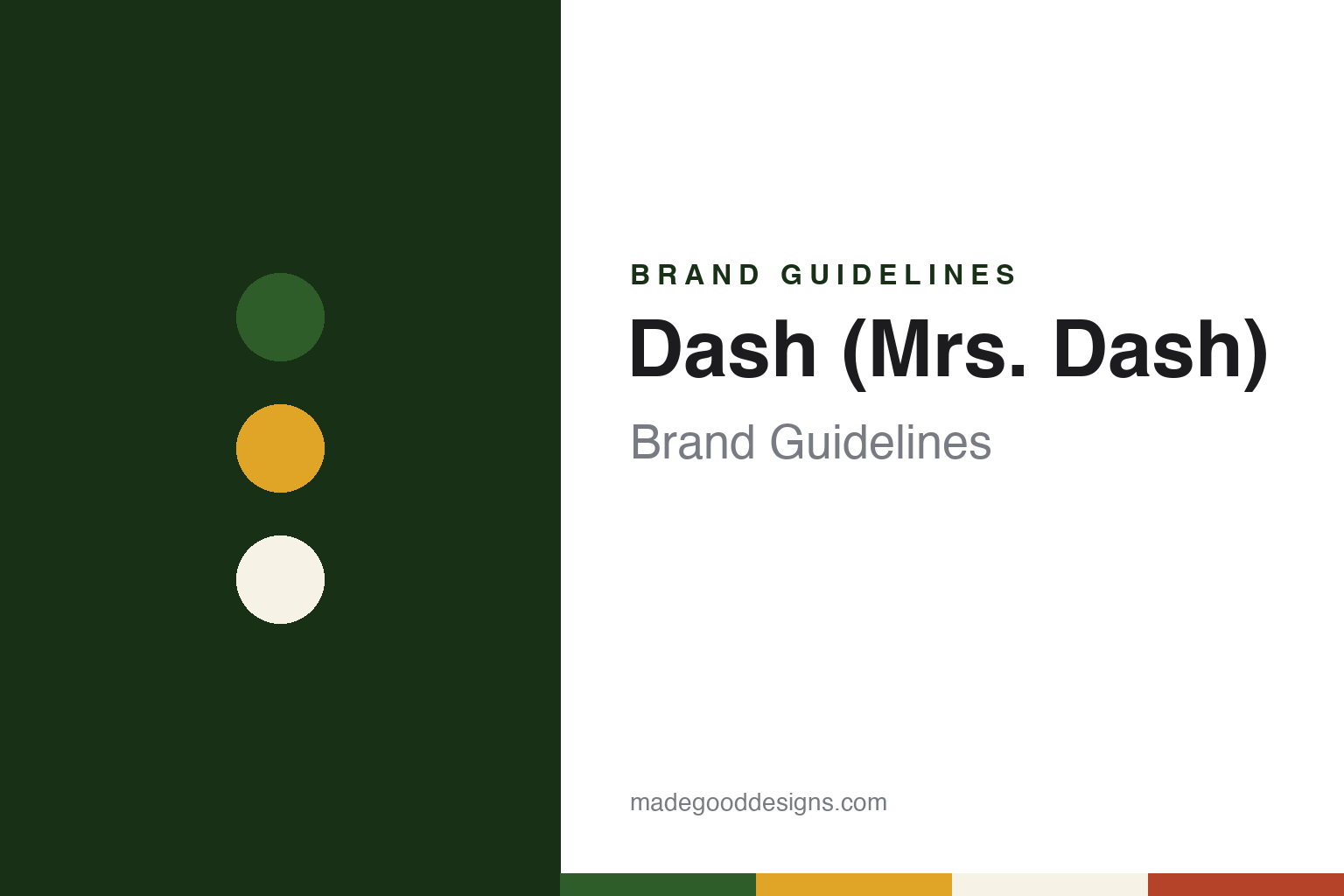
Two constants: a herb green, lemon pepper gold and shaker cream palette and a rounded sans register. Abstract homage — not a Dash product or mark; no bottle, label or logo is reproduced.
A seasoning from a hair-care company
A marketing executive, a family dinner table and a blend without salt.
Dash is an American brand of salt-free seasoning blends, sold for most of its life as Mrs. Dash and owned today by B&G Foods of Parsippany, New Jersey. The name on the bottle has always belonged to an invented character. Food & Wine, in a news story by Jelisa Castrodale dated 21 February 2020, put it plainly: there is no real-life Mrs. Dash.
The person behind the blend was Carol Bernick. Food & Wine reported that the seasoning was developed in the early 1980s by Bernick, who was then a marketing executive at the consumer goods company Alberto-Culver. Citing a cached version of the “About Us” section of the brand’s website, the magazine said she wanted a simple, salt-free way to season the meals she cooked for her family, that she worked with a number of spice suppliers until they had the right combination of flavours, and that the result was bottled and given the Mrs. Dash name.
English Wikipedia says the original formula was first marketed in 1981, citing the brand’s own former website. The trade weekly Baking Business, reporting in October 2011, said Mrs. Dash was introduced in 1983, and Ad Age said in February 2020 that the name had been seen on bottles of seasoning since 1983.
The company that made it was not a food business by origin. English Wikipedia describes Alberto-Culver as an American corporation whose principal business was hair and skin care, under brands such as Alberto VO5, TRESemmé and St. Ives. The same article says the company grew out of a Los Angeles beauty supply house founded by Blaine Culver, that it dates from 1955, that its founder was Leonard H. Lavin, and that it was later headquartered in Melrose Park, Illinois, outside Chicago. Wikipedia lists Carol Lavin Bernick among its key people as executive chairman.
Mrs. Dash was not Bernick’s only seasoning character. Food & Wine said that in 1987 she also helped to develop Molly McButter, a butter-flavoured sprinkle sold under another invented woman’s name. The magazine quoted her telling the Chicago Tribune shortly after that launch that when the company promoted a brand, it wanted consumers to really remember the product. The two brands would later leave Alberto-Culver’s ownership together.
Colour
A beauty takeover, a forced sale and a New Jersey food group.
Mrs. Dash changed hands because of a deal in another industry. English Wikipedia says the consumer goods group Unilever bought Alberto-Culver in 2010, and that the terms of the acquisition required Unilever to divest selected hair care brands and the entire food business in the United States to satisfy antitrust concerns.
The buyer was announced the following year. Baking Business, in a report by Keith Nunes dated 31 October 2011, said B&G Foods had entered into an agreement with Unilever U.S. to acquire its Culver Specialty Brands business unit. The unit included Mrs. Dash and Molly McButter alongside the sugar substitute Sugar Twin, the baking spray Baker’s Joy and two non-food brands, Static Guard and Kleen Guard. English Wikipedia’s article on B&G Foods also dates the purchase to 2011.
The seasoning was the reason most often named. Baking Business quoted David L. Wenner, then president and chief executive of B&G Foods, as saying that Mrs. Dash seasonings had a unique position within the seasonings category, and that the other brands fitted the company’s strategy of acquiring smaller brands. The same report described Mrs. Dash simply as a salt-free seasoning.
The report also recorded where the products came from at the time of the sale. Unilever said the Culver Specialty Brands products were manufactured at third-party facilities, and that no Unilever-owned plants would be affected by the transaction.
B&G Foods has owned the brand since 2011. The company traces its own name to an older grocery line: B&G, the Bloch & Guggenheimer pickles of Manhattan. The brand’s website in 2014 included an “About B&G” section describing the group as based in Parsippany, New Jersey, and as a maker and distributor of branded shelf-stable foods across the United States, Canada and Puerto Rico. The current site, still at mrsdash.com, carries a 2026 copyright line in the name of B&G Foods.
Under B&G the range kept widening beyond the original shaker. The brand’s 2014 website grouped its products into seasoning blends, grilling blends, marinades and seasoning packets for dishes such as chili, tacos and pot roast. English Wikipedia describes the core varieties as granulated mixtures of dried herbs and spices sold in small plastic shaker bottles, with single-serving packets for consumers and institutions.
Typography
Design and documentation.
Spice jars, seasoning shakers and boxed potato pouches share a problem: the product inside is a dry powder, a blend or a flake that looks much the same from one maker to the next, so much of what a shopper sees on the shelf has to be carried by the container and its label. A cap colour, the shape of a tin, a band of type across a carton or a pouch that stands upright can do more work than any description of the contents.
Many of these packs are long-lived. A jar or carton may keep its basic form for decades while the company behind the name changes owners, moves its plants or widens its range far beyond the product it began with. That makes the plain questions worth asking of each name: who started it, who owns it now, and where its spices, blends or potatoes are actually grown, milled and packed.
Each guide separates what independent sources record from what the company says about itself — its founding story, its owners over time, where its products are made and how its labels have changed — and marks plainly what rests only on the company’s own word.
Aa
A soft, rounded sans — the friendly kitchen-shelf register of a seasoning shaker. (Specimen set in Nunito, a rounded sans STAND-IN; NOT the Dash or Mrs. Dash logo.)
Dropping the “Mrs.”
A flavour statement, a shorter name and a website that kept the old one.
For most of its life the brand spoke through its name and one idea. On its website in 2014, Mrs. Dash called itself “The salt-free flavor statement”, set with a trademark sign, and described each blend, packet and marinade as a mix of spices meant to give flavour without salt. The product names on that site all began with the same possessive form, from Original Blend to Lemon Pepper and Southwest Chipotle.
The identity changed in 2020. Ad Age, in a story by its food reporter Jessica Wohl published on 20 February 2020, reported that the seasoning would drop “Mrs.” from its name that spring and go simply by Dash, as announced by its parent company B&G Foods. The magazine said the company’s statement referred not to gender roles but to the speed of using the product. It quoted Julie Gould, marketing director at B&G Foods, as saying the line would continue to let consumers elevate their cooking quickly and simply, “in a dash”.
Food & Wine carried a longer version of the same statement, in which Gould said the company was thrilled to roll out the new Dash branding and products. The magazine reported that the brand’s logo would be changed to reflect the Dash-only name. Ad Age added that existing products were not set to change except for the brand name, and that a new blend, Everything But the Salt, a salt-free take on the flavour of an everything bagel, was due that spring.
The relaunch came with a public face. Both publications said the brand would work with Joy Bauer, whom Ad Age described as a speaker who appears on NBC’s Today; the magazine said she would be featured in national advertising and would prepare recipes for the brand’s site and social channels.
The web address did not follow the name. Ad Age noted that the brand’s site would remain at mrsdash.com, and that dash.com instead redirected to a Procter & Gamble page, likely because P&G sells a laundry detergent of the same name. Six years on, the site still sits at the old address while the pages themselves say Dash™, with the line “No Salt? No Problem.” on the home page and newer products such as a range of Pasta Blends.
For a design guide, Dash shows how a brand can rename itself and keep its shelf: the character behind the original name was invented, so removing her title changed the word on the label rather than the product in the bottle. Compare it with McCormick and Morton Salt. For this guide we use herb green, lemon pepper gold and shaker cream with a rounded sans, an unofficial interpretation; no product or logo is reproduced.
Explore & save
Keep Dash (Mrs. Dash)’s identity on hand — save it to a board in the Made Good inspiration library.
Dash identity set
Pin the Dash herb green, lemon pepper gold and shaker cream palette and the rounded sans register to your own board.