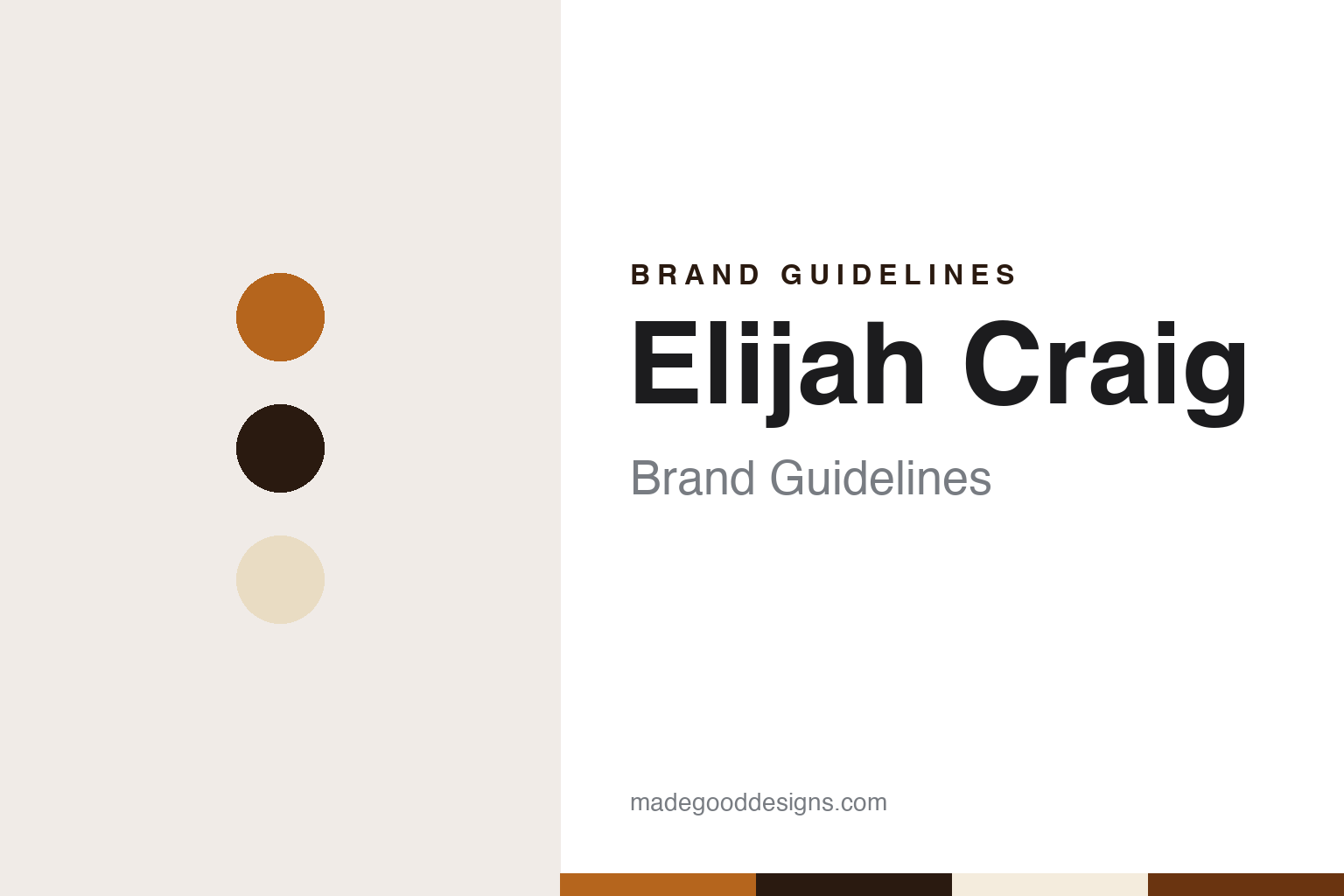
Elijah Craig Brand Guidelines
Heaven Hill’s 1986 bourbon, named for a Kentucky preacher.
Aa
Two constants: a charred amber, barrel brown and paper cream palette and an old-style serif register. Abstract homage — not an Elijah Craig product or mark; no label, logo or bottle is reproduced.
A Bardstown family’s bourbon
From a 12-year-old small batch to a range of single barrels.
Elijah Craig is a Kentucky straight bourbon made by Heaven Hill Distilleries, the family-owned whiskey company headquartered in Bardstown, Kentucky. English Wikipedia gives 1986 as the year the brand was introduced, with a Small Batch bottling that originally carried a 12-year age statement. Heaven Hill itself dates from 1935: the Lexington Herald-Leader reported in 2015 that it was founded shortly after the repeal of Prohibition by a group of investors that included a member of the Shapira family and the distiller Joseph L. Beam, a first cousin of Jim Beam, English Wikipedia notes. The Shapira family still runs the business.
Where the whiskey is made has changed once. On 7 November 1996 a fire almost completely destroyed Heaven Hill’s production plant in Bardstown, English Wikipedia records. The company kept going with distilling capacity provided by neighbours, and in 1999 it bought the Bernheim distillery in Louisville from Diageo, The New York Times reported in February 1999. English Wikipedia says the brand’s whiskey is distilled at that Louisville plant, now called the Heaven Hill Bernheim distillery, while the company keeps its headquarters in Bardstown, where it opened the Bourbon Heritage Center visitor attraction in 2004.
The line widened from the single Small Batch. English Wikipedia lists an 18 Year Old Single Barrel, which Heaven Hill suspended in May 2012 because of limited stocks of barrels near that age; a 20-year-old single barrel followed in 2012, a 21-year-old in 2013 and a 23-year-old in 2014, according to company releases cited there, and the 18-year-old returned in 2015. A Barrel Proof small batch, bottled without dilution, has appeared three times a year since 2013. In January 2016 Heaven Hill dropped the 12-year age statement from Small Batch, the writer Fred Minnick reported, moving to a blend of 8- to 12-year-old bourbon to stretch its stocks.
Colour
A preacher’s name, a legend and the year 1789.
The name belongs to the Reverend Elijah Craig, an 18th-century Baptist preacher born in Orange County, Virginia. English Wikipedia, citing The Kentucky Encyclopedia, says he led his congregation to what was then the Kentucky County of Virginia in 1782, laid out the town later renamed Georgetown, opened a classical school in 1787 and built some of the region’s first mills, and that around 1789 he founded a distillery.
The brand’s story leans on what historians treat as a legend. Heaven Hill’s advertising calls Craig “The Father of Bourbon,” crediting him with ageing whiskey in charred oak barrels; the whiskey writer Charles K. Cowdery has argued that Craig made the same kind of whiskey as his neighbours, and the historian Henry G. Crowgey, in Kentucky Bourbon: The Early Years of Whiskeymaking (1971), called the story a “charming legend.” English Wikipedia also notes that Craig’s distillery was never in Bourbon County.
The packaging took up the date rather than the legend. On 29 September 2016 Heaven Hill announced what it called a major redesign of Elijah Craig Small Batch, reported by Distillery Trail the next day. The new bottle was taller, with cleaner lines, made in a custom mould with 1789 embossed in the glass; the brand name and the words “Kentucky Straight Bourbon Whiskey” were applied directly to the bottle, a small textured paper label low on the front carried Elijah Craig’s signature and the product details, and the wooden cork was stained dark brown. The company said the whiskey inside was unchanged. Max L. Shapira, Heaven Hill’s president and a second-generation family member, was quoted saying the bottle celebrated the bourbon’s promise as a premium whiskey. No design agency was named in the announcement. For the lettering itself, see our note on the Elijah Craig font.
The Barrel Proof label carries its own system: English Wikipedia says that from the thirteenth release, batch codes such as B517 give the release order, month and year on the label.
Typography
Design and documentation.
The seven brands in this group are all bourbon names: Elijah Craig, Eagle Rare, Blanton’s, Angel’s Envy, Old Forester, Michter’s and Basil Hayden. Bourbon brands in general sit at many different points in the trade, from family distillers that still carry a founder’s name to labels that now belong to much larger drinks groups, and a single brand can be sold everywhere from a corner shop to a hotel bar.
A bourbon brand’s identity is usually carried less by the whiskey itself than by a bottle, a label and a name, because the company behind the name may have changed hands, moved its distilling or grown far beyond the place where it started. That makes the questions behind each name worth asking plainly: who started it, who owns it now, and where its whiskey is actually distilled, aged and bottled.
Each guide separates what independent sources record from what the company says about itself — its founding story, its owners over time, where its whiskey is made and how its bottles and labels have changed — and marks plainly what rests only on the company’s own word.
Aa
An old-style serif for a preacher’s name and a signature. (Specimen set in Libre Caslon Text, a serif STAND-IN; NOT the Elijah Craig logo.)
Elijah Craig
Awards, age statements and a family owner.
The brand built its reputation with critics. English Wikipedia records that the 18-year-old single barrel was named Best Bourbon with a Double Gold rating at the San Francisco World Spirits Competition in 2010. Whisky Advocate named the 20-year-old single barrel its American Whiskey of the Year in its awards for 2011, and in 2017 the magazine named Elijah Craig Barrel Proof, batch B517, its Whisky of the Year.
Elijah Craig sits in a Heaven Hill portfolio that also includes Evan Williams, Old Fitzgerald and Larceny, English Wikipedia lists, and the company describes itself as family-owned and independent. Like its stablemate, the brand takes its name from an early Kentucky figure rather than from the family that owns it.
The name needs care online, because the preacher and the bourbon share it; the brand’s own site is elijahcraig.com, while Heaven Hill’s company site is heavenhill.com.
For a design guide, Elijah Craig shows how a bourbon can borrow an 18th-century name and a single date, 1789, and carry both on the glass itself, with a signature on a small paper label doing the work a large label once did. Compare Evan Williams, Heaven Hill’s 1957 bourbon, and Jim Beam, the bourbon of the family that gave Heaven Hill its first master distiller. For this guide we use charred amber, barrel brown and paper cream with a serif, an unofficial interpretation; no product or logo is reproduced.
Explore & save
Keep Elijah Craig’s identity on hand — save it to a board in the Made Good inspiration library.
Elijah Craig identity set
Pin the Elijah Craig charred amber, barrel brown and paper cream palette and the old-style serif register to your own board.