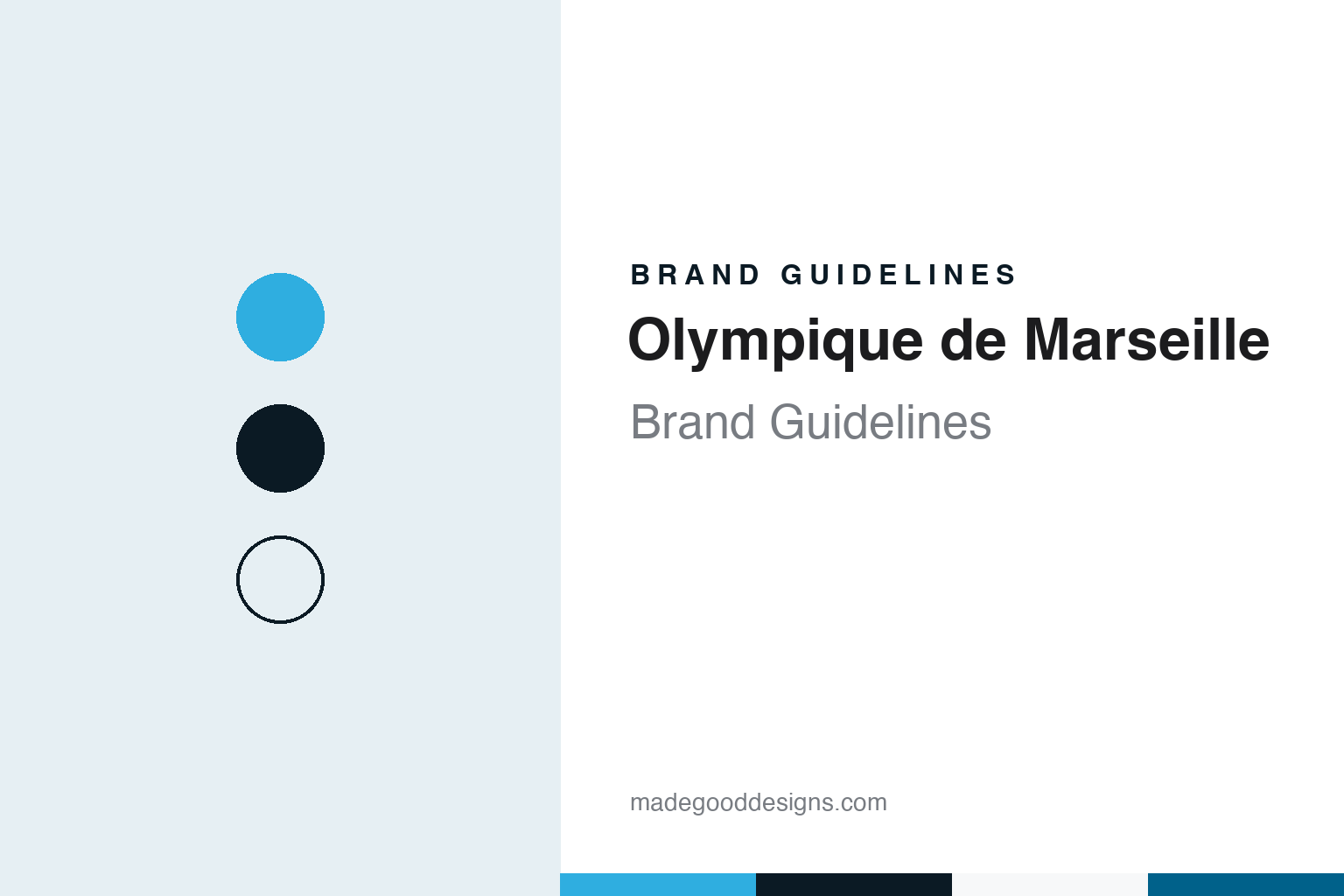
Olympique de Marseille Brand Guidelines
White shirts, a sky-blue monogram and a gold star above it.
Aa
Two constants: a Phocéen sky blue, ink and shirt white palette and a narrow harbour sans register. Abstract homage — not an Olympique de Marseille product or mark; no crest, shirt or logo is reproduced.
Olympique de Marseille
A rugby club, a Greek name and a founder’s seal.
Olympique de Marseille began as a club for several sports. English Wikipedia says it was founded in 1892 as an omnisport club by René Dufaure de Montmirail, a French sports official, and was known as Football Club de Marseille for its first seven years. In 1899 it took the name Olympique de Marseille. Wikipedia says “Olympique” refers to the ancient Olympic Games and honours the Greeks from Phocaea who founded Marseille some twenty-five centuries earlier, a link that also gives the club and the city the nickname Phocéens.
The early club played rugby before association football. Wikipedia says rugby union was its main team sport at first, and that the club had been affiliated with the French sports union, the USFSA, since 1898. Football in the modern sense was only taken up in 1902, and Wikipedia notes that at the time the French word “football” still meant rugby, while the round-ball game was called “association”. That history explains the motto. Wikipedia says the phrase “Droit au but”, French for “straight to the goal”, dates from the rugby years, when the club was still Football Club de Marseille.
Ownership has changed hands several times in the modern era. Wikipedia says Bernard Tapie became club president on 12 April 1986. From 1996 the club was backed by Robert Louis-Dreyfus, then chief executive of Adidas and later by Margarita Louis-Dreyfus. On 29 August 2016 it was announced that the American businessman Frank McCourt had agreed to buy the club from her, and Wikipedia says the purchase was completed on 17 October 2016.
The trade press reported the handover the next day. Inside World Football, in a story by Paul Nicholson dated 18 October 2016, said McCourt, a former owner of the Los Angeles Dodgers baseball team, had completed his acquisition of the club, ending two decades under the control of the Louis-Dreyfus family. Wikipedia says McCourt then appointed Jacques-Henri Eyraud as club president, and that Pablo Longoria replaced Eyraud as president in February 2021. McCourt has owned the club since 2016.
Colour
An interlaced O and M, redrawn across a century.
The badge grew out of a personal monogram. English Wikipedia says founder René Dufaure de Montmirail drew on his own seal, which carried the interlaced letters D and M, to create the club’s first badge. The original badge set an ornate letter M over an O, with the motto draped across the letters, so the club’s initials and its rugby-era phrase have been joined from the start.
Later decades tried other forms before the club came back to the original idea. Wikipedia says the first badge lasted three decades, until 1935, when the club adopted an art deco shield with a simple M set inside the O. In 1972 it changed again, this time to a more complex M letterform. In 1986 the club re-adopted its first badge, and Wikipedia says the mark then evolved slightly over the following decades. A star was added above it in 1993.
Anniversaries have produced their own variants. Wikipedia says a version with a golden O and a turquoise M was used for the centenary in 1999, and a similar logo marked the club’s 110th anniversary in the 2009–10 season. The current form was unveiled on 17 February 2004. Wikipedia describes it as an O and M drawn as a single unit in turquoise, without shading or borders, capped by a golden star, with the motto “Droit au but” set in gold beneath the monogram.
Typography
Design and documentation.
Football club identities are often built from a handful of recurring devices, and the clubs in this part of the round show several of them. The first is the monogram: interlocking initials that compress a long formal name into a mark small enough for a shirt, a scarf or a stadium gate. Monograms tend to survive redesigns because supporters read them as a signature rather than a picture, so designers usually redraw the letters, adjust their weight and spacing, and leave the arrangement alone.
The second device is the motto. Some crests carry a short phrase, sometimes in the home language and sometimes in Latin, set on a ribbon or band. A motto gives a club a line of copy that can move from the badge to banners, stands and advertising without a change of meaning.
The third is origin. A number of European clubs began as works teams or sports associations attached to a factory, a school or a parish, and the founding organisation’s name or initials can remain in the club name long after the link has loosened. Finally there is the stadium name, which may honour a former president, a place or a sponsor, and which becomes part of the brand on tickets, signage and broadcast graphics.
Aa
A narrow harbour sans — the register of a stand banner and a scarf. (Specimen set in Archivo Narrow, a sans-serif STAND-IN; NOT the Olympique de Marseille logo.)
Olympique de Marseille
White and blue from the city flag, and the Vélodrome.
The colours come from the city. English Wikipedia says the club’s blue and white originate from the flag of Marseille, and that because the city was founded by Greeks the colours are presumed to have a Greek origin. The traditional kit was white shirts and shorts with blue socks until 1986. From 1986 the team wore white socks as well, and Wikipedia says the blue became lighter because of Adidas marketing. In the 2012–13 season the club returned to its original kit with blue socks.
The club has played at two main grounds. Wikipedia says that from 1904 to 1937 Marseille played at the Stade de l’Huveaune, a ground the club owned and which was once named Stade Fernand Buisson after a former rugby player of the club who became a member of the French National Assembly. In 1937 the team moved to the larger Stade Vélodrome, owned by the city, after persuading the city to lower its rent. The club returned to l’Huveaune during the 1982–83 season while the Vélodrome was renovated for Euro 1984.
The Vélodrome itself has been rebuilt several times. Wikipedia says it was redeveloped for the 1998 World Cup into a ground with two curved ends, the Virage Nord and Virage Sud, where supporters’ groups gather, along with the Jean Bouin and Ganay stands. For Euro 2016 the city added a roof over the stands. Matchdays have their own sound cues as well: Wikipedia says “Jump” by Van Halen plays before each home game.
The club’s rivalry with Paris Saint-Germain is known as Le Classique, a name modelled on Spain’s El Clásico.
For a design guide, Olympique de Marseille shows how a founder’s seal can become a lasting club monogram, with a motto as its fixed caption. Compare the Eiffel Tower crest of Paris Saint-Germain and the starball of the UEFA Champions League. For this guide we use Phocéen sky blue, ink and shirt white with a narrow sans, an unofficial interpretation; no product or logo is reproduced.
Explore & save
Keep Olympique de Marseille’s identity on hand — save it to a board in the Made Good inspiration library.
Olympique de Marseille identity set
Pin the Olympique de Marseille Phocéen sky blue, ink and shirt white palette and the narrow harbour sans register to your own board.