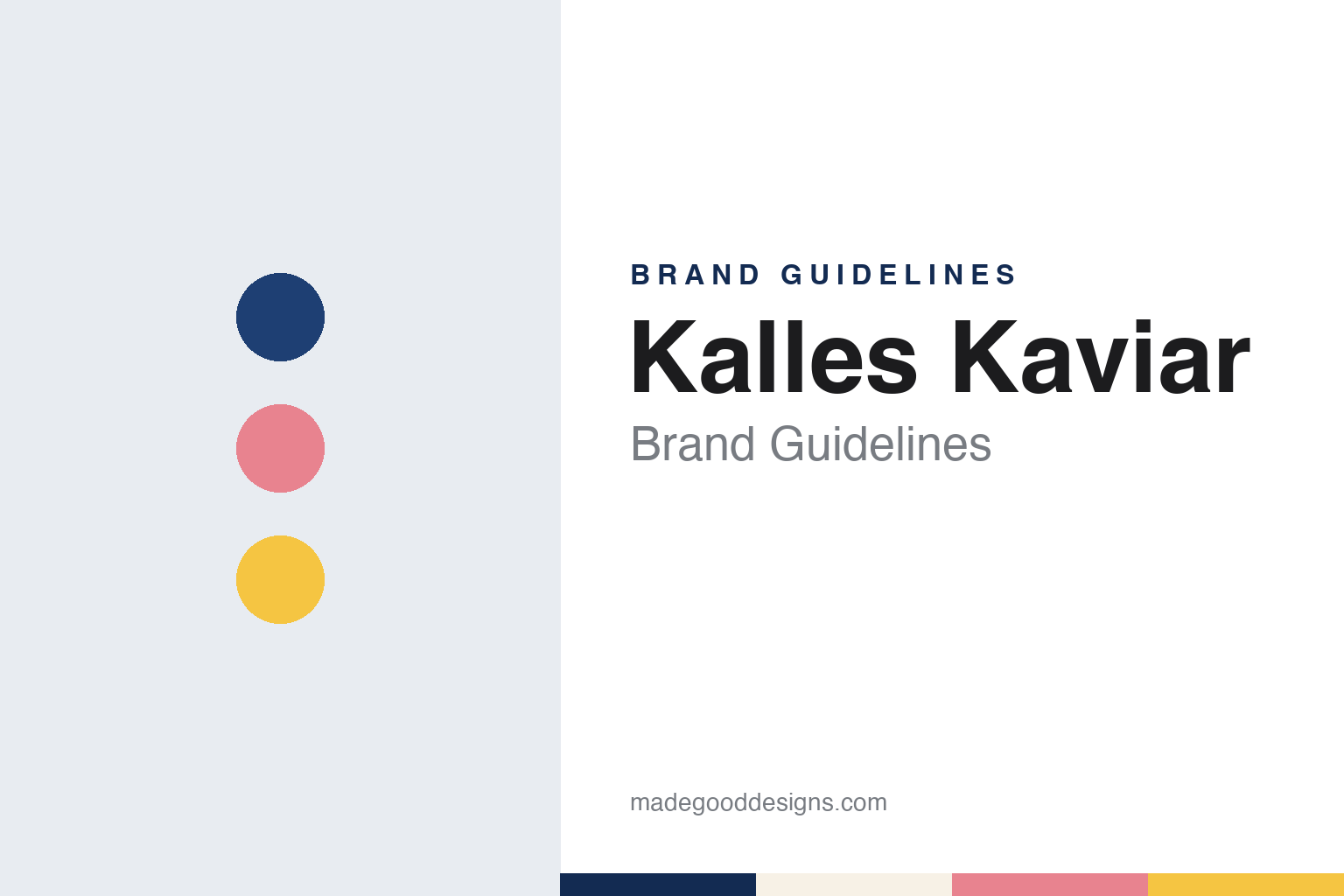
Kalles Kaviar Brand Guidelines
Abba’s smoked cod-roe tube and the boy called Kalle.
Aa
Two constants: a tube blue, roe coral and butter yellow palette and a rounded friendly sans register. Abstract homage — not a Kalles product or mark; no tube, logo or portrait is reproduced.
From Bergen to Kungshamn
A fish merchant, his sons and a company name in capitals.
Kalles Kaviar is a product of Abba, one of Sweden’s oldest seafood companies, and Abba’s story begins in Norway. Swedish Wikipedia says the business was founded in Bergen in 1838 by Christian Gerhard Ameln, who came from a merchant family, as a fish-trading firm. In the 1850s his sons moved the business to Stockholm, where it traded as Bröderne Ameln — “the Ameln brothers.” In 1906 it was registered as AB Bröderne Ameln, ABBA, and from 1920 the short form Abba was used as a trademark, Swedish Wikipedia says. The company’s own history gives the same founder and founding year and dates the registration of the abbreviated name to 1906.
Production moved to the west coast in the twentieth century. According to Swedish Wikipedia, Abba operated on the island of Rösholmen, between Kungshamn and Smögen in Bohuslän, from 1933, gathered all of its production there in 1943, and in the early 1970s moved to Hagaberg in Kungshamn. The company says it still operates from Kungshamn, where it makes the herring and seafood products for which it is best known, and it holds the title of Kunglig hovleverantör, purveyor to the Swedish royal court, granted by the King.
The Abba name had a second life in pop music. The company tells how, before the Swedish group ABBA won the Eurovision Song Contest with “Waterloo” in 1974, the band’s manager asked permission to use the name. Abba’s personnel director, Per Brolund, agreed — on condition, the company says, that the young people behaved themselves and did not damage Abba’s good reputation.
Colour
A pedlar’s recipe, an advertising man and a six-year-old.
Smoked roe in a tube was not Abba’s invention. Swedish Wikipedia traces salted cod roe as a popular Swedish food to the 1850s and a milder version, with the roe mixed with oil, to the 1910s; the Konsum co-operative was advertising smoked caviar in tubes in 1936, and Abba advertised its own tubed smoked caviar in 1946. The recipe that became Kalles, Swedish Wikipedia says, Abba bought in 1950 from a gårdfarihandlare, an itinerant pedlar.
The name and face came from advertising. Swedish Wikipedia says the advertising man Claes Mörner suggested that the tube should carry a picture of a blond, blue-eyed boy, and English Wikipedia says he put the idea to Abba’s chief executive, Christian Ameln. The boy chosen was Ameln’s own son, Carl Ameln; the company says he was six years old at the time and was promised free caviar for the rest of his life. His drawn portrait, based on a family photograph taken by his mother, appeared in an advertisement for “Kalles kaviar” on 17 November 1950 in Svenska Dagbladet and Dagens Nyheter, Swedish Wikipedia says, showing the boy holding a caviar sandwich. Kalle is the everyday Swedish form of Carl, and the company says it was a popular name in the 1950s.
Although the product was advertised from 1950, the company dates its launch to 1954, the year it gives as the start of Kalles Kaviar, and English Wikipedia notes that 1954 is the officially credited date. The spread itself is made from smoked cod roe, with sugar and salt among its ingredients, Swedish Wikipedia says.
The package matters as much as the picture. English Wikipedia says Kalles has stayed in an aluminium tube rather than a plastic one because the product does not stay fresh for long in contact with air, and an aluminium tube collapses and keeps the shape it was pressed into.
Typography
Design and documentation.
The seven brands in this group are all Nordic food and dairy names: Kalles Kaviar, Felix, Estrella, Valio, Arla, Stabburet and Nidar. Nordic food brands in general sit at many different points in the trade, from names that still carry a founder’s story to brands that now belong to much larger food groups or farmer-owned co-operatives, and a single brand can be sold everywhere from a corner shop to a supermarket shelf.
A food brand’s identity is usually carried less by a single product than by a pack, a name and the meal or snack it promises, because the company behind the name may have changed hands, moved its factory or grown far beyond the town where it started. That makes the questions behind each name worth asking plainly: who started it, who owns it now, and where its food is actually made and packed.
Each guide separates what independent sources record from what the company says about itself — its founding story, its owners over time, where its products are made and how its packaging has changed — and marks plainly what rests only on the company’s own word.
Aa
A rounded friendly sans for a breakfast-table brand named after a boy. (Specimen set in Nunito, a sans STAND-IN; NOT the Kalles logo.)
Kalles
Brewers, a carmaker, a state group and Orkla.
Abba changed hands several times after the war years. Swedish Wikipedia gives the chain: the brewer Pripps bought the company in 1969; Beijerinvest became the owner in 1975 when it bought Pripps; Abba became part of the Volvo group in 1981; it was sold to Procordia in 1990; and in 1995 it passed to the Norwegian group Orkla. In 2013 Abba and its sister company Procordia were merged into Orkla Foods Sverige, and the company says Abba has been part of Orkla Foods Sverige since 1 January 2014. Abba also bought AB Hållöfisk, a shrimp and crayfish processor, in 2005.
The brand itself has been shortened. Swedish Wikipedia says the spread has been marketed simply as Kalles since 2015. Variations have followed the original: the company dates Kalles Randiga, a striped version with banana, to 2007, and Swedish Wikipedia records Kalles Vegan, made with seaweed caviar, from early 2022.
Kalles is sold mainly in Sweden, Finland and Norway, Swedish Wikipedia says, and abroad through IKEA’s food shops. Its name has not travelled unchanged. English Wikipedia says that in Finland, where “kaviar” was reserved for sturgeon roe, it was sold as Kallen Mätitahna, “Kalle’s roe paste.” It also records that in 2011 IKEA replaced Kalles with its own-brand roe spread, that the switch drew complaints, and that the retailer later brought Kalles back. English Wikipedia adds that the Swedish market for smörgåskaviar has since fragmented, with each supermarket chain promoting its own brand.
For a design guide, Kalles Kaviar shows how a single drawn face on a squeezed aluminium tube can carry a brand for more than seventy years, through a change of name and a string of owners. Compare Felix, another Swedish Orkla brand, and Wasa, the Swedish crispbread that Kalles is so often spread on. For this guide we use a tube blue, a roe coral and a butter yellow with a rounded sans, an unofficial interpretation; no product or logo is reproduced.
Explore & save
Keep Kalles Kaviar’s identity on hand — save it to a board in the Made Good inspiration library.
Kalles Kaviar identity set
Pin the Kalles tube blue, roe coral and butter yellow palette and the rounded friendly sans register to your own board.