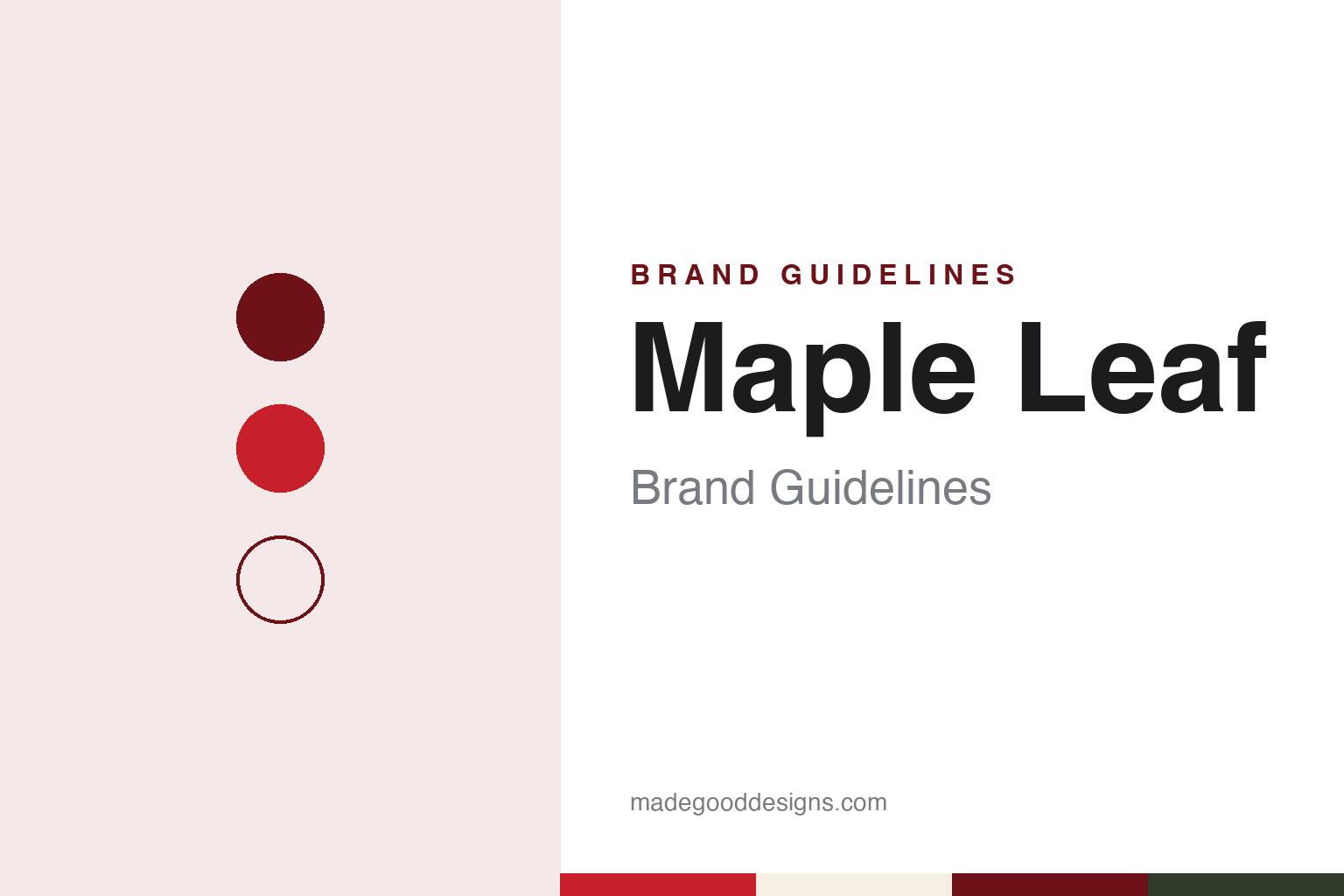
Maple Leaf Brand Guidelines
The Canada Packers meat brand that became a protein company.
Aa
Two constants: a leaf red, deep red and butcher-paper palette and a sturdy grotesque register. Abstract homage — not a Maple Leaf product or mark; no pack, logo or leaf is reproduced.
Packers and millers
Two Toronto food businesses and one name.
Maple Leaf Foods, the company behind the Maple Leaf brand, was created in 1991 from two older Canadian businesses: a meat packer and a flour miller. Wikipedia, citing a 1991 report in The Globe and Mail, says the merger of Canada Packers and Maple Leaf Mills was renamed Maple Leaf Foods that year. The company itself says the Maple Leaf brand first appeared in 1898, and traces its oldest roots further back still, to Grantham Mills, built in 1836 in St. Catharines, Ontario.
The meat side began in 1927. Canada Packers was formed that year as a merger of several large Toronto meat packers, the best known being the William Davies Company, Wikipedia says, and was at once the country’s largest food processor, a position it held for about sixty years. By the 1930s it was already using the name Maple Leaf, alongside Klik and Kam, for its pork products. Its hog-processing operations, much of their output exported to Britain, helped give Toronto its nickname, “Hogtown.” Canada Packers later became the country’s biggest beef slaughterer, and by 1950 it sold ice cream, cheese and canned and frozen produce under the York name. In the 1980s it added brands such as Squirrel peanut butter and Black Diamond cheese, while closing some plants.
The milling side was Maple Leaf Mills, created in 1961 from the amalgamation of the Maple Leaf Milling Company, Toronto Elevators and Purity Flour Mills, and by the late 1980s owned by the British food group Hillsdown Holdings. In 1989 the McLean family, which had run Canada Packers since its founding, announced that it would sell its stake. Control passed in 1990 to Hillsdown, the historian Ian MacLachlan writes in Kill and Chill (2001), through a deal in which Canada Packers bought Maple Leaf Mills in exchange for its own shares. The combined company took the Maple Leaf name in 1991, along with a large bread business best known for the Dempster’s brand.
Colour
A potato family, a pension fund and plant protein.
The company’s next owners came from New Brunswick. Wallace McCain, who had founded McCain Foods with his brother Harrison in 1956, left that business in the 1990s after a long dispute over its leadership. In 1995 his McCain Capital Corporation and the Ontario Teachers’ Pension Plan bought a controlling interest in Maple Leaf Foods from Hillsdown, the company says. His son Michael McCain moved with him and went on to lead Maple Leaf Foods as chief executive for 25 years. Wallace McCain died in 2011, The Globe and Mail and Bloomberg reported.
Under the McCains the business grew and then narrowed. The company says it bought Vancouver Fancy Meats and the Shopsy’s plant in 1992, opened a pork plant in Brandon, Manitoba, in 1999 and acquired J.M. Schneider, the Kitchener meat packer founded in 1890, in 2004. Its Maple Leaf Prime poultry was rolled out nationally in 1995. Then it sold everything that was not protein: in 2014 its majority stake in Canada Bread went to Mexico’s Grupo Bimbo, the Financial Post reported, and the company says it sold its non-protein businesses across 2013 and 2014.
The protein it kept came to include plants. Maple Leaf Foods says it bought Lightlife Foods in 2017 and Field Roast Grain Meat Co. in 2018, and the Financial Post reported in 2019 that it was betting heavily on meat alternatives, most of that business being in the United States. Closer to home, the company says it founded Greenfield Natural Meat Co. in 2015 in Landmark, Manitoba, as a brand for meat raised without antibiotics.
The look of the brand changed in 2018. That year, the company says, it unveiled a new logo as part of the biggest brand-strategy launch in its history, refreshing Maple Leaf, Schneiders and Swift together. The Maple Leaf brand now uses the line “We’re for Real,” and the company says it became the world’s first major carbon-neutral food company on 7 November 2019, marking packs with a Carbon Zero logo.
Typography
Design and documentation.
The seven brands in this group are all food brands, and all of them are Canadian: President’s Choice, Clover Leaf, Maple Leaf, Lantic, Christie, Neilson and Old Dutch. Canadian food brands in general sit at many different points in the trade, from family firms that still carry a founder’s name to names that now belong to much larger food groups, and a single brand can be sold everywhere from a corner store to a national supermarket chain.
A food brand’s identity is usually carried less by a single product than by a pack, a name and the meal or snack it promises, because the company behind the name may have changed hands, moved its factory or grown far beyond the town where it started. That makes the questions behind each name worth asking plainly: who started it, who owns it now, and where its food is actually made and packed.
Each guide separates what independent sources record from what the company says about itself — its founding story, its owners over time, where its food is made and how its packaging has changed — and marks plainly what rests only on the company’s own word.
Aa
A sturdy grotesque for a brand built on bacon, ham and chicken. (Specimen set in Archivo, a sans STAND-IN; NOT the Maple Leaf logo.)
Maple Leaf Foods
New plants, a new chief and a revived old name.
Maple Leaf Foods has its head office in Mississauga, Ontario. In November 2018 it announced that it would close older plants in St. Marys, Brampton and Toronto and build a new poultry plant in London, Ontario, CP24 reported, with Michael McCain saying the old plants were 50 to 60 years old; the company says the London plant began operating in 2022. It also lists a bacon centre in Winnipeg, opened in 2021, among its investments.
One episode stands apart in the company’s history. In August 2008 a listeria outbreak was traced to one of its Toronto prepared-meats plants, and the Canadian Food Inspection Agency warned the public against several of its products, the National Post reported; the company says the outbreak caused 23 deaths and that it has since made food safety a central commitment.
The chief executive’s job changed hands in 2023. The Globe and Mail reported in May 2022 that Michael McCain would become executive chairman, and Curtis Frank was appointed president and chief executive in May 2023, the company says. In October 2025 Maple Leaf completed the spin-off of its pork business as a separate listed company, reviving an old name: Canada Packers Inc., The Globe and Mail reported. Its brands today include Maple Leaf, Maple Leaf Prime, Schneiders and Greenfield, and in 2026 it announced that it would bring the Yves Veggie Cuisine brand back to Canadian shelves.
For a design guide, Maple Leaf shows how a national symbol can serve as a meat brand for more than a century while the company behind it is merged, sold, slimmed and split. Compare McCain, the frozen-food company Wallace McCain co-founded, and Bimbo, which bought Maple Leaf’s Canada Bread. For this guide we use a leaf red, a deep red and a butcher-paper cream with a sans, an unofficial interpretation; no product or logo is reproduced.
Explore & save
Keep Maple Leaf’s identity on hand — save it to a board in the Made Good inspiration library.
Maple Leaf identity set
Pin the Maple Leaf leaf red, deep red and butcher-paper palette and the sturdy grotesque register to your own board.