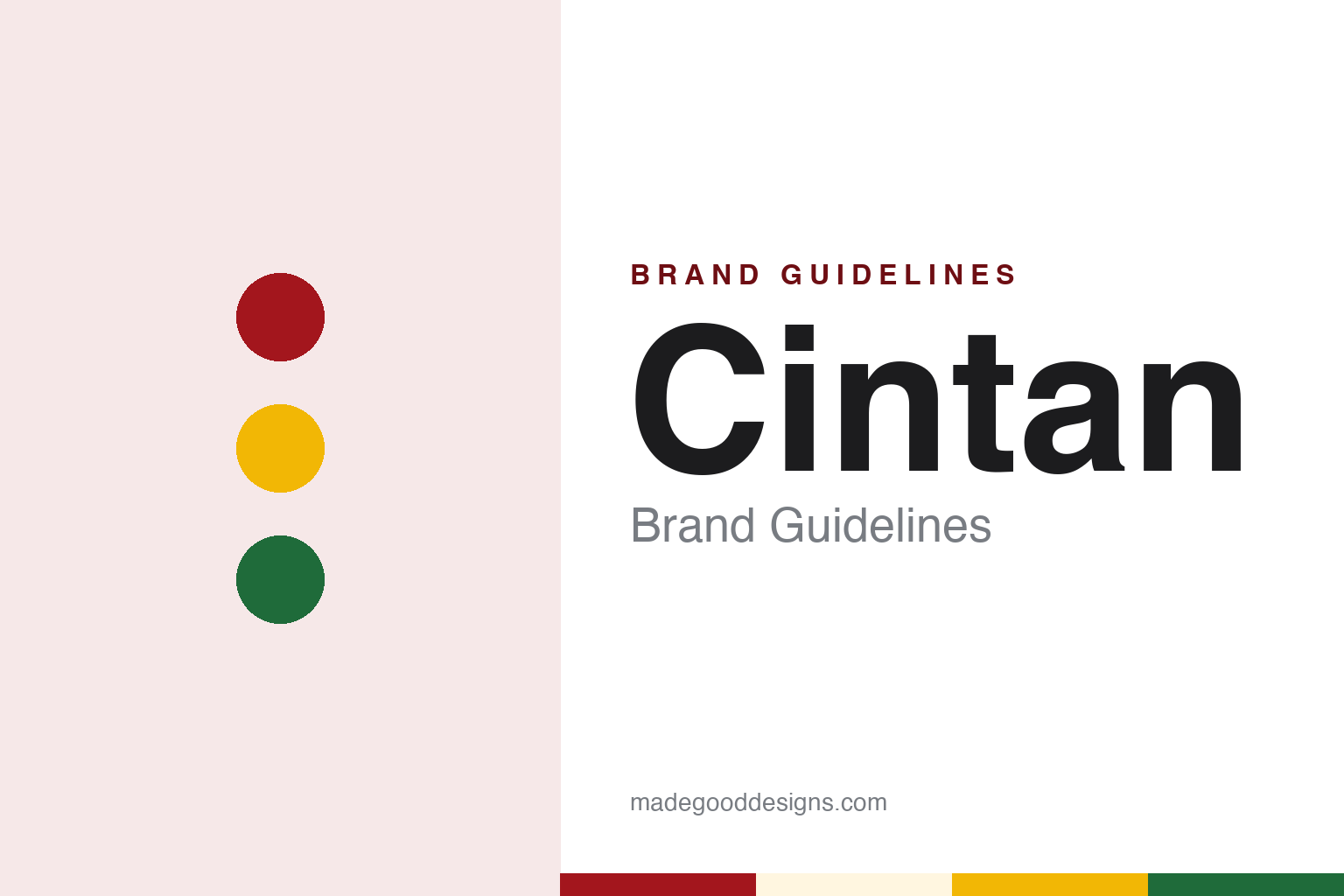
Cintan Brand Guidelines
The Yeo’s instant noodle it dates to 1969.
Aa
Two constants: a chilli red, noodle gold and pandan green palette and a heavy grotesque sans register. Abstract homage — not a Cintan product or mark; no pack, logo or noodle block is reproduced.
A noodle from a soy sauce house
A 1969 claim, and the company behind it.
Cintan is a Malaysian instant noodle brand, and it belongs to Yeo Hiap Seng (Malaysia), the Malaysian arm of the Singapore food and drinks company better known as Yeo’s. Its Malaysian website, which the old cintan.com.my address now redirects to, files four Cintan noodle products under “Instant Noodles”, and the company’s product pages carry the same line on the brand’s standard and mid-range packs: Cintan, Yeo’s says, was the first instant noodle introduced in Malaysia, in 1969. The claim is not new. An archived Yeo’s page from October 2014 carried the identical wording, “1st Instant Noodle introduced in Malaysia in 1969”, under the brand name.
The company behind it is much older than the noodle. In its own milestone list, Yeo Hiap Seng traces its origins to 1901, when its founder, Yeo Keng Lian, began a small soy sauce business in Zhangzhou, in China’s Fujian province. A soy sauce factory followed in Singapore as a partnership in 1935, and Yeo’s says the business expanded into Malaysia in 1942. From 1950 it began making food and drinks beyond soy sauce under the Yeo’s name, and in 1959 the Malaysian company was incorporated with a canning plant in Petaling Jaya, Selangor. By the late 1960s, the company says, its range ran from chilli, tomato, soy and oyster sauces to instant noodles and its Asian drinks.
Yeo Hiap Seng (Malaysia) Berhad was listed on the Kuala Lumpur Stock Exchange in 1975, according to the company. Its website footer read “Berhad” in 2014; today the company trades as Yeo Hiap Seng (Malaysia) Sdn Bhd, a private company, based in Shah Alam, Selangor. Its Singapore parent, Yeo Hiap Seng Limited, is controlled by Far East Organization, the property group of the Ng Teng Fong family, according to English Wikipedia.
Colour
Non-fried noodles, ginseng and a celebrity chef.
The earliest detailed picture of Cintan in the company’s own words comes from its annual reports around the turn of the century, preserved on archived copies of the Yeo’s Malaysia website. The 2000 annual report said the “CINTAN range” had been broadened, and described the noodles as made from high-protein, top-quality flour under HACCP food-safety practices, in a range of flavours meant for every level of consumer. The 2001 report listed the year’s advertising and promotion pushes, and among them, beside Yeo’s soya milk and Yeo’s Campur, was “CINTAN Instant Noodles with Natural Ginseng”.
A second line set Cintan apart from fried-noodle rivals. On its current product page for Cintan Non-Fried Noodles, Yeo’s says it first introduced non-fried noodles in the early 1990s, and describes them as steam-cooked and air-dried rather than fried. In the company’s Chinese-language recipes, the non-fried block appears as Cintan 风干面, “air-dried noodles”, and the brand itself as 金旦, the Chinese name under which Chinese Wikipedia also lists Cintan among Malaysia’s instant noodle brands. Archived Yeo’s recipe pages from 2014 used the non-fried noodles as an ingredient in their own right — deep-fried into crisps for a lettuce wrap, for example — rather than only as a quick bowl.
Celebrity and flavour have been the brand’s other tools. In 2007, according to the Yeo’s milestone list, the company teamed up with the television chef Chef Wan to add two flavours under a “Selera Chef” banner: a curry laksa and a soup noodle, each given an exclamatory Malay slang name. In September 2014 Yeo’s announced the Cintan Grab Mi cup noodle range, in curry, vegetable and assam laksa flavours, pitched as an easy-to-carry cup that needs only hot water and three minutes. Its launch text called the brand “the preferred brand and a favourite of many”, a phrase that is the company’s own.
Typography
Design and documentation.
The seven brands in this group all make food or drink, and all of them come from Malaysia: Ayamas, Adabi, Aik Cheong, Apollo, Cintan, Dutch Lady and Massimo. Malaysian food and drink brands in general sit at many different points in the trade, from family firms that still carry a founder’s name to names that now belong to much larger food groups, and a single brand can be sold everywhere from a neighbourhood sundry shop to a supermarket shelf.
A food or drink brand’s identity is usually carried less by a single product than by a pack, a name and the meal or snack it promises, because the company behind the name may have changed hands, moved its factory or grown far beyond the town where it started. That makes the questions behind each name worth asking plainly: who started it, who owns it now, and where its products are actually made and packed.
Each guide separates what independent sources record from what the company says about itself — its founding story, its owners over time, where its products are made and how its packaging has changed — and marks plainly what rests only on the company’s own word.
Aa
A heavy grotesque sans for a bold supermarket-shelf noodle brand. (Specimen set in Archivo Black, a sans STAND-IN; NOT the Cintan logo.)
Cintan
A local flavour list and a long-running brand.
Today’s Cintan range, as listed on the Yeo’s Malaysia website, is built around Malaysian and regional flavours. The standard packs come in chicken, “Seafood Asli”, curry and two vegetarian versions; a mid-range line adds Mee Goreng Pedas, a dry “Goreng Ala Indonesia”, Asam Laksa and Tom Yam. Alongside them sit the fried noodles and the non-fried noodles sold as blocks for home cooking. The brand still runs consumer promotions under its own name: in 2025 Yeo’s ran a “Cintan Discovery” purchase contest from May to June, entered by sending a receipt for any Cintan product through WhatsApp.
Cintan sits inside a much larger Yeo’s portfolio in Malaysia. The company’s food pages put the noodles next to its canned curries and vegetables, kaya, Tong Nam and other soy sauces, vinegar, taucu and cooking pastes, while its drinks side covers Yeo’s Asian drinks, tea, soy drinks and the Justea range. Yeo’s itself has collected Malaysian brand awards over the years — its milestone list includes Reader’s Digest Trusted Brands platinum awards in 2009 and 2010 and a Putra Brand Award in 2010 — though those were for the Yeo’s name rather than for Cintan specifically.
The name is worth pinning down for anyone searching for it. Cintan is also a Malay slang word, heard in the phrase “cintan-cintun” for a teenage romance, so it turns up in Malaysian television and magazine listings that have nothing to do with noodles. And the domain cintan.com is a parked page unconnected to the brand; the Malaysian address cintan.com.my is the one that leads to Yeo’s.
For a design guide, Cintan shows how a noodle brand can live for decades as one line inside a soy sauce and canned-food house, kept current through new flavours, a non-fried block, a celebrity chef and a cup format. Compare Yeo’s, the company that owns it, and Mamee, the Malacca noodle-snack maker. For this guide we use chilli red, noodle gold and pandan green with a heavy grotesque sans, an unofficial interpretation; no product or logo is reproduced.
Explore & save
Keep Cintan’s identity on hand — save it to a board in the Made Good inspiration library.
Cintan identity set
Pin the Cintan chilli red, noodle gold and pandan green palette and the heavy grotesque sans register to your own board.