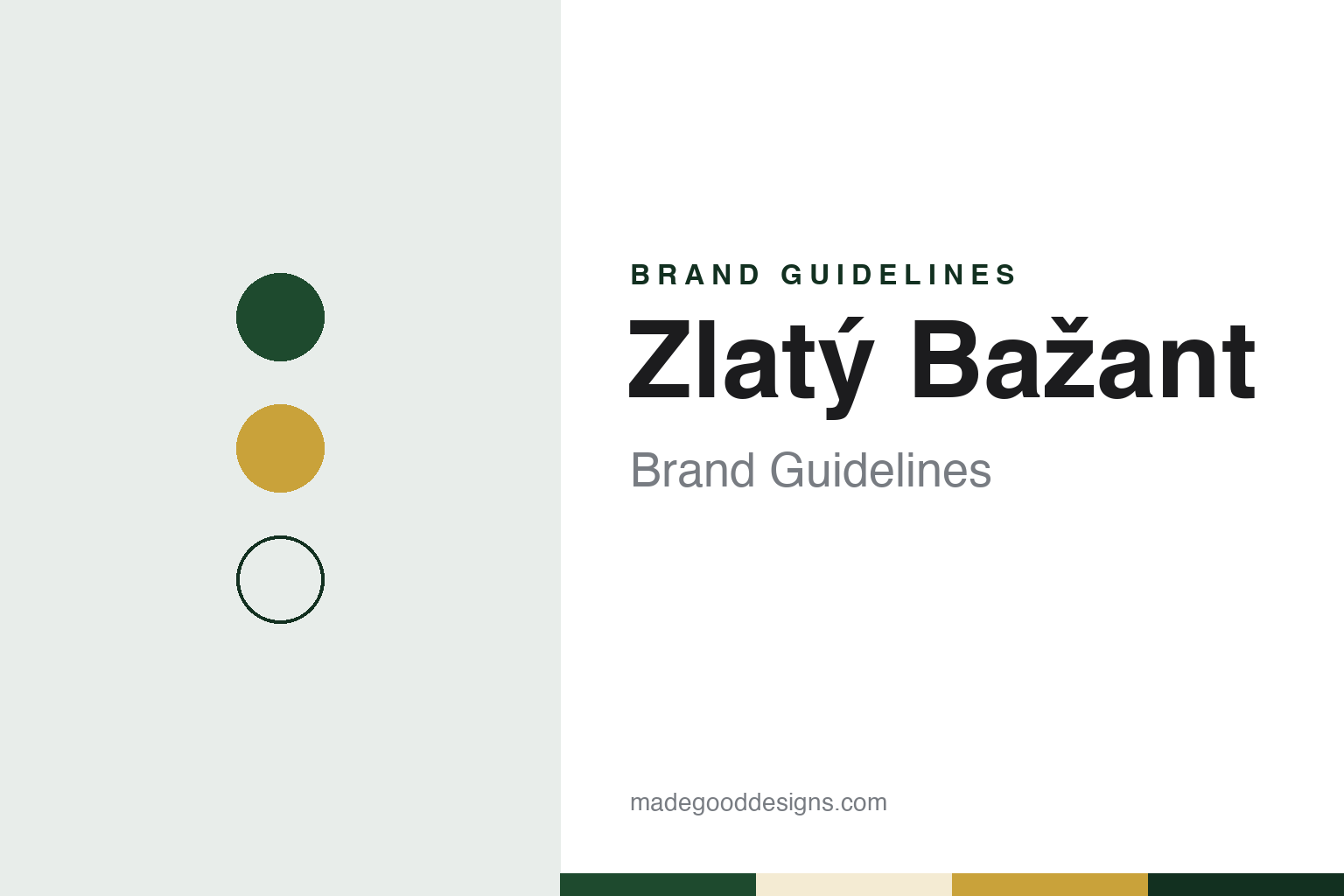
Zlatý Bažant Brand Guidelines
The golden pheasant lager brewed in Hurbanovo.
Aa
Two constants: a bottle green, pheasant gold and barley cream palette and a classic label serif register. Abstract homage — not a Zlatý Bažant product or mark; no bottle, label or logo is reproduced.
Hurbanovské pivo
A new brewery, a malthouse and a bird.
Zlatý Bažant — Slovak for “golden pheasant” — is brewed in Hurbanovo, a small town in southern Slovakia between the Žitava and Nitra rivers. The brewery was not built around an old family business. Slovak Wikipedia says the Hurbanovo brewery was founded on 1 November 1964, chosen for the climatic and strategic conditions of the region, and that its malthouse was completed in 1967. The company today says the foundation stone of the brewery and malthouse was laid in 1964, that the malthouse opened in 1967 with a capacity of up to 35,000 tonnes of malt a year, and that Hurbanovo was picked as the warmest place in Czechoslovakia and ideal for growing barley.
The beer followed the brewery. Slovak Wikipedia says Zlatý Bažant began to be brewed shortly after the brewery was completed in 1969, the year English Wikipedia also gives for the brand, and that the beer was first called simply Hurbanovské pivo, “Hurbanovo beer,” before it was renamed. It explains the new name by the many pheasants in the countryside around Hurbanovo, and links the golden pheasant, a relative of the common pheasant that lives mainly in China, to the beer through its golden colour. The company says the brewery’s own malthouse let it control the main ingredient “from a barley grain to a dewy glass of beer,” and that the right to distribute the beer across Czechoslovakia made Hurbanovo one of the country’s most significant breweries.
Slovak Wikipedia adds that Zlatý Bažant quickly found a following beyond Slovakia and, together with Pilsner Urquell and Budějovický Budvar, made a significant contribution to Czechoslovakia’s beer exports.
Colour
Cans, a green bottle and a new label.
The brand’s first claim to novelty was its packaging. In 1971, Slovak Wikipedia says, Zlatý Bažant began to be sold in cans, thanks to the first line in Czechoslovakia able to fill beer into them; the company calls it the first canning line in the Eastern Bloc and says the beer went not only to shops but to embassies, aircraft and express trains. Slovak Wikipedia adds that the cans went with Slovak mountaineers to the Himalayas, and the company says a can travelled into orbit with the crew of Soyuz 29 in 1978. By 1977, the company says, the beer was exported to twelve countries in Europe, Africa and Asia.
Its look has been reworked several times. The Slovak Spectator reported in January 2000 that the label had been given a makeover after Heineken bought the brand in 1995, and quoted Heineken Slovakia’s marketing manager saying that consumers had seen new labels and a more consistent taste since the takeover, along with a stronger presence at events and festivals. In 2001 the brand moved into a new green bottle of its own design, which Slovak Wikipedia says broke up a market of standard beer bottles; the company says Zlatý Bažant 12% was also the first beer on the Slovak market sold with a twist-off cap. The company dates a new label, with a golden collar on the neck of the green bottle, to 2008, and a further brand redesign to 2015, which it says paid tribute to the brewer’s craft and returned the brand to its roots in Hurbanovo, under the toast “Na zdravie, Slovensko” — “Cheers, Slovakia.”
The range has widened around the core lager. Slovak Wikipedia says the brewery made a non-alcoholic beer, Pito, from the 1980s; the company says Zlatý Bažant Nealko followed in 1997 and was replaced in 2018 by Zlatý Bažant 0.0%. Since 2007 the brewery has released seasonal specials such as a wheat beer and a porter, and on 1 April 2011 it launched Bažant Radler, a beer and lemon drink. In April 2016 came Zlatý Bažant ’73, a lager in retro dress that Slovak Wikipedia says was inspired by the oldest surviving brewing sheet for the beer, dated 16 April 1973.
Typography
Design and documentation.
The seven brands in this group all make food or drink, and all of them come from the Czech Republic or Slovakia: Opavia, Budvar, Kozel, Mattoni, Horalky, Figaro and Zlatý Bažant. Czech and Slovak food and drink brands in general sit at many different points in the trade, from names that still belong to the town or company where they began to names that now belong to much larger international groups, and a single brand can be sold everywhere from a village shop to a supermarket shelf abroad.
A food or drink brand’s identity is usually carried less by a single product than by a pack, a name and the taste or moment it promises, because the company behind the name may have changed hands, moved production or grown far beyond the place where it started. That makes the questions behind each name worth asking plainly: who started it, who owns it now, and where its products are actually made and packed.
Each guide separates what independent sources record from what the company says about itself — its founding story, its owners over time, where its products are made and how its packaging has changed — and marks plainly what rests only on the company’s own word.
Aa
A classic label serif for a lager named after a golden bird. (Specimen set in Playfair Display, a serif STAND-IN; NOT the Zlatý Bažant logo.)
Zlatý Bažant
A Heineken brand that never left Hurbanovo.
Zlatý Bažant has been owned by Heineken since 1995. Slovak Wikipedia says the international brewer announced its intention to invest in the Hurbanovo brewery at the end of that year and gradually raised its output. The Slovak Spectator reported in January 2000 that Heineken had bought Zlatý Bažant in 1995 and the Nitra beer Corgoň in 1997, and that Zlatý Bažant’s share of the Slovak market had grown from 8% at the time of the purchase to 18%, lifting it from fourth to first place among Slovak beers. The same report described a deal signed in December 1999 for majority stakes in the breweries in Martin and Rimavská Sobota, which would give Heineken four breweries in Slovakia.
The beer is still made where it began. The owner today is Heineken Slovensko, part of Heineken N.V., and Slovak Wikipedia lists Zlatý Bažant alongside Corgoň, Kelt, Martiner and Gemer among the brands brewed at Hurbanovo. The company says the beer is brewed exclusively from 100% malt from Hurbanovo; in 2002, it says, a new malthouse was built there with a capacity of 150,000 tonnes a year, and in 2017, on the malthouse’s 50th anniversary, it began promoting that Hurbanovo malt on the brand. In the United States and Canada the beer is sold as Golden Pheasant, a translation of its name, English Wikipedia says, citing a Canadian trademark record and a Canadian distributor.
The brand also has a public life away from the bottle. English Wikipedia, citing The Slovak Spectator, says the Slovak business daily Hospodárske noviny named Zlatý Bažant the top Slovak trademark in a 2008 review. Slovak Wikipedia links the brand to cultural events including the Bažant Pohoda music festival and Bažant Kinematograf film screenings, and says it has long supported Slovak film.
For a design guide, Zlatý Bažant shows how a new brewery’s beer, a bird’s name and a green bottle with a golden collar became one of Slovakia’s best-known brands. Compare Budvar, the České Budějovice lager it once shared Czechoslovakia’s export trade with, and Kozel, the Velké Popovice beer. For this guide we use bottle green, pheasant gold and barley cream with a classic serif, an unofficial interpretation; no product or logo is reproduced.
Explore & save
Keep Zlatý Bažant’s identity on hand — save it to a board in the Made Good inspiration library.
Zlatý Bažant identity set
Pin the Zlatý Bažant bottle green, pheasant gold and barley cream palette and the classic label serif register to your own board.