Goplana Brand Guidelines
Poznań’s chocolate factory named after a lake nymph.
Aa
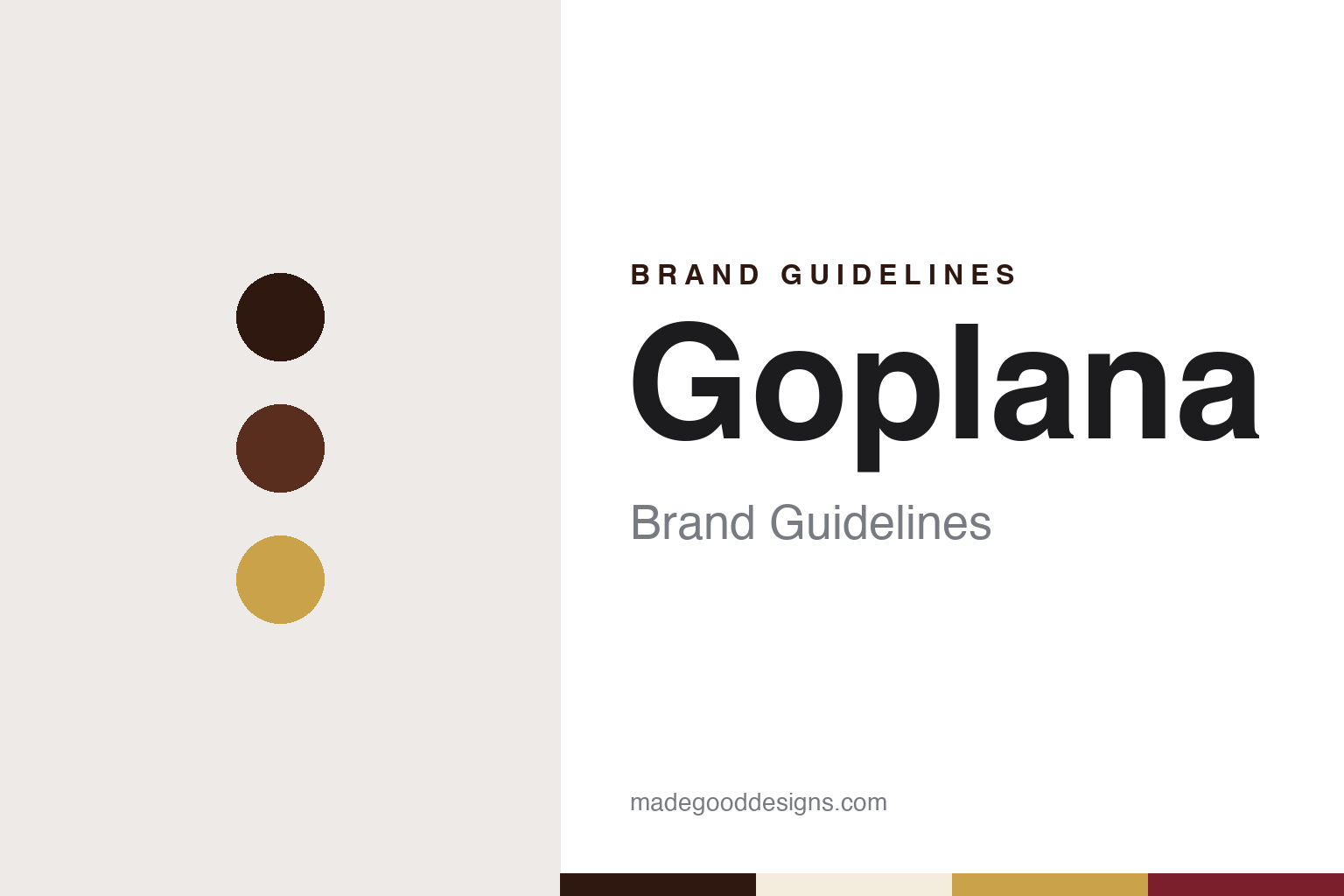
Two constants: a cocoa brown, foil gold and cream palette and a heritage display serif register. Abstract homage — not a Goplana product or mark; no pack, logo or bar is reproduced.
Luna, Gonda, Goplana
Three names in two years, and a nymph from Lake Gopło.
Goplana took three attempts to arrive at its name. Polish Wikipedia, citing a history of the factory published by Jadwiga Perzyna in the Kronika Miasta Poznania in 1970, says that on 22 April 1911 Janusz and Wiesław Wilkoński founded the Poznań Chocolate Factory “Luna” as a limited company. In December 1911 it was renamed “Gonda.” On 17 July 1913 Tadeusz Prądzyński joined as a partner and the name changed again, to Poznańska Fabryka Czekolady “Goplana.” Poznań was then part of the German Empire, and Iwona Kienzler’s 2015 book on Polish cult brands, cited by Polish Wikipedia, says the new name was meant to stress the factory’s regional and national character and to encourage Poles to buy its products. Goplana is the water nymph of Lake Gopło, best known from Juliusz Słowacki’s 1839 play Balladyna. The company itself counts its history from 1912, and that is the year it uses today.
The first factory was small: a single-storey building on Warszawska Street, on a site now taken by the Śródka roundabout. It made hard chocolate in tablets, chocolate pastilles, cocoa and marzipan, with about thirty workers, most of them women, and an output Perzyna put at around a hundred tonnes a year. The First World War made cocoa scarce, so the factory turned to fondant sweets.
In 1921 Goplana was re-formed as a joint-stock company and bought land on Święty Wawrzyniec Street in the Jeżyce district, where a large new factory was finished by 1925. The range widened year by year, Polish Wikipedia says: caramels, drops and toffees from 1928, biscuits, sponge cakes and gingerbread from 1931, dragées from 1934 and wafers from 1935. In 1931 the company opened its first factory shop in Poznań, and by the early 1970s there were 70 of them across Poland, according to Colian’s history of the site.
Colour
War, nationalisation and two hundred lines.
The German occupation took Goplana away from its owners. Polish Wikipedia says the plant was seized on 9 October 1939 and in September 1940 sold to Kaisers Kaffeegeschäft of Viersen, which renamed it “Gotana” and turned production over to supplies for the front. In February 1945, while the battle for Poznań was still being fought, a group of former employees took over the factory and secured it, and within days they were boiling caramels over open fires, without electricity.
The factory was nationalised on 1 January 1946 as Chocolate, Sugar and Cake Factory No. 1 “Goplana.” It went through a series of state groupings: an association with factories in Kargowa and Poznań from 1949, independence as the Goplana confectionery works from 1951, a merger with the Rywal sweet factory in Leszno in 1966 and, from 1967, a combined Greater Poland and Lubusz confectionery works. Under the Three-Year Plan the Jeżyce site expanded onto neighbouring land, including a former vodka distillery, and a new production building went up between 1964 and 1966. By the end of 1969 Goplana employed 1,530 people, Perzyna recorded.
By the late 1960s the factory made more than two hundred products, Polish Wikipedia says, among them “Goplanki” and the very popular “Bé-Bé” biscuits and caramels named after apricots, lemons and roses. Between 1959 and 1969 its products won 12 medals and 62 diplomas at the Poznań International Fair. The first export order came in 1956: Colian’s history of the site says it was 187 tonnes of biscuits for Sudan. Colian also says that about 40% of Goplana’s output was still sold in Poznań and Greater Poland, even as its distribution reached the whole country.
Typography
Design and documentation.
The seven brands in this group all make food or drink, and all of them come from Poland: Goplana, Mlekovita, Łowicz, Krakus, Żywiec, Kubuś and Winiary. Polish food and drink brands in general sit at many different points in the trade, from cooperatives and family firms to names that now belong to much larger food groups, and a single brand can be sold everywhere from a corner shop to a supermarket shelf.
A food or drink brand’s identity is usually carried less by a single product than by a pack, a name and the meal or moment it promises, because the company behind the name may have changed hands, moved its factory or grown far beyond the town where it started. That makes the questions behind each name worth asking plainly: who started it, who owns it now, and where its products are actually made and packed.
Each guide separates what independent sources record from what the company says about itself — its founding story, its owners over time, where its products are made and how its packaging has changed — and marks plainly what rests only on the company’s own word.
Aa
A heritage display serif for a Poznań chocolate name of 1913. (Specimen set in DM Serif Display, a serif STAND-IN; NOT the Goplana logo.)
Goplana
Nestlé, Jutrzenka, Colian and a housing estate.
After the political changes of 1989 Goplana was privatised and bought by Nestlé; Polish Wikipedia’s article on Nestlé dates that ownership from 1994. In 2004 the Bydgoszcz confectioner Jutrzenka bought the Goplana factory and brand from Nestlé, Polish Wikipedia says, citing the group’s own history. Jutrzenka was then controlled by Jan Kolański, whose family had started the herb and spice firm Ziołopex near Kalisz in 1990. The group added the Grześki wafers in 2005, moved its head office to Opatówek near Kalisz in 2008, renamed itself Colian in 2011 and became Colian Holding in 2014. Colian describes Goplana as a brand with Greater Poland roots that brought chocolate into its portfolio. Its other names now include Jutrzenka, Solidarność, Elizabeth Shaw and Ireland’s Lily O’Brien’s, and the group says it exports to 70 countries.
Today the Goplana name sits on a compact range. The brand’s own site lists milk and dark chocolate bars, square pralines with soft fillings including a hand-packed Golden Collection, Toffino toffees with a chocolate centre and Mella jellies coated in chocolate. Its line is “Przyjemności słodko smakują i dobrze się dzielą” — pleasures taste sweet and are good to share.
The Jeżyce factory itself closed at the end of 2017, after more than nine decades on Święty Wawrzyniec Street; English Wikipedia, citing local press, gives traffic for lorries, nuisance to neighbours and city costs as reasons for leaving the city-centre site. Colian’s property arm has since turned it into a housing estate called Goplana, keeping the historic chocolate building. Colian Developer says archive Goplana packs are part of the history of Polish industrial design, and that the estate’s illustrations draw on those packs and on the graphic language of the 1950s and 1960s. It also says the estate won Poznań’s Architectus Civitatis Nostrae award in 2024.
For a design guide, Goplana shows how a national-minded name chosen in 1913 can outlast its owners, its factory and its street. Compare E. Wedel, Warsaw’s chocolate house of 1851, and Wawel, Kraków’s chocolate maker since 1898. For this guide we use cocoa brown, a foil gold and cream with a display serif, an unofficial interpretation; no product or logo is reproduced.
Explore & save
Keep Goplana’s identity on hand — save it to a board in the Made Good inspiration library.
Goplana identity set
Pin the Goplana cocoa brown, foil gold and cream palette and the heritage display serif register to your own board.