Żywiec Brand Guidelines
The Habsburg brewery whose beer is sold under a dancing Kraków couple.
Aa
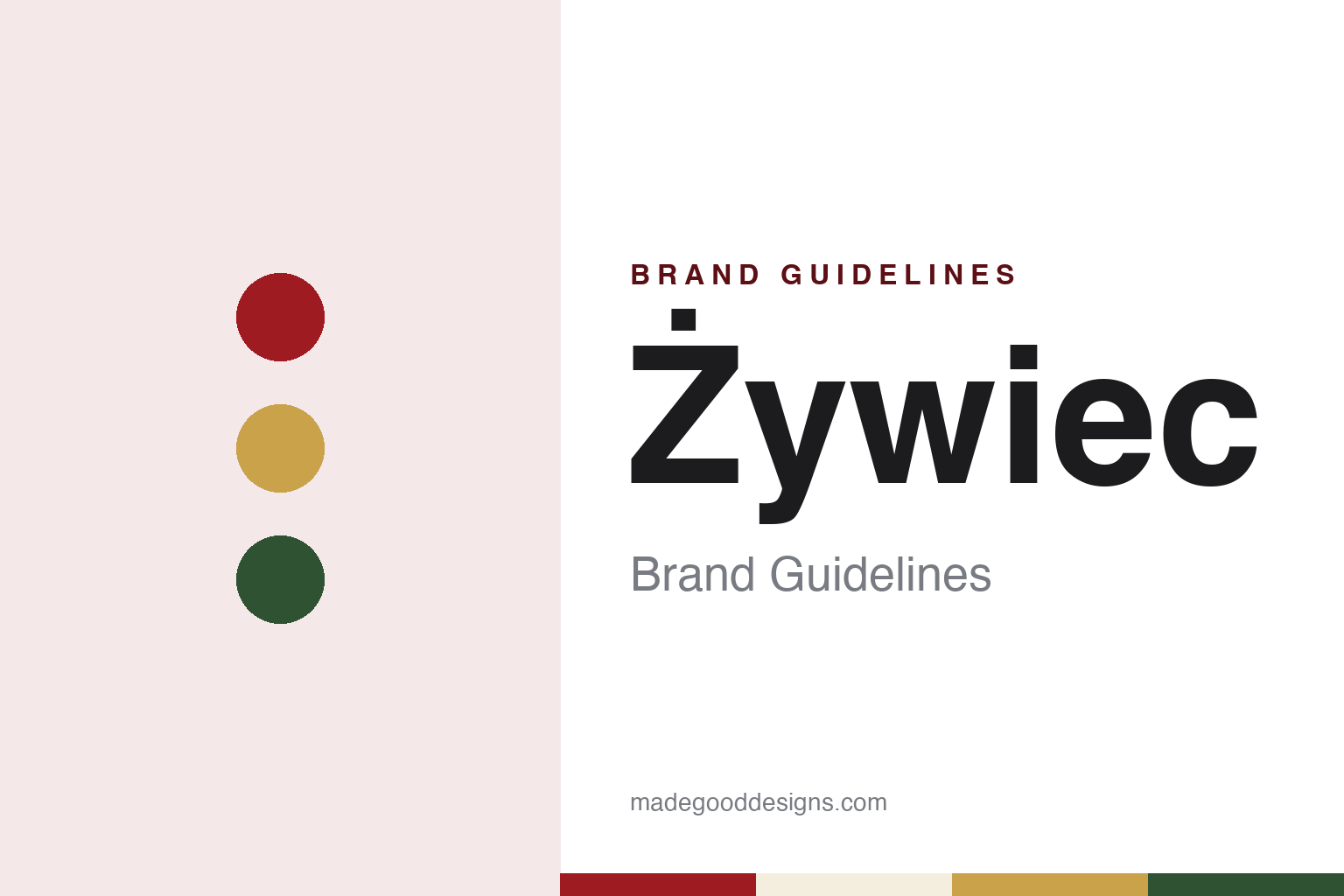
Two constants: a Żywiec red, gold and spruce green palette and a heritage serif register. Abstract homage — not a Żywiec product or mark; no bottle, label, crown or dancing couple is reproduced.
The archduke’s brewery
A Habsburg estate, a mountain spring and a registration date.
Żywiec beer comes from a brewery founded by a Habsburg. Polish Wikipedia, drawing on the brewery histories written by Adam Spyra and Grzegorz Zwierzyna, says the brewery in Żywiec, a town in the Beskid foothills of southern Poland, was built on the initiative of Archduke Albrecht Friedrich Habsburg, Duke of Teschen and owner of the Żywiec estate, who had already founded a brewery in Cieszyn. The foundation stone was laid on 16 June 1852 on land belonging to the village of Pawlusie, where a distillery had stood, and 1856, the year the business was registered, is taken as the official founding date. By then the site already had a brewhouse, a malt house and fermentation cellars. The architect Karol Pietschka designed its buildings between 1852 and 1891, from the malt house to the boiler house with its tall chimney.
The brewery took its water from springs feeding the Leśnianka stream below Skrzyczne mountain, and it grew quickly. Polish Wikipedia says it brewed 17,856 hectolitres in 1857 and that, twelve years later, it had doubled its output and become the largest of 260 breweries then working in Galicia. It brewed bottom-fermented beers from the start, both pale and dark; it added a Porter in 1881, from a recipe by the brewmaster Juliusz Wagner, and an Ale ten years later. Early beers carried names such as Cesarskie (Imperial), Eksportowe and Marcowe.
Ownership stayed in the family for three generations. In 1895 the brewery passed to Albrecht’s nephew, Archduke Karl Stephan, who added a second brewhouse before the First World War, and in 1933, under his will, to his son Karl Albrecht, known in Poland as Karol Olbracht. After the German invasion of 1939 the brewery was seized and renamed Beskidenbrauerei Saybusch. It survived the war, was taken over by the Polish state under the land-reform decree of 1944 and ran as a state plant from May 1945. English Wikipedia records that descendants of the former owners went to court in the 1990s over the nationalisation and over the use of the family name and arms, and that the case was settled out of court in December 2005.
Colour
A couple in Kraków costume, drawn for America.
The image everyone knows is the dancing couple. Polish Wikipedia’s article on the brewery, citing a company page of 2006, says the label showing a man and a woman dancing in Kraków folk costume was created in 1956 for a new export beer. In the 1950s the brewery had worked with the Fermentation Institute in Warsaw on a method that gave its beer a shelf life of six months, and a Polish emigrant to the United States named Lutom proposed exporting it there. He supervised the label design himself and wanted it to remind the Polish community in America of home, so, although motifs from the Beskids around Żywiec were suggested, he chose the Kraków couple. Polish Wikipedia’s article on the beer itself, citing the Spyra and Zwierzyna history, dates Żywiec Jasne Pełne with the dancing couple on its label to 1955, so the two articles differ by a year. English Wikipedia identifies the dance as the Krakowiak.
The export beer, called Full Light Żywiec Beer, was sold at first only in duty-free shops, on Polish passenger ships and in the United States. A second symbol followed. Polish Wikipedia, citing Agro Przemysł (2009), says three spruce trees, standing for the Beskid forests, appeared as an extra element from 1960 and became the main mark of Krakus, an export beer launched in 1975 at the suggestion of Leon Rubin, head of the American food importer Atalanta Corporation, which had done well importing Krakus ham from Poland. English Wikipedia lists the spruce trees, the year 1856 beneath a crown and a red sash carrying the Żywiec name among the elements of the present label.
Today’s Żywiec lager descends from Zdrój Żywiecki, a pale beer launched in 1918, Polish Wikipedia says. In May 2011 Grupa Żywiec introduced a new bottle with motifs engraved in the glass that refer to the beer’s archducal heritage, portalspożywczy.pl reported. The brand has a long advertising record, from pre-war posters and leaflets to a campaign built on the line “Prawie robi wielką różnicę” (“Almost makes a big difference”), which Rzeczpospolita described in 2008. English Wikipedia credits the brewery with starting Męskie Granie, a touring concert series.
Typography
Design and documentation.
The seven brands in this group all make food or drink, and all of them come from Poland: Goplana, Mlekovita, Łowicz, Krakus, Żywiec, Kubuś and Winiary. Polish food and drink brands in general sit at many different points in the trade, from cooperatives and family firms to names that now belong to much larger food groups, and a single brand can be sold everywhere from a corner shop to a supermarket shelf.
A food or drink brand’s identity is usually carried less by a single product than by a pack, a name and the meal or moment it promises, because the company behind the name may have changed hands, moved its factory or grown far beyond the town where it started. That makes the questions behind each name worth asking plainly: who started it, who owns it now, and where its products are actually made and packed.
Each guide separates what independent sources record from what the company says about itself — its founding story, its owners over time, where its products are made and how its packaging has changed — and marks plainly what rests only on the company’s own word.
Aa
A heritage serif for a brewery founded under the Habsburgs. (Specimen set in Playfair Display, a serif STAND-IN; NOT the Żywiec logo.)
Żywiec
A state brewery, a stock listing and a Dutch owner.
The modern company took shape after communism. On 31 December 1990 the brewery became a state-owned joint-stock company, Zakłady Piwowarskie w Żywcu; it made its debut on the Warsaw Stock Exchange on 24 September 1991, and in July 1992 more than 70 percent of its shares were sold in a public offering, Polityka reported in 2000. In 1994 the Dutch brewer Heineken became its main shareholder, according to Rzeczpospolita. In December 1998 the Żywiec company merged with Brewpole, which owned breweries in Elbląg, Leżajsk, Warka and elsewhere, to form Grupa Żywiec. The group’s shares were listed in Warsaw until 2023, when Heineken bought out the remaining shareholders, Bankier.pl reported in January that year, and Polish Wikipedia gives Heineken as the sole owner.
Żywiec beer is brewed only at the brewery in Żywiec, Polish Wikipedia says, and it lists the same site as brewing Warka, Tatra, Heineken and Desperados. The group’s other active breweries are in Elbląg and Warka, and in 2025 it announced that it would close the brewery at Namysłów in 2026, Notes from Poland reported. The range under the Żywiec name has grown beyond the pale lager to include Żywiec Porter, Żywiec Bock, Żywiec Białe and several IPA and APA beers, Polish Wikipedia’s list of the group’s brands shows. Żywiec was exported to more than 40 countries, chiefly the United States, Germany, the United Kingdom, France and Canada, Dziennik Gazeta Prawna and portalspożywczy.pl reported in 2011.
For a design guide, Żywiec shows how a single folk image, chosen in the 1950s to speak to emigrants, can carry a brewery founded under an archduke through German occupation, state ownership and a Dutch takeover. Compare Wawel, the Kraków chocolate maker, and Goplana, another long-lived Polish name. For this guide we use a sash red, a crown gold and a Beskid spruce green with a serif, an unofficial interpretation; no product or logo is reproduced.
Explore & save
Keep Żywiec’s identity on hand — save it to a board in the Made Good inspiration library.
Żywiec identity set
Pin the Żywiec sash red, crown gold and Beskid spruce palette and the heritage serif register to your own board.