Rémy Martin Brand Guidelines
The 1724 Cognac house of the centaur.
Aa
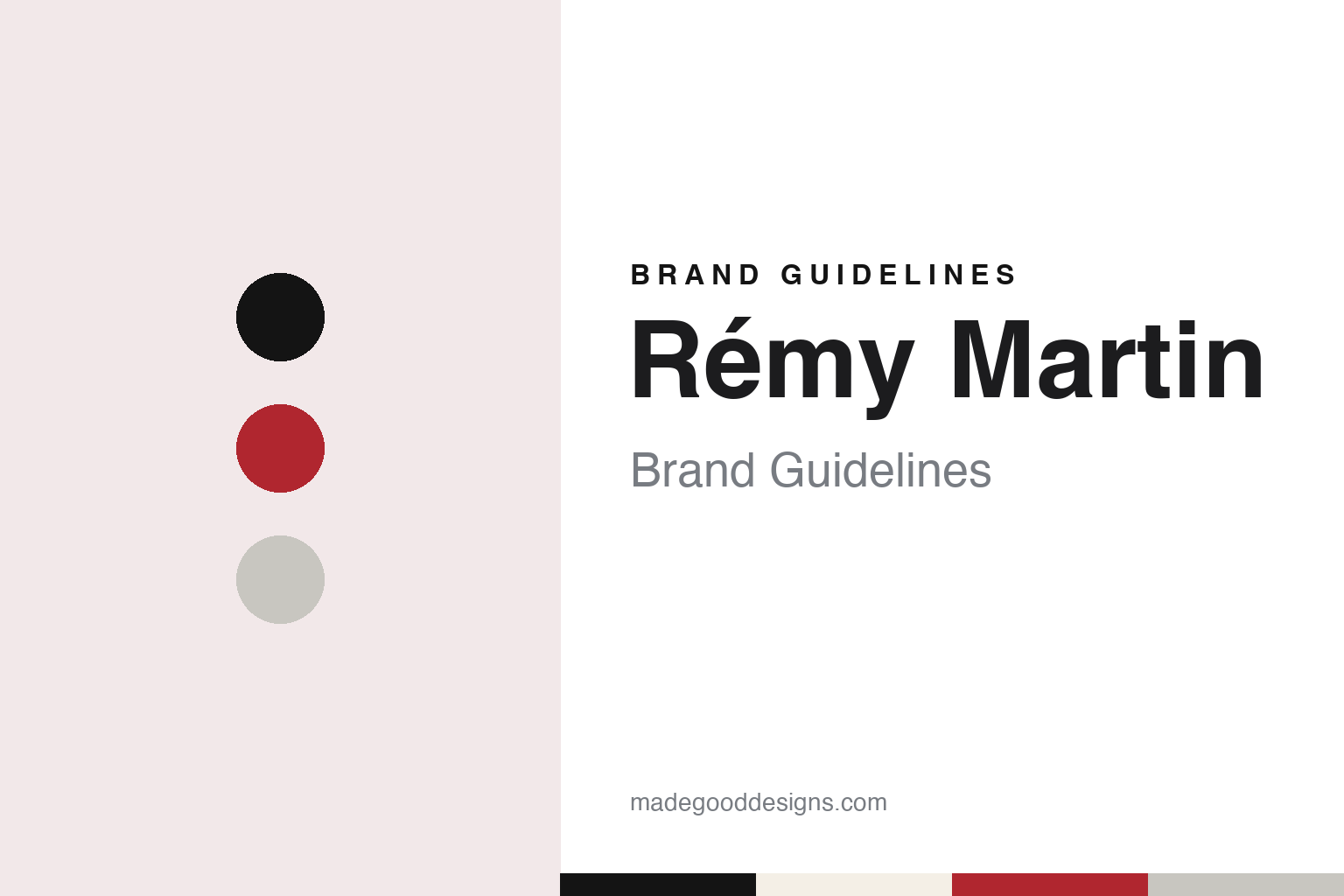
Two constants: a cellar black, centaur red and frosted grey palette and a classic old-style serif register. Abstract homage — not a Rémy Martin product or mark; no bottle, label or logo is reproduced.
A centaur in Cognac
A vintner, a grandson and a man-headed horse.
Rémy Martin is one of the oldest cognac houses still trading. English and French Wikipedia, citing the Dictionnaire biographique des Charentais (2005), say its founder, Rémy Martin, was born in 1695 near Rouillac, in the Charente, worked as a vintner and in 1724 set up a house trading in Charente eau-de-vie. In 1773 the business passed to his grandson, also called Rémy. The house is still based in the town of Cognac, and the Oxford Companion to Spirits and Cocktails (2021) counts it among the “big four” cognac houses, with Hennessy, Courvoisier and Martell, that together make most of the world’s cognac.
The brand’s modern shape came under Paul-Emile Rémy Martin, who took control in 1841. A history of the house by Thomas Laurenceau (1991), cited by English Wikipedia, says he began selling the cognacs under the family name and bottling them rather than selling them only by the barrel. He also gave the house its emblem, a centaur. English Wikipedia says he chose it after Sagittarius, his own zodiac sign, and put it on bottles and cases; French Wikipedia dates the adoption of the centaur as the logo to 1870. In China the brand is known as réntóumă, “man-headed horse,” English Wikipedia says.
The house’s most elaborate object also dates from Paul-Emile’s time. In 1850, Laurenceau writes, he came across a metal flask recovered from the site of the Battle of Jarnac (1569), bought it and registered the rights to reproduce it. In 1874, for the house’s 150th anniversary, he had a glass replica made to hold his best Grande Champagne cognac, first sold as “Grande Champagne Very Old – Age Unknown” and later known as Louis XIII. The decanters are now made by hand in crystal by French makers including Baccarat and Saint-Louis, Town & Country reported in 2016.
Colour
Fine Champagne, VSOP and a frosted bottle.
In the twentieth century the house was led by a family connected by marriage. André Renaud, a lawyer and merchant who had been a partner in E. Rémy Martin & Co since 1910, took charge between the wars, the Charente biographical dictionary says; English Wikipedia’s article on the parent group, citing Le Point (2022), says Renaud bought the house in 1924. In 1927 the brand launched its VSOP Fine Champagne, which English Wikipedia calls the best-selling VSOP cognac in the world.
Renaud also set the rule that still defines the range. Since 1948, French Wikipedia says, Rémy Martin has blended all its cognacs from the two central crus of the Cognac region, Grande Champagne and Petite Champagne. Under the Fine Champagne appellation the eaux-de-vie must come only from those two crus, with at least 50% Grande Champagne. To secure supply, Renaud’s son-in-law André Hériard Dubreuil set up the Alliance Fine Champagne cooperative in the 1960s; it brings together close to a thousand growers and supplies nearly 90% of the house’s eaux-de-vie, the regional daily Sud Ouest reported in 2016. Both Wikipedias say the house distils on the lees in small copper stills and ages its spirits in Limousin oak.
The bottles became part of the identity. The VSOP’s frosted bottle was introduced in 1972, according to English and French Wikipedia. Cellar master André Giraud created the XO in 1981, a blend of up to 400 eaux-de-vie. CLUB, made for China from 1986, has an octagonal bottle, and in 2015, Rémy Martin and its partner Selinko said in a Business Wire release, it became the first spirits bottle with high-security NFC technology, letting buyers check its authenticity with a phone. 1738 Accord Royal, launched in 1997, is named for a royal grant Louis XV gave the house in 1738. Artists have been drawn in too: English Wikipedia says the photographer David LaChapelle designed a bottle in 2008, and in 2015 Louis XIII made a film with the actor John Malkovich and the director Robert Rodriguez, 100 Years, which is not due to be released until 2115, Adweek reported.
Typography
Design and documentation.
The seven brands in this group are all cognac and champagne names: Rémy Martin, Martell, Courvoisier, Moët & Chandon, Veuve Clicquot, Dom Pérignon and Bollinger. Cognac and champagne brands in general sit at many different points in the trade, from family houses that still carry a founder’s name to names that now belong to much larger drinks groups, and a single brand can be sold everywhere from a wine merchant to an airport shop.
A cognac or champagne brand’s identity is usually carried less by a single bottle than by a label, a name and the place it comes from, because the company behind the name may have changed hands, bought vineyards or grown far beyond the town where it started. That makes the questions behind each name worth asking plainly: who started it, who owns it now, and where its wines and spirits are actually made.
Each guide separates what independent sources record from what the company says about itself — its founding story, its owners over time, where its wines and spirits are made and how its bottles and labels have changed — and marks plainly what rests only on the company’s own word.
Aa
A classic old-style serif for a house that dates from 1724. (Specimen set in Cormorant Garamond, a serif STAND-IN; NOT the Rémy Martin logo.)
Rémy Martin
A family house inside a listed group.
Rémy Martin has stayed with the same family since the war. André Hériard Dubreuil became president in 1965, Les Echos reported, and his children joined him; his daughter Dominique Hériard Dubreuil became general manager in 1988. In November 1989 The New York Times reported that Rémy Martin and the liqueur house Cointreau planned to merge. The group that resulted, Rémy Cointreau, gives 1990 as its founding date, and Les Echos reported in December 1991 on the merger of the two sides’ holding companies, Rémy et Associés and Pavis. Dominique Hériard Dubreuil chaired the group’s executive board from 2001 to 2013, when she handed over to her brother François, the trade magazine Rayon Boissons reported.
Today the house is the cognac arm of Rémy Cointreau, which is listed on Euronext Paris, has the Hériard Dubreuil family as its main shareholder and is based in Cognac. Its sister brands include Cointreau, the Greek spirit Metaxa and the Barbados rum Mount Gay. Its cognacs carry the Cognac Fine Champagne appellation, which ties them to the Grande and Petite Champagne crus around the town. Its cellar masters have included André Renaud, André Giraud, Georges Clot and Pierrette Trichet, followed in 2014 by Baptiste Loiseau, then 34, the wine magazine Terre de Vins reported. Rémy Martin is a member of the Comité Colbert, the association of French luxury houses.
For a design guide, Rémy Martin shows how one emblem, a centaur, and a few bottle shapes, from the frosted VSOP to the Louis XIII decanter, can carry a house through three centuries. For its typography see our guide to what font Rémy Martin uses. Compare Martell, the oldest of the big four houses, and Mount Gay, its sister brand in the Rémy Cointreau group. For this guide we use a cellar black, a centaur red and a frosted-glass grey with a classic serif, an unofficial interpretation; no product or logo is reproduced.
Explore & save
Keep Rémy Martin’s identity on hand — save it to a board in the Made Good inspiration library.
Rémy Martin identity set
Pin the Rémy Martin cellar black, centaur red and frosted grey palette and the classic old-style serif register to your own board.