Cockburn’s Brand Guidelines
The 1815 Port house behind Special Reserve.
Aa
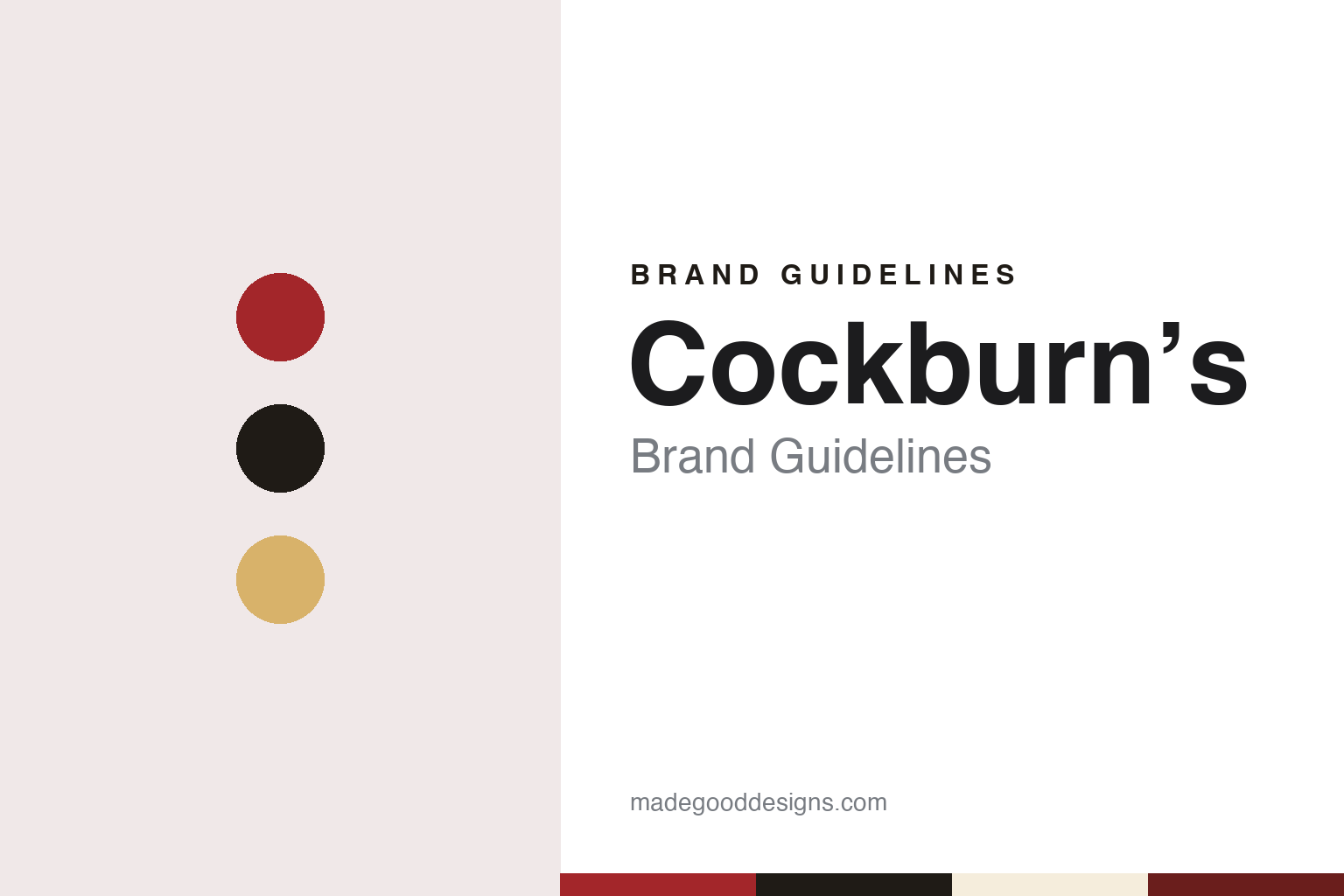
Two constants: a cockerel red, oxblood and archive cream palette and a high-contrast display serif register. Abstract homage — not a Cockburn’s product or mark; no label, logo or bottle is reproduced.
A Scot in Porto
From a soldier of the Peninsular War to Cockburn Smithes.
Cockburn’s was founded in 1815 by Robert Cockburn, a Scot. English Wikipedia says he had first seen Portugal as a soldier serving under Wellington in the Napoleonic Wars and returned after the fighting to set up a business of his own in the Port trade. The enthusiast reference site vintageport.se adds that the young firm dealt in wine, dried cod and oil before it concentrated on Port.
Partners soon joined the founding family. The Oxford Companion to Wine says the brothers Henry and John Smithes joined in 1845 and the house became Cockburn Smithes & Co.; vintageport.se dates the new name to 1854. The same site says members of the Cockburn, Smithes and Cobb families held leading roles in the firm until 1999.
The family era ended in the early 1960s. English Wikipedia and vintageport.se say the company was sold to Harveys of Bristol in 1962 (some accounts give 1963). Harveys was itself absorbed into larger groups, and Cockburn’s passed with it through Allied Breweries, Allied-Lyons and Allied Domecq. When Pernod Ricard took over Allied Domecq in 2005, English Wikipedia says, it sold Cockburn’s to Fortune Brands, the parent of Beam Global.
The return to family ownership came in two steps. According to vintageport.se, the Symington family took over Cockburn’s vineyards and lodges in 2006 while Beam kept the brand and the company name, and Difford’s Guide says Symington Family Estates completed its acquisition of Cockburn’s Port from Beam Global on 15 December 2010. English Wikipedia describes the buyer as a family-owned business with more than 1,000 hectares of vineyards in the Douro Valley; the same family also owns Graham’s and Dow’s.
Colour
A branded ruby, two relaunches and a pair of cockerels.
The wine that made the name familiar beyond the Port trade was Special Reserve. Jancis Robinson, writing in 2012 in an article titled “Reviving Cockburn,” said it was launched in 1969, when the Babycham maker Showerings of Shepton Mallet had taken over Harveys of Bristol and wanted a Port to sit beside the group’s sherry, Harveys Bristol Cream. Robinson wrote that Special Reserve rapidly became the world’s best-selling Port, helped by heavy advertising, including on television, and by deals with large retailers and distributors.
That success shaped the reputation the Symingtons inherited. Robinson wrote that the family was determined to move Cockburn’s back from the mass market towards fine wine.
The first design step came soon after the purchase. Glass Online reported in September 2011 that Symington Family Estates had appointed the design agency Bloom late in 2010 to redesign the bottle and label for a global relaunch that autumn, covering Special Reserve, the Late Bottled Vintage, the aged tawnies, the vintage Ports and the single-quinta Quinta dos Canais, and Design Week reported the rebrand the same month. The Drinks Business reported in July 2011 that the new look would draw on design cues from the first Special Reserve of 1969, with Paul Symington describing the aim as reinventing that original version.
A second refresh marked fifty years of Special Reserve. Harper’s reported on 4 September 2019 that Fine Ruby, Fine Tawny, Fine White and Special Reserve were moving to new bottles and labels inspired by early-20th-century labels in the Cockburn’s archive. The new artwork showed two cockerels sharing a glass of Port, with the strapline “Welcome to the Family,” a reference to the return to family ownership, and the white Port was renamed Porto Branco, The Drinks Business also reported. vintageport.se describes the house’s cockerel crest as a symbol of the company.
Typography
Design and documentation.
The seven brands in this group are all port and sherry names: Sandeman, Graham’s, Taylor’s, Cockburn’s, Dow’s, Tío Pepe and Harveys. Port and sherry brands in general sit at many different points in the trade, from family houses that still carry a founder’s name to labels that now belong to much larger drinks groups, and a single brand can be sold everywhere from a corner shop to a restaurant list.
A port or sherry brand’s identity is usually carried less by a single bottle than by a label, a name and the place it promises, because the company behind the name may have changed hands, moved its production or grown far beyond the place where it started. That makes the questions behind each name worth asking plainly: who started it, who owns it now, and where its wine is actually made, aged and bottled.
Each guide separates what independent sources record from what the company says about itself — its founding story, its owners over time, where its wine is made and how its labels have changed — and marks plainly what rests only on the company’s own word.
Aa
A high-contrast display serif for a 19th-century Port label. (Specimen set in Playfair Display, a serif STAND-IN; NOT the Cockburn’s logo.)
Cockburn’s
A bicentenary, an open lodge and a family owner.
Cockburn’s marked its bicentenary in 2015 with what Harper’s called a year of celebrations, and The Moodie Davitt Report covered bicentenary gift editions for travel retail. In June that year the house opened its lodge in Vila Nova de Gaia to visitors, showing a working Port cellar with its own coopers, according to the Port guide For the Love of Port, which says the lodge holds the largest collection of oak casks and wooden vats of any Port cellar in Gaia’s historic area.
Under Symington ownership the brand sits in a portfolio of Port houses run by one family from the Douro, alongside Graham’s and Dow’s, while the single-quinta wine Quinta dos Canais carries the name of a Douro property linked to the house’s vintage Ports. The range reaches from Fine Ruby and Special Reserve to aged tawnies, Late Bottled Vintage and vintage Port.
The brand is written Cockburn’s, with the apostrophe, and the house’s own site is cockburns.com.
For a design guide, Cockburn’s shows how a Port house can step back from a mass-market chapter by mining its own archive, first for the 1969 Special Reserve and then for early-20th-century labels and a pair of cockerels. Compare Taylor’s, the Port house founded in 1692, and Sandeman, another Port name from the riverbank in Gaia. For this guide we use cockerel red, oxblood and archive cream with a serif, an unofficial interpretation; no product or logo is reproduced.
Explore & save
Keep Cockburn’s’s identity on hand — save it to a board in the Made Good inspiration library.
Cockburn’s identity set
Pin the Cockburn’s cockerel red, oxblood and archive cream palette and the high-contrast display serif register to your own board.