Gosling’s Brand Guidelines
The Bermuda Black Seal rum family of 1806.
Aa
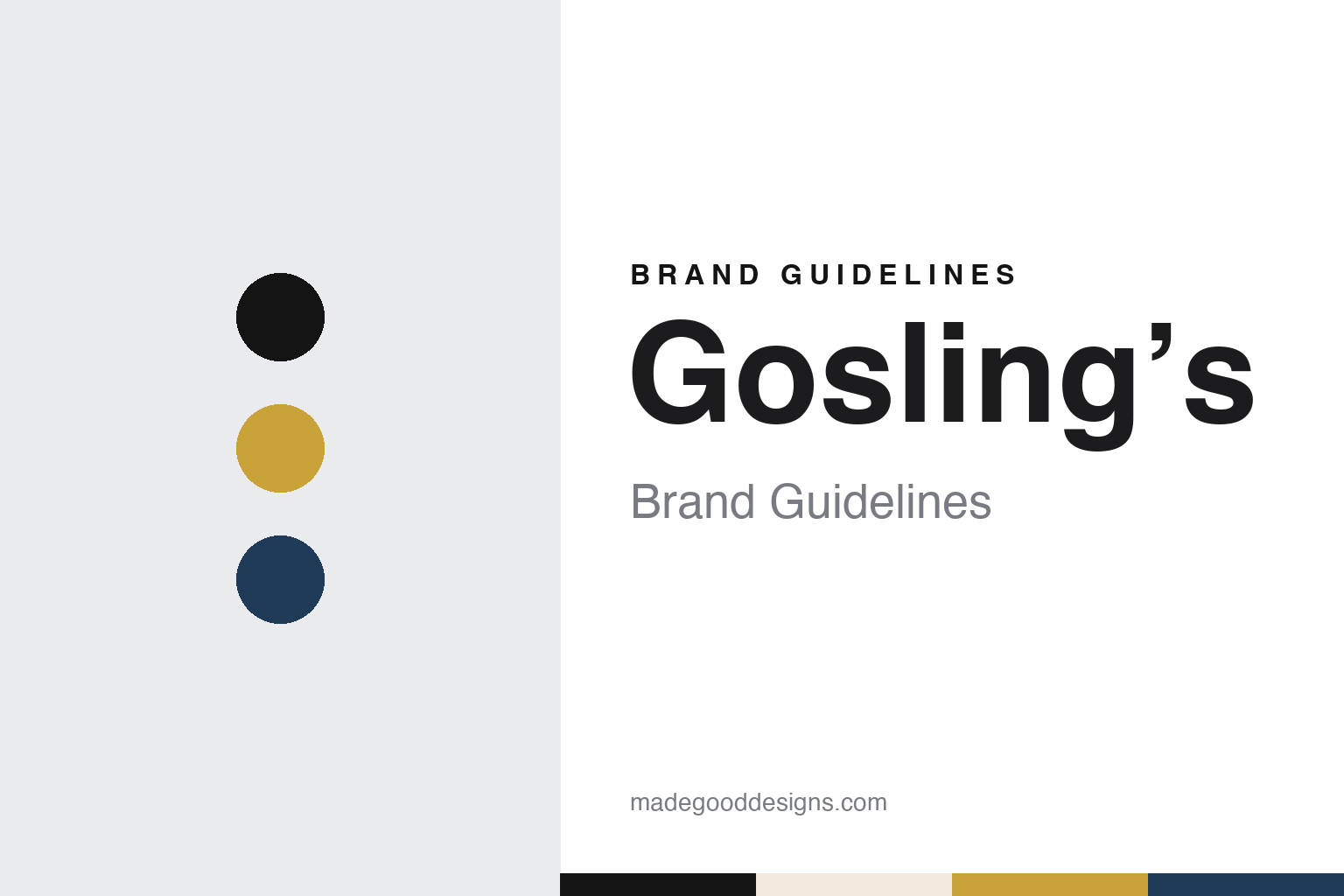
Two constants: a wax black, harbour blue and ginger gold palette and an old-style serif register. Abstract homage — not a Gosling’s product or mark; no seal, label or bottle is reproduced.
Becalmed into Bermuda
A merchant’s son bound for America, and a charter that ran out.
Gosling’s is a Bermuda rum business, and its founding story is a story of a voyage that went wrong. The company says that in 1806 James Gosling, the eldest son of the wine and spirits merchant William Gosling, sailed from Gravesend in Kent for America with a cargo of goods. After ninety-one days on the ship Mercury, much of it on becalmed seas, the charter ran out and the ship put into the nearest port, St. George’s, Bermuda. English Wikipedia gives the business’s founding as December 1806 in St. George’s; its headquarters is now in Hamilton.
The business moved with the island’s capital. The company says that in 1824 James and his brother Ambrose opened a shop on Front Street in Hamilton, which had recently become the capital, and that the family kept a store at that address for 127 years. In 1857, the company says, the firm’s name changed from “Gosling and Son” to Gosling Brothers, the name it still trades under, and three years later the first oak barrels of rum distillate arrived in Bermuda for blending.
Blending, not distilling on the island, is the craft the company describes. Its history says the family experimented with blends until it produced a dark rum offered for sale as “Old Rum,” sold from the barrel to customers who brought their own bottles. English Wikipedia, drawing on the company’s own history, says the Goslings began developing rum blends in 1860 and had created Old Rum within three years.
The business has stayed in the family. The company says the seventh generation now runs it, with five members of the eighth generation working for the firm, and it describes itself as a family-owned business “born in 1806 on Bermuda and still thriving today.” The bottles say “Product of Bermuda,” and the company presents the rum as an emblem of the island and of what it now calls leisure.
Colour
A wax seal, then a seal with whiskers.
The brand’s name is a packaging accident. The company says that around the First World War the Goslings began selling Old Rum in champagne bottles reclaimed from the British officers’ mess, with the corks sealed in black sealing wax, and that customers soon asked for “the Black Seal.” English Wikipedia tells the same story of salvaged champagne bottles and black wax. The rum was renamed Black Seal Rum.
The animal came later, as a pun. The company says the seal emblem, an actual seal rather than a wax one, was drawn in 1949 by Francis “Goose” Gosling of the sixth generation, and that only afterwards was Old Rum officially named Goslings Black Seal Rum. Goose Gosling was also an athlete: English Wikipedia, citing the Olympic database Olympedia, records the Bermudian springboard diver Frank Gosling at the London Olympics of 1948 and at Helsinki in 1952.
The spelling has shifted with the brand. Newspapers and English Wikipedia write Gosling’s or Gosling Brothers; the company’s current website and labels write simply Goslings, with the line “The Official Rum of Leisure.”
The cocktail is the other half of the identity. The company says the Dark ’n Stormy was born in Bermuda after the First World War, when British naval officers who ran a ginger beer factory on the island added the local black rum. The family protects the name: the company dates its trademark to June 1980, and English Wikipedia says “Dark ’n Stormy” has been a registered US trademark of Gosling Brothers since 1991, so that a drink can be marketed under that name in the United States only if it is made with Black Seal. The New York Times reported in July 2009 that the family defends the mark vigorously, and Law360 reported in 2015 that Gosling’s had sued a rival rum maker over its use of the name.
Typography
Design and documentation.
The seven brands in this group are all rum and bitters names: Diplomático, Gosling’s, Myers’s, Lamb’s, Wray & Nephew, El Dorado and Angostura. Rum and bitters brands in general sit at many different points in the trade, from family houses that still carry a founder’s name to labels that now belong to much larger drinks groups, and a single brand can be sold everywhere from a corner shop to a cocktail bar.
A rum or bitters brand’s identity is usually carried less by a single bottle than by a label, a name and the place it promises, because the company behind the name may have changed hands, moved its production or grown far beyond the place where it started. That makes the questions behind each name worth asking plainly: who started it, who owns it now, and where its rum or bitters is actually made and bottled.
Each guide separates what independent sources record from what the company says about itself — its founding story, its owners over time, where its rum or bitters is made and how its labels have changed — and marks plainly what rests only on the company’s own word.
Aa
An old-style serif for a family name from 1806. (Specimen set in Libre Caslon Text, a serif STAND-IN; NOT the Gosling’s logo.)
Gosling’s
A family company at home, a partnership abroad.
The family built the cocktail into products of its own. The company says it introduced Stormy Ginger Beer in 2009, a mixer made for the Dark ’n Stormy, and that canned, ready-to-drink Dark ’n Stormy followed in 2011. Its range today also includes aged rums such as Gold and Family Reserve Old Rum, which English Wikipedia describes as drawn from the same blend as Black Seal but aged longer and packaged differently, as well as tonic waters.
Outside Bermuda the brand travels through a partnership. Castle Brands, the New York spirits company, said in its annual reports to the US Securities and Exchange Commission that it formed Gosling-Castle Partners with the Gosling family in 2005, taking a 60 percent controlling interest, and that the venture holds the exclusive long-term export and distribution rights for the Goslings rum products in every country except Bermuda, under agreements later extended to 2030. Castle Brands raised its stake in the venture to 80.1 percent in 2017, the company announced. Pernod Ricard completed its acquisition of Castle Brands on 9 October 2019, the French group announced, which brought the export partnership inside Pernod Ricard. In Bermuda itself the family business, Gosling Brothers, still sells its own rum, and the brand’s website today carries a Gosling-Castle Partners copyright line and names Castle Brands of Pearl River, New York, as US importer.
The name needs a little care in searches. James Gosling is also the name of the Canadian computer scientist who created the Java programming language, and Gosling is a common surname; the rum’s own site is goslings.com. For the typeface question, see our note on what font Gosling’s uses.
For a design guide, Gosling’s shows how a dab of black wax on a borrowed champagne bottle, and a family member’s pun drawn as a seal, can carry a Bermuda rum for more than two centuries, with a trademarked cocktail doing much of the travelling. Compare Mount Gay, the Barbados rum with a 1703 deed, and Havana Club, the Cuban rum sold abroad by Pernod Ricard. For this guide we use wax black, harbour blue and ginger gold with a serif, an unofficial interpretation; no product or logo is reproduced.
Explore & save
Keep Gosling’s’s identity on hand — save it to a board in the Made Good inspiration library.
Gosling’s identity set
Pin the Gosling’s wax black, harbour blue and ginger gold palette and the old-style serif register to your own board.