Caymus Brand Guidelines
A Rutherford family winery that began with 240 cases.
Aa
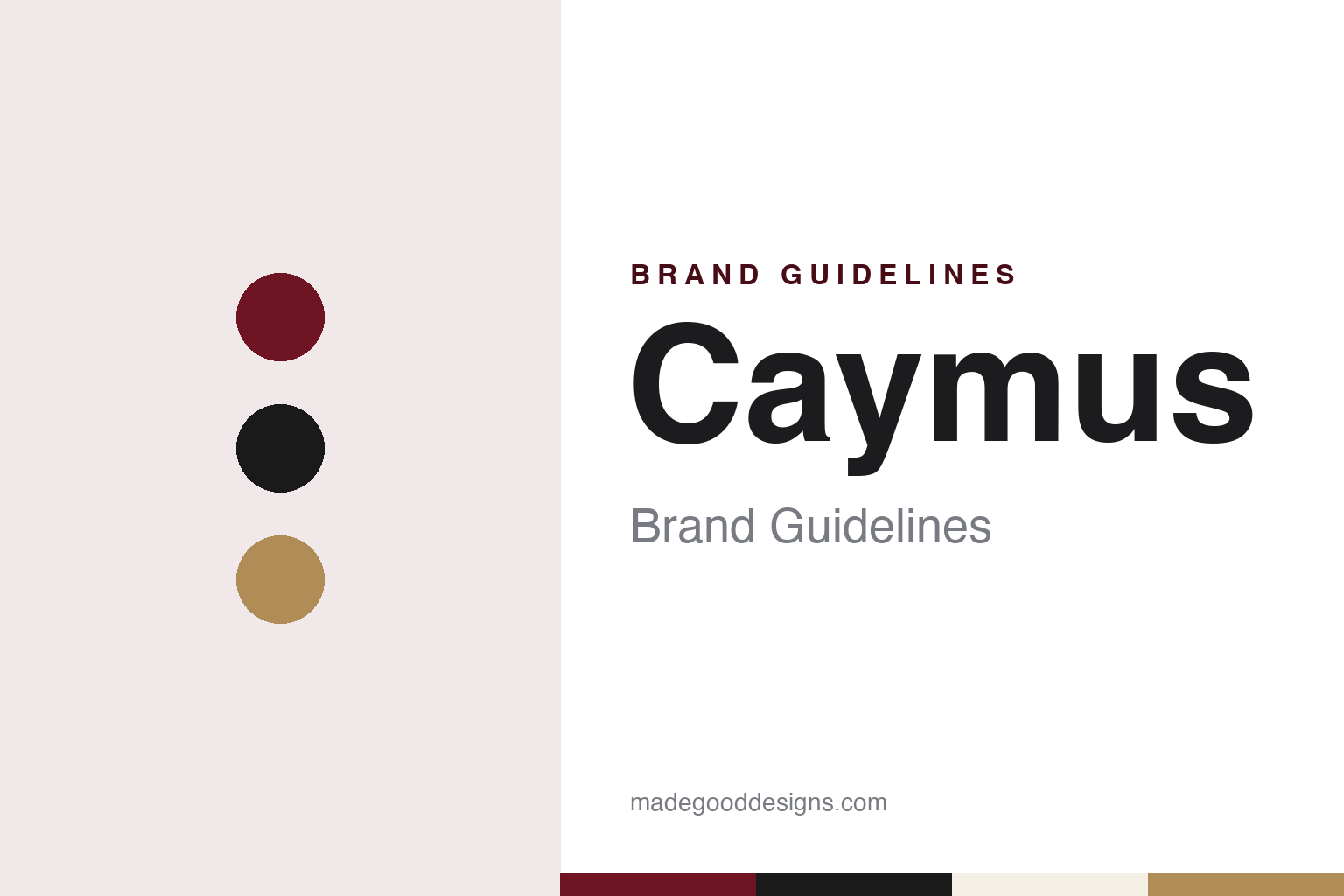
Two constants: a Cabernet red, cellar black and old gold palette and a high-contrast serif register. Abstract homage — not a Caymus product or mark; no label, logo or bottle is reproduced.
Three generations in Rutherford
A farming family that decided to bottle its own grapes.
Caymus Vineyards is a family winery in Rutherford, in the heart of California’s Napa Valley. The company says Chuck Wagner and his parents, Charlie and Lorna Wagner, opened it in 1972, starting with 240 cases of Cabernet Sauvignon. The name is older than the winery: English Wikipedia says it comes from Rancho Caymus, the land grant held by the Napa pioneer George Yount, which was itself named after the Kaimus villages of the Wappo people.
The family had been in the valley long before that. Wine Spectator, profiling the Wagners in 2016, said Chuck’s grandfather Carl Wagner came from Alsace and arrived in the Napa Valley in 1906, and built a winery on land that is now part of Honig Vineyard, a business ended by Prohibition. The company traces the other side of the family to the Glos family, German emigrants who reached the Napa Valley in the 1880s and homesteaded on Howell Mountain, and says a great-grandfather of Chuck’s, Lafayette Stice, worked as a winemaker at the Brun & Chaix winery there around 1900.
Charlie Wagner and Lorna Belle Glos married in 1934, the company says, after growing up a mile apart in Rutherford. Wine Spectator wrote that by the early 1950s they were farming 73 acres there, the land that is now the family estate, and selling their grapes to other wineries. In 1966 Charlie began replanting with new varieties, Cabernet Sauvignon among them, and in 1971 he offered his son, just out of high school, a job helping to make the winery solvent. Chuck accepted; the company says the three of them then worked side by side for decades.
Caymus remained a family business through the next handovers. Wine Spectator recorded that Charlie Wagner Sr. died in 2002, the same year Chuck’s younger son, Joe, started at the winery. The company today names Chuck and his children Charlie and Jenny Wagner as the people who run it, and describes Caymus as “100% family-owned and run.” A Zinfandel in its range is made in honour of Charlie Sr., the company says, because it was his favourite wine.
Colour
One flagship Cabernet, made only in the better years.
The wine that made the name came early. Wine Spectator said the reserve bottling, Special Selection, was created in 1975, as Caymus’s Cabernets began to gain notice; English Wikipedia adds that the winery hired Randy Dunn as winemaker the same year. Special Selection is drawn from the best barrels of the year’s Napa Valley Cabernet, the company says, and English Wikipedia notes that it is made only in better years, alongside a regular Napa Valley Cabernet produced every year.
Two vintages turned it into a reference point. Wine Spectator named the 1984 Special Selection its Wine of the Year in 1989, and the 1990 vintage took the same title, making Special Selection the only wine to earn the honour twice, the magazine said in 2016. English Wikipedia dates the second award to 1994.
The house style is described by the winery itself. The company says its Cabernet is grown on low-fertility soils on the valley floor and the surrounding mountains, with some dry farming, close planting and harvesting at an elevated degree of ripeness, and that the result is dark and concentrated with a ripe, fruit-driven softness from the day of release. Those are the company’s own words.
For the lettering on the label, see our separate look at What Font Does Caymus Use?
Visitors come to Rutherford for tastings, which the company says are seated and by appointment, alongside wines from the rest of the family’s labels.
Typography
Design and documentation.
The seven brands in this group are all American wine names: Woodbridge, Josh Cellars, Meiomi, La Crema, Duckhorn, Caymus and Stag’s Leap Wine Cellars. American wine brands in general sit at many different points in the trade, from family houses that still carry a founder’s name to labels that now belong to much larger drinks groups, and a single brand can be sold everywhere from a corner shop to a restaurant list.
A wine brand’s identity is usually carried less by a single bottle than by a label, a name and the place it promises, because the company behind the name may have changed hands, moved its production or grown far beyond the place where it started. That makes the questions behind each name worth asking plainly: who started it, who owns it now, and where its wine is actually made and bottled.
Each guide separates what independent sources record from what the company says about itself — its founding story, its owners over time, where its wine is made and how its labels have changed — and marks plainly what rests only on the company’s own word.
Aa
A high-contrast serif for a classic Napa Valley Cabernet label. (Specimen set in Playfair Display, a serif STAND-IN; NOT the Caymus logo.)
Wagner Family of Wine
One winery, then a family of labels across California.
Caymus became the anchor of a wider group, sold today under the name Wagner Family of Wine. Wine Spectator recorded in 2016 how it grew. In 1989 Chuck Wagner experimented with a white blend that became Conundrum. In the early 1990s the family planted vineyards in the Santa Lucia Highlands and created Mer Soleil, a Chardonnay-focused label now run by Chuck’s elder son, Charlie. A few years later Chuck began buying Pinot Noir from Santa Barbara County for a label he named Belle Glos, after his mother, Lorna Belle Glos Wagner, which his younger son Joe was expected to run. Jenny Wagner makes Merlot and Sauvignon Blanc under her own Emmolo label, the magazine said.
One branch went its own way. Wine Spectator reported that Joe Wagner founded Copper Cane in 2014, centred on Meiomi, a Pinot Noir brand he had developed with his father, and Wines & Vines reported in July 2015 that Constellation Brands had agreed to buy Meiomi from Copper Cane, in a deal that did not include Belle Glos.
The family has also moved beyond Napa County. The company says it opened the Caymus-Suisun winery in Suisun Valley, in Fairfield in neighbouring Solano County, in spring 2022, on the site of a former apricot-drying plant, and that its Suisun wines include Grand Durif, a Petite Sirah. The family’s site also lists Red Schooner, Sea Sun and Bonanza among its labels, and the company has added a Caymus California Cabernet Sauvignon drawn from vineyards beyond the Napa Valley. The winery’s site is caymus.com; the shop and the wider range sit at wagnerfamilyofwine.com.
For a design guide, Caymus shows how a borrowed historic place name, a family’s continuity and one flagship bottling made only in good years can carry a Napa Valley winery for more than half a century. Compare Duckhorn, the St. Helena winery founded four years later, and Stag’s Leap Wine Cellars, another Napa Cabernet house of the early 1970s. For this guide we use Cabernet red, cellar black and old gold with a serif, an unofficial interpretation; no product or logo is reproduced.
Explore & save
Keep Caymus’s identity on hand — save it to a board in the Made Good inspiration library.
Caymus identity set
Pin the Caymus Cabernet red, cellar black and old gold palette and the high-contrast serif register to your own board.