1800 Tequila Brand Guidelines
The Beckmann family’s pyramid bottle from Jalisco.
Aa
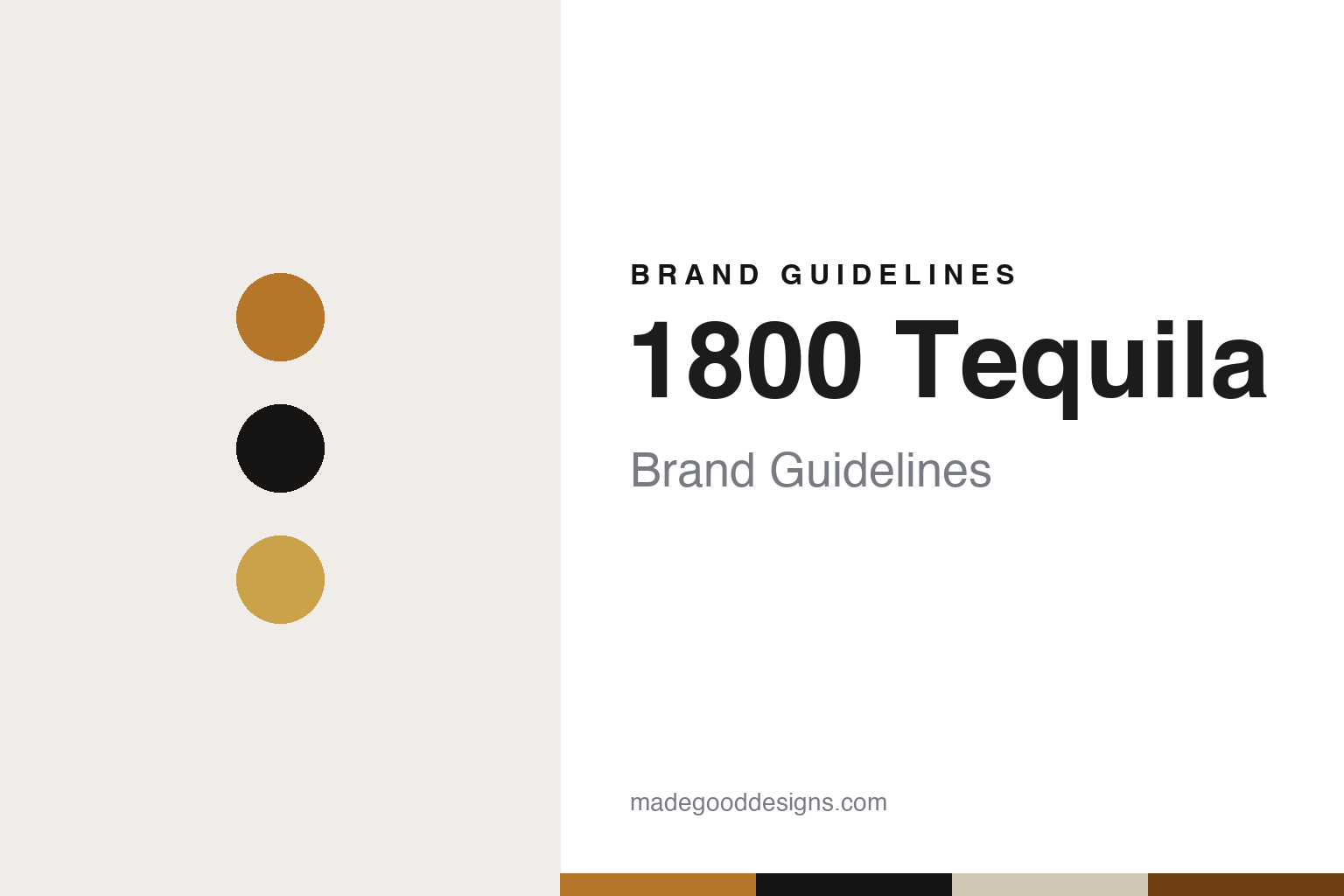
Two constants: an añejo amber, crest gold and label black palette and a high-contrast display serif register. Abstract homage — not a 1800 Tequila product or mark; no bottle, label, crest or logo is reproduced.
A year for a name
An aged tequila from the family behind Jose Cuervo.
1800 is a tequila made in Jalisco, Mexico, and owned by the Beckmann family, who also own Jose Cuervo. English Wikipedia, citing a 2011 New York Times DealBook report, gives that shared ownership, and the brand’s own website calls the family tenth-generation descendants of the original tequila family. The company says its tequila is distilled at its distillery in Jalisco from blue Weber agave grown in its own estate fields and by selected third-party growers in the same state.
The name is a date. The brand says 1800 is the year tequila was first aged in oak casks, and its history page puts it in family terms, as the year the Beckmann family first placed tequila in barrels. English Wikipedia repeats the oak-ageing explanation, citing the tequila history site In Search of the Blue Agave (2011) and the review site TequilaKnight. The company says the label carries the brand name, the variant and that year together.
The launch date needs two sources side by side. English Wikipedia, citing the spirits ratings site Proof66, says the brand was launched in 1967 as a sipping tequila with 1800 Añejo, and that it was first sold as Cuervo 1800, citing a 2012 design blog. The brand’s own history instead places the launch of 1800 Añejo in the 1970s, in the same decade Mexico secured its Denomination of Origin for tequila, and credits Juan Beckmann Vidal; the company describes it as the first official 100% agave aged tequila, which is the brand’s own claim. English Wikipedia, citing the business-history site Funding Universe, names Juan Beckmann Vidal as part of Grupo Cuervo from 1979.
The range grew slowly from the aged original. English Wikipedia, citing tequila review sites, says Silver and Reposado labels followed in 2004 and a 100-proof Select Silver in 2008, and that a ready-to-serve margarita arrived in 2006; its 2026 list of the range runs from Silver, Reposado and Añejo to Cristalino and Milenio.
Colour
A pyramid in glass, a crest and a signature.
The bottle is the brand’s largest graphic device. The company describes its trapezoidal bottle as an ode to the Mayan pyramids found throughout Mexico, and English Wikipedia, citing a 2012 article on the design blog betterspoon, adds that the cap was once made to double as a shot glass.
The label carries a crest with three parts, which the company sets out on its history page: a Mayan pyramid; a cross with the letters J and B, for the owner Juan Domingo Beckmann; and a ribbon carrying the brand’s three values, trabajo, pasión, honestidad (hard work, passion, honesty). English Wikipedia gives the same three elements. The company says each bottle also carries its bottle number and Juan Domingo Beckmann’s signature, and that the label shows the stages by which the tequila is made, from agave plant to bottle, together with the batch number.
The other long-running design programme is the Essential Artists series. The company says it began in 2008 and has since featured more than fifty works, with each year’s artists given a set of six bottles of the Blanco as a canvas; the artists whose work it names include Jean-Michel Basquiat and Keith Haring, Shantell Martin and Okuda San Miguel. Wired reported in October 2009 on the second series, in which one bottle came from Shepard Fairey’s firm Studio Number One and the others were chosen from online submissions. The brand’s 2026 site lists an Essential Artists 12 edition by Raúl de Nieves and a Colección extra añejo in a sculptural decanter by the Mexican artist Pedro Friedeberg.
Typography
Design and documentation.
The seven brands in this group are all tequila and liqueur names: Casa Noble, Clase Azul, 1800, Hornitos, Cazadores, Corralejo and RumChata. Tequila and liqueur brands in general sit at many different points in the trade, from family houses that still carry a founder’s name to labels that now belong to much larger drinks groups, and a single brand can be sold everywhere from a corner shop to a cocktail bar.
A tequila or liqueur brand’s identity is usually carried less by a single bottle than by a label, a name and the place it promises, because the company behind the name may have changed hands, moved its production or grown far beyond the place where it started. That makes the questions behind each name worth asking plainly: who started it, who owns it now, and where its spirit is actually made and bottled.
Each guide separates what independent sources record from what the company says about itself — its founding story, its owners over time, where its spirit is made and how its labels have changed — and marks plainly what rests only on the company’s own word.
1800
A high-contrast display serif for a numeral that doubles as a name. (Specimen set in Playfair Display, a serif STAND-IN; NOT the 1800 Tequila logo, which is custom lettering.)
1800 Tequila
A family brand with an American distributor of its own.
In the United States, 1800 is handled by Proximo Spirits, a company of the Beckmann family based in Jersey City, New Jersey. English Wikipedia says Proximo was founded in 2007 and has distributed 1800 in the US since 2008, citing the drinks writer Chuck Cowdery (2013), and lists Proximo as a subsidiary of Becle. The arrangement grew in July 2013, when Proximo also took over US distribution of Jose Cuervo from Diageo, Adweek and Advertising Age reported at the time. The brand’s website names JC Master Distribution Limited as owner of its trademarks.
The brand’s marketing has leaned on sport and celebrity. The New York Times reported in October 2010 that Proximo had marketing agreements to promote 1800 at the arenas of the Los Angeles Lakers and the New York Knicks. Adweek reported in June 2009 that the rapper Rick Ross was backing the brand, and in October 2013 on an 1800 advertisement starring the actor Ray Liotta.
For more on the font question, see our separate note on the 1800 Tequila font, which treats the wordmark as custom lettering rather than a downloadable typeface.
For a design guide, 1800 Tequila shows how a single number, a bottle shaped like a pyramid and a crest with a three-word motto can carry an aged tequila, and how a yearly artists’ edition can keep the same bottle fresh. Compare Jose Cuervo, the family’s older tequila house, and Patrón, the Jalisco tequila launched in 1989. For this guide we use añejo amber, crest gold and label black with a serif, an unofficial interpretation; no product or logo is reproduced.
Explore & save
Keep 1800 Tequila’s identity on hand — save it to a board in the Made Good inspiration library.
1800 Tequila identity set
Pin the 1800 Tequila añejo amber, crest gold and label black palette and the high-contrast display serif register to your own board.