Monbana Brand Guidelines
The cocoa-powder maker named after a friend’s brand.
Aa
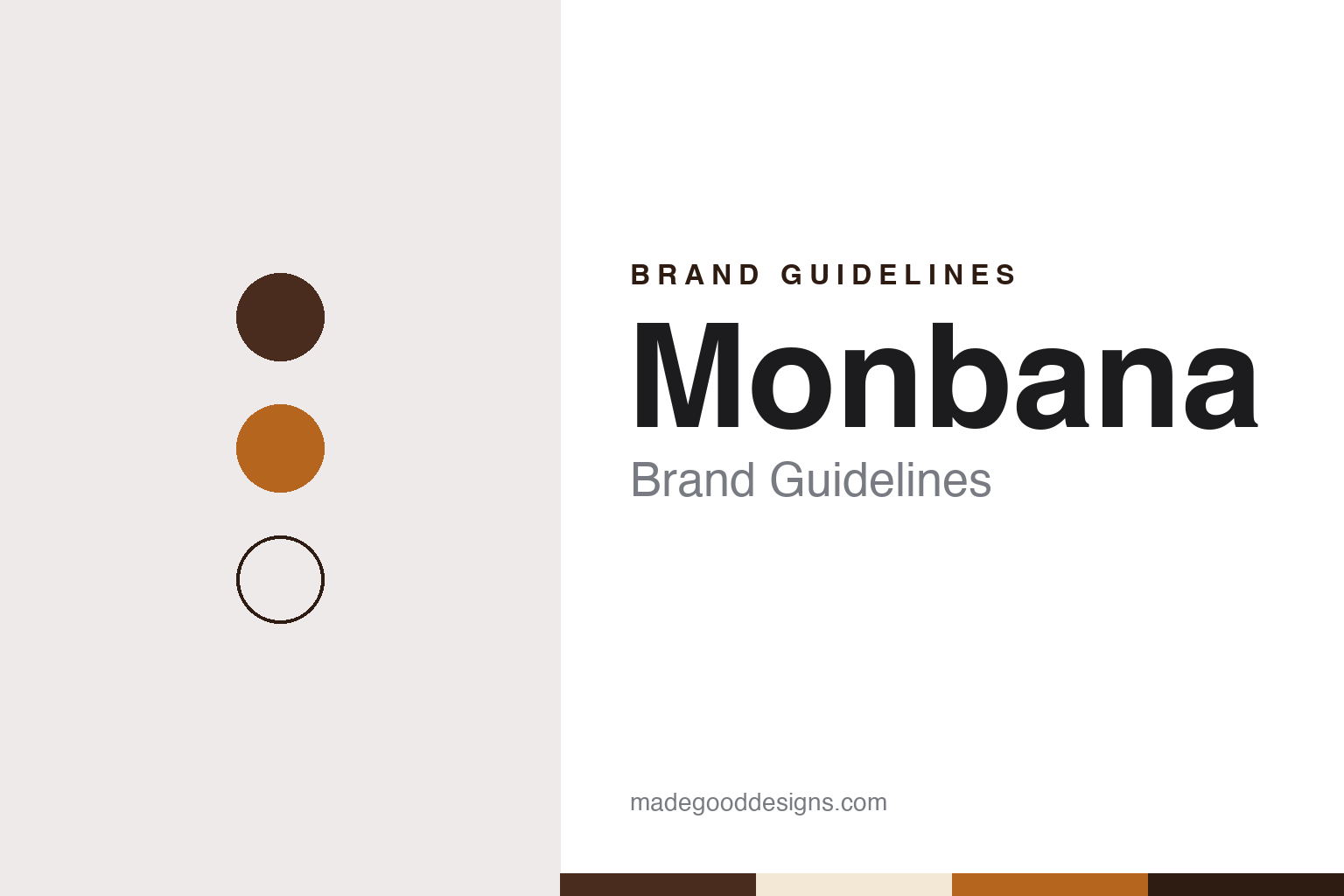
Two constants: a Monbana cocoa, cream and caramel palette and a warm display serif register. Abstract homage — not a Monbana product or mark; no pack, logo or mascot is reproduced.
Mon Banania
A trench friendship and a cocoa works outside Paris.
Monbana began as a cocoa manufactory at Courbevoie, just west of Paris, in 1934. Its founder, Louis Guattari, had met Pierre-François Lardet, the founder of Banania, in the trenches of the First World War, and worked on the Banania business for some years before setting up on his own, the company says; L’Express, in an AFP report of April 2015, describes him the same way, as a trench friend of Banania’s creator. The name is the homage: Monbana stands for “mon Banania” — “my Banania.”
The company tells its early story through drawings. It says Guattari, trained as an industrial draughtsman, drew the Monbana logo for its powders himself in 1934, and invented the mascot Louisette, a little girl drinking a bowl of cocoa, named after his wife Louise. The breakfast cocoa powder she advertised was the start of the business.
Monbana grew as a family company. The company says Louis’s sons Jean and Paul added cocoa roasting and made it a specialist in chocolate powder; L’Express reported that Jean launched a range of sports nutrition products in 1958. Jean’s son Yves Guattari joined in 1973, according to L’Express, and Le Figaro reported in 2012 that he had been chairman since 2001, with the third generation of the family in charge.
Colour
The little square beside the espresso.
For most of its history Monbana worked behind other names. The company says the idea for its Napolitain — the small wrapped square of chocolate served with coffee — came at the end of the 1970s and that the first was launched in 1985; coated almonds followed. In January 2012 Le Figaro reported that for thirty years Monbana had made, in two factories in Mayenne, nearly three quarters of the Napolitains served in French cafés, hotels and restaurants, often wrapped under the names of coffee roasters such as Lavazza and Segafredo, at about 1.5 million squares a day, and that it supplied 60 per cent of the powder used for hot chocolate drinks there. Those shares are as the newspaper reported them.
The move to its own brand came later. The company dates a consumer “gourmet” collection to 2008, followed by its own “Chocolaterie Monbana” shops; Le Figaro counted eleven company shops opened in two years by 2012, with franchising planned. In 2013, the company says, it adopted a new logo and graphic identity and began calling itself the Chocolaterie Monbana. L’Express reported in 2015 that the brand was sold in 1,200 outlets and exported to 60 countries.
Production has moved over the decades within the west of France. L’Express reported in 2015 that the head office and chocolate works were at Ernée, in Mayenne, enlarged three times in ten years, with finishing still done by hand; that cocoa powder was made at Landivy, also in Mayenne; and that in 2013 Monbana had bought a chocolate-moulding factory in Colmar, in Alsace, for Easter and Christmas pieces. In September 2016 Le Télégramme reported the opening of a new powder plant at Saint-Sauveur-des-Landes, near Fougères in Brittany, replacing Landivy, and quoted the managing director, Dominique Renault, as saying that 80 per cent of its powder output was exported.
The newspaper described a building of 6,000 square metres, producing about 2,500 tonnes a year with room for twice that, and employing 47 people three weeks after it opened; Renault said Monbana was present in 56 countries and named coffee companies such as Lavazza and Segafredo among the clients it wanted to show the plant to. The Colmar works, L’Express had reported the year before, made only about 300 tonnes a year — mostly Easter eggs and bells, most of them turned out of the moulds by hand and all decorated by hand.
Typography
Design and documentation.
The seven brands in this group all sell chocolate, and they come from three countries: Cémoi, Jeff de Bruges, Monbana and À la Mère de Famille from France, Summerbird and Peter Beier from Denmark, and Puccini Bomboni from the Netherlands. They sit at different points in the chocolate trade, from names found on supermarket shelves and in shopping-centre chains to single shops known mainly to the people who walk past their windows.
Some of these businesses are manufacturers, buying cocoa or chocolate in bulk and turning it into bars, drinks and seasonal shapes sold far from where they are made. Others are chocolatiers, who buy finished chocolate from a supplier and use it to make bonbons, truffles and filled pieces by hand, and whose identity rests on a shop, a recipe and a family name as much as on any wrapper. Many sit somewhere between the two, running workshops and shops at once.
Each guide separates what independent sources record from what the company says about itself — who founded it, who owns it now, where its cocoa comes from and where its chocolate is made — and marks plainly what rests only on the company’s own word.
Aa
A warm display serif for a cocoa house with a drawn mascot. (Specimen set in DM Serif Display, a serif STAND-IN; NOT the Monbana logo.)
Monbana
From the Guattari family to the Buton group.
The Guattari family’s ownership ended in July 2017, when, the company says, Monbana changed chairman and joined the Buton group. It describes Buton as a family group from Pornic, in Loire-Atlantique, chaired by Christian Buton, that makes biscuits, viennoiseries and confectionery; French Wikipedia, citing Ouest-France in July 2017, adds that the group already owned Réauté Chocolat. The website’s legal notice names the publisher as La Chocolaterie Monbana, a société anonyme with its head office at Ernée.
Today the company says it works from two production sites covering 20,000 square metres and making more than 5,000 tonnes of chocolate products a year, and that its chocolatiers use cocoa beans from West Africa; we give those as its own figures. It still sells to cafés and restaurants as well as through its shops and website. Since 2022 its name has also been on the racing yacht of the skipper Maxime Sorel, V and B–Monbana–Mayenne, which the company says was entered for the 2024 Vendée Globe; it marked its 90th anniversary in 2024.
For a design guide, Monbana shows how a supplier that spent decades unseen inside other companies’ wrappers can build a consumer brand on a founder’s story — a borrowed name, a hand-drawn mascot and a logo redrawn in 2013. Compare Cemoi, another French chocolate maker with a large trade business, and Michel Cluizel, a family chocolate maker in Normandy. For this guide we use cocoa brown, cream and caramel with a serif, an unofficial interpretation; no product or logo is reproduced.
Explore & save
Keep Monbana’s identity on hand — save it to a board in the Made Good inspiration library.
Monbana identity set
Pin the Monbana cocoa, cream and caramel palette and the warm display serif register to your own board.