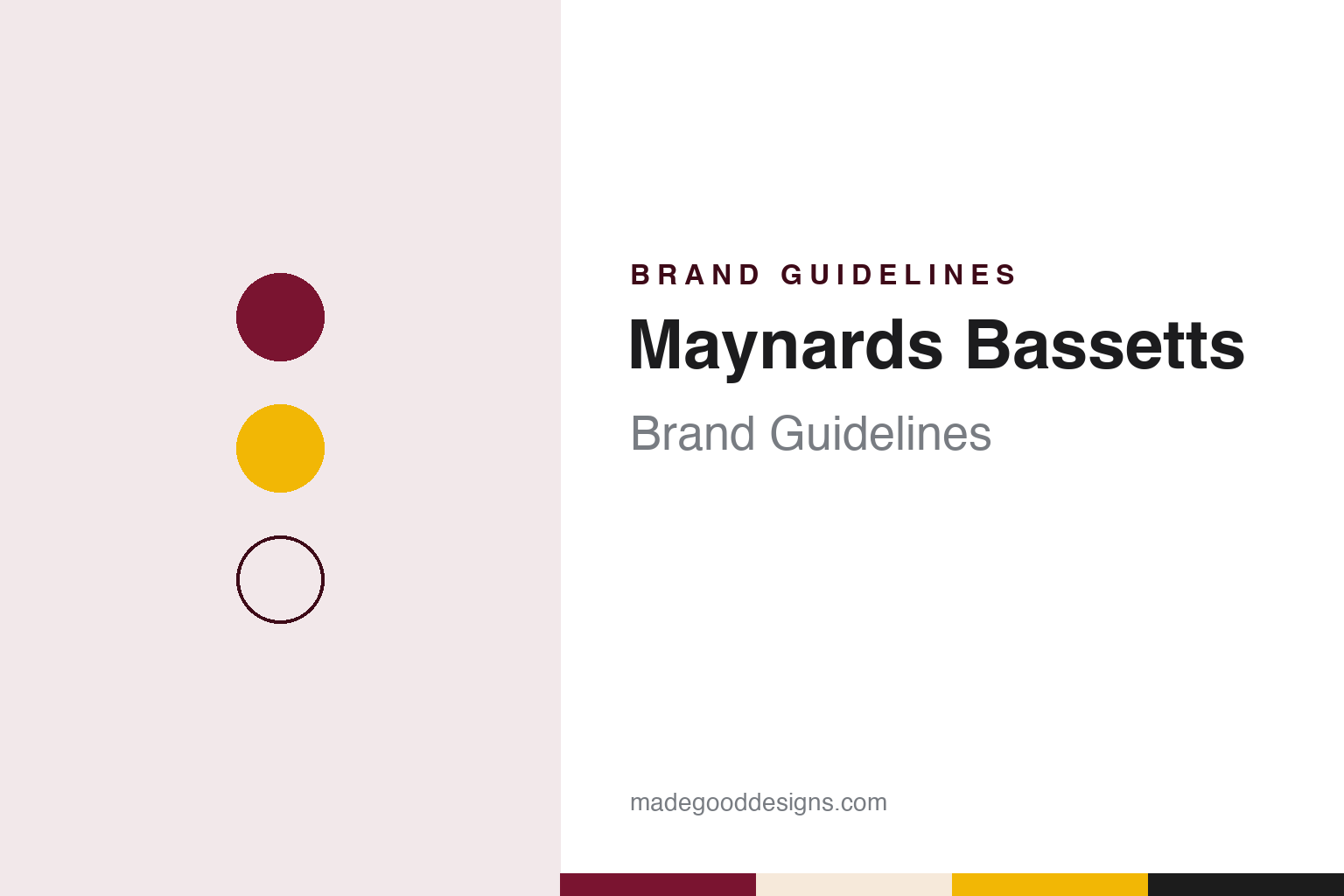
Maynards Bassetts Brand Guidelines
Wine Gums, Liquorice Allsorts and Jelly Babies under one name.
Aa
Two constants: a Maynards Bassetts claret, yellow and black palette and a playful grotesque sans register. Abstract homage — not a Maynards Bassetts product or mark; no pack, logo or sweet is reproduced.
Two old sweet makers
A Sheffield lozenge maker and a Hackney kitchen.
Maynards Bassetts is a young name for two old businesses. The older half is Bassett’s, founded in Sheffield in 1842 by George Bassett. English Wikipedia, citing Robert Opie’s history Sweet Memories, says the Sheffield directory of that year listed him as a “wholesale confectioner, lozenge maker and British wine trader.” Bassett, born at Ashover in Derbyshire, later became Mayor of Sheffield, in 1876. In 1851 he took on an apprentice, Samuel Meggitt Johnson, who became his son-in-law; Johnson’s descendants ran the company until Gordon Johnson retired as chairman in the 1970s. The firm opened a factory on Broad Street in 1852 and moved in 1933 to Owlerton, in the north of the city, where, the Sheffield Star reported in 2015, it remains. It was listed on the London Stock Exchange in 1929, and in 1966 it bought another sweet maker, Barratt, in a friendly takeover reported by the Financial Times.
The younger half is Maynards. English Wikipedia says Charles Riley Maynard and his brother Tom began making sweets in their kitchen in 1880, in the Stamford Hill area of Hackney, London, while Charles’s wife, Sarah Ann, sold them in a shop next door. The brothers formed the Maynards company in 1896, and in 1906 it opened a factory on Vale Road in Harringay, north London. Over the following decades it also built up a chain of sweet shops, around 140 of which were sold in 1985, Investors Chronicle reported that year.
Colour
Wine Gums, Allsorts and Jelly Babies.
Each half brought a famous sweet. Maynards Wine Gums were introduced in 1909. According to a Cadbury factsheet cited by English Wikipedia, the idea came from Charles Riley Maynard’s son, Charles Gordon Maynard, who had to persuade his father, a strict Methodist and teetotaller, that the sweets contained no wine. The gums are traditionally stamped with the names of drinks; Maynards, Cadbury said, used port, sherry, burgundy and claret, and red and black were the most popular colours.
Bassett’s best-known product, Liquorice Allsorts, comes with a story. English Wikipedia, citing Opie, says a Bassett’s salesman, Charlie Thompson, dropped a tray of samples in front of a prospective client, who liked the idea of selling the sweets mixed together; its article on the sweets dates the incident to 1899, with a client in Leicester, and calls the story “supposedly” true. The assortment acquired a mascot, Bertie Bassett, a figure built from allsorts. English Wikipedia dates Bertie to 1926; Metro marked his 80th year in 2009, when Bassett’s staged a mock wedding between Bertie and a new partner, Betty, at its Sheffield factory. A liquorice Bertie is now one of the pieces in the mix.
The third star is the Jelly Baby. The BBC reported in 2015 that similar sweets were made in the north-west of England in the 19th century, and that Bassett’s launched its own in 1918 as “Peace Babies,” relaunching them as Jelly Babies in the 1950s.
Typography
Design and documentation.
The seven brands in this group all make sweets and gummies, and they come from Germany, Sweden, Britain and the United States: Katjes, Trolli, Werther’s Original, Cloetta, Maynards Bassetts, Swizzels and Jelly Belly. Sweet and gummy brands in general sit at many different points in the trade, from family firms that still carry a founder’s surname to names that now belong to much larger confectionery groups, and a single brand can be sold everywhere from a corner shop to a supermarket aisle.
A sweet brand’s identity is usually carried less by a single product than by a pack, a name and the treat it promises, because the company behind the name may have changed hands, moved its factory or grown far beyond the town where it started. That makes the questions behind each name worth asking plainly: who started it, who owns it now, and where its sweets are actually made and packed.
Each guide separates what independent sources record from what the company says about itself — its founding story, its owners over time, where its sweets are made and how its packaging has changed — and marks plainly what rests only on the company’s own word.
Aa
A playful grotesque sans for a brand repackaged around “fun at the factory.” (Specimen set in Bricolage Grotesque, a sans STAND-IN; NOT the Maynards Bassetts logo.)
Maynards Bassetts
From Trebor and Cadbury to one Mondelez masterbrand.
The two firms came together through takeovers. Maynards was bought in 1985 by the mint maker Trebor, which gained a large Maynards factory in Tottenham with the deal, according to a history of Trebor. Bassett’s, together with Barratt, was bought by Cadbury Schweppes in 1989, for £91 million, the Sheffield Star reported, and Cadbury Schweppes bought Trebor in the same year, English Wikipedia says. From 1 March 1990 the combined sweets business traded as Trebor Bassett, a division of Cadbury. The brands then passed with Cadbury to the American group Kraft Foods in 2010, and so to its successor, Mondelez International.
In January 2016 Mondelez announced that Maynards and Bassett’s would be sold under a single “masterbrand,” Maynards Bassetts, aimed at adults. Talking Retail and Just Food reported that the company cited research showing that 65% of sweets were bought by adults, valued the combined brand at £127.9 million, and backed the launch with a £4 million campaign across television, PR, digital and shops. A new assortment, Bertie’s Jelly Mix, launched alongside the classics. The packs were redesigned by the design agency Bulletproof, which Mondelez had appointed in March 2015; the agency described its idea as “a bit of British bonkers inventiveness” and “fun at the factory,” built around a Maynards Bassetts plaque at the centre of the pack from which the sweets tumble down a colourful “flavour slide.” The new packs reached shops in February 2016. In 2022 the brand renamed its Midget Gems as Mini Gems, Liverpool World reported.
Mondelez says its Sheffield site makes Liquorice Allsorts and Jelly Babies, along with Trebor mints, and produces about 40,000 tonnes of sweets and crisps a year. The sources we checked do not say where the Wine Gums are made.
For a design guide, Maynards Bassetts shows how a company can fold two heritage names and a mascot into one pack system without losing the individual sweets. Compare Fry’s, another old Cadbury name now owned by Mondelez, and Rowntree’s, a British sweet brand now owned by Nestlé. For this guide we use a wine-gum claret, an allsorts yellow and a liquorice black with a sans, an unofficial interpretation; no product or logo is reproduced.
Explore & save
Keep Maynards Bassetts’s identity on hand — save it to a board in the Made Good inspiration library.
Maynards Bassetts identity set
Pin the Maynards Bassetts claret, yellow and black palette and the playful grotesque sans register to your own board.