Ayam Brand Brand Guidelines
The Singapore rooster started by a Frenchman in 1892.
Aa
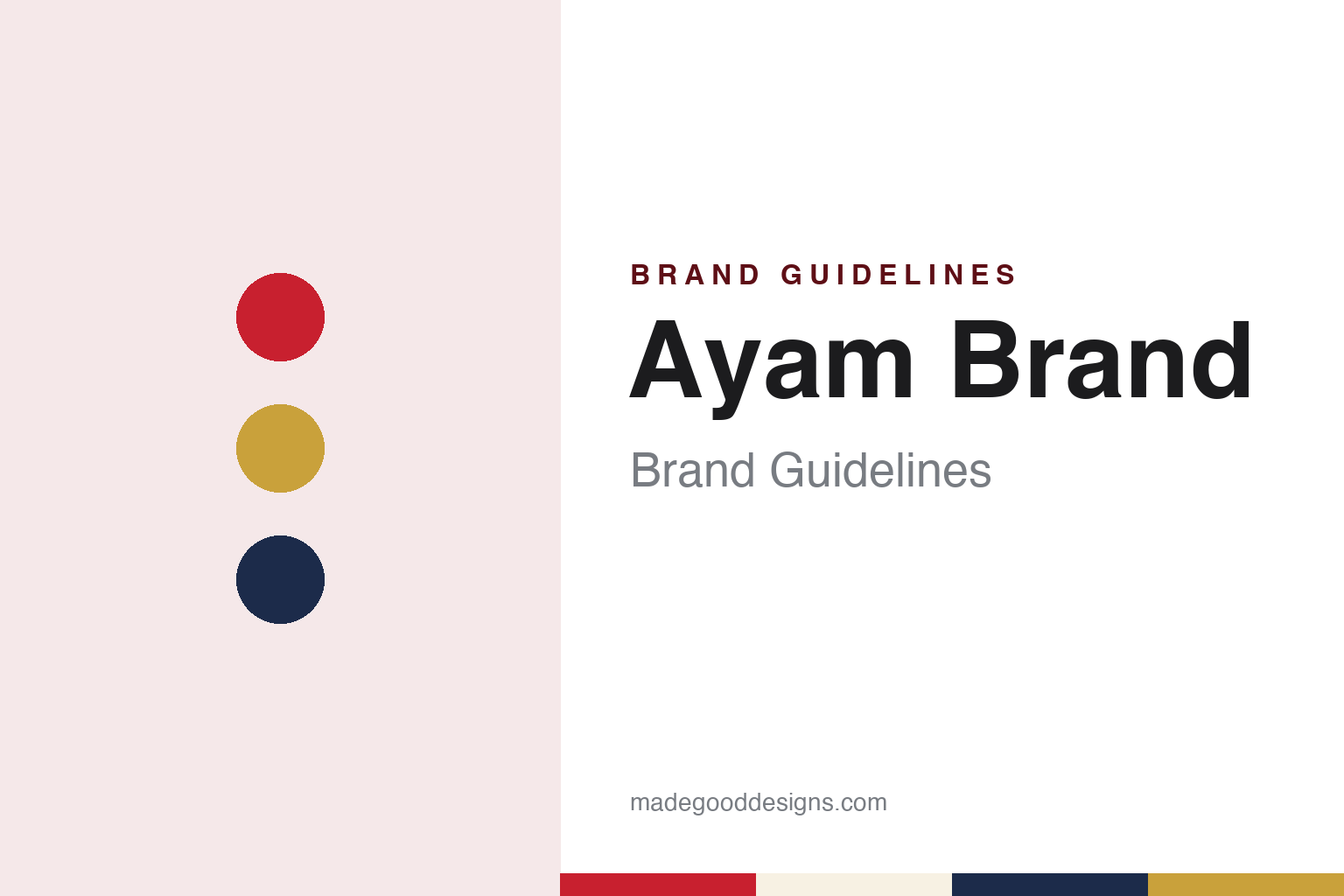
Two constants: a rooster red, medal gold and deep navy palette and a heritage trading-house serif register. Abstract homage — not an Ayam Brand product or mark; no can, label or logo is reproduced.
A. Clouet & Co
A Le Havre trader, a Singapore import house and a rooster.
Ayam Brand began in Singapore, then part of the British Straits Settlements, and its founder came from the French port of Le Havre. Alfred Clouet was born there in 1866, the company says, and French Wikipedia, citing the Normandy newspaper Paris-Normandie in 2021, gives his dates as 1866 to 1949. The company’s own history says that in 1889, at the age of 23, he left France for New York, and that he reached Singapore in 1891. His first job there, it says, was with a Frenchman named Labarbe who ran a cigar-trading business and who, on returning to France, left the company in Clouet’s hands.
In 1892 Clouet registered his own import-export firm, A. Clouet & Co, the company says. Singapore had a sizeable European community, and he began by importing French perfumes and Bordeaux wines. When those sold less well than he had hoped, he turned to another product then considered a luxury: canned food. English Wikipedia, citing the 2011 book The French in Singapore (1819–today) by Maxime Pilon and Danièle Weiler, says the business supplied food to colonial staff and also traded in building materials, and that canned food was then out of reach of most people. The company says Clouet set out to bring it to a wider public and began producing tinned sardines in 1899, later adding canned mushrooms and peas; the sardines were the most popular.
The rooster came first and the name followed. The company says Clouet created a logo made up of his name and a rooster, a symbol of France, and that his cans carried his name, pictures of gold medals won at the Exposition Universelle in Paris and the bird. English Wikipedia says local traders and shoppers began calling the cans of sardines and salmon by the bird on the label; ayam is the Malay word for chicken or rooster. The company says customers asked for “chop ayam,” the chicken brand, and that the management then changed the official name to Ayam Brand. French Wikipedia gives an earlier English name, Cock Brand, for the mark Clouet launched in 1892.
Colour
Sardines, coconut and a trading house from Saigon.
Ayam Brand’s range is built around the can. The company’s Singapore site lists sardines, tuna, mackerel and saba, baked beans, coconut milk and cream, curry pastes and other ingredients, and its range varies by country, English Wikipedia notes. French Wikipedia names sardines in tomato sauce as the brand’s historic signature product. Outside its home markets, English Wikipedia says, the brand is known mainly for Asian cooking ingredients such as coconut milk, satay sauce and curry pastes, in Australia, New Zealand, France and the United Kingdom.
The founder’s firm changed hands in 1954. That year, French Wikipedia says, citing Kham Vorapheth’s 2004 history Commerce et colonisation en Indochine, the Denis Frères group bought the house of Alfred Clouet, which had been established in Malaya since 1892; English Wikipedia gives the same year. Denis Frères was itself a French colonial trading house, founded in Saigon in 1862 by the brothers Gustave and Émile Denis to trade rice and pepper between Cochinchina and Europe, French Wikipedia says. After the Second World War it moved away from Indochina, into Malaya in 1954 and Madagascar in 1962, and in 1970 it set up a Swiss holding company, with its operating headquarters in Singapore.
Clouet’s name has outlived his ownership. English Wikipedia lists distribution companies that still carry it: A. Clouet & Co. (KL) in Malaysia, Clouet Trading in Singapore and A. Clouet (Australia), which covers Australia and New Zealand. According to the same article, the brand was active mainly in Malaya until the 1950s and spread beyond its historical territory only afterwards, and it now leads its category in Malaysia, Singapore, Brunei, Thailand, Indonesia and Hong Kong for everyday products such as sardines, tuna, coconut and baked beans.
Typography
Design and documentation.
The seven brands in this group all make food, and all of them come from South Korea, Singapore and Southeast Asia: CJ CheilJedang, Haitai, Binggrae, Paldo, Khong Guan, Yeo’s and Ayam Brand. Food brands from this part of Asia in general sit at many different points in the trade, from family firms that still carry a founder’s name to names that now belong to much larger food groups, and a single brand can be sold everywhere from a neighbourhood shop to a supermarket shelf abroad.
A food brand’s identity is usually carried less by a single product than by a pack, a name and the meal or snack it promises, because the company behind the name may have changed hands, moved its factories or grown far beyond the city where it started. That makes the questions behind each name worth asking plainly: who started it, who owns it now, and where its food is actually made and packed.
Each guide separates what independent sources record from what the company says about itself — its founding story, its owners over time, where its food is made and how its packaging has changed — and marks plainly what rests only on the company’s own word.
Aa
A heritage serif for a trading house founded in 1892. (Specimen set in Libre Baskerville, a serif STAND-IN; NOT the Ayam Brand logo.)
Ayam Brand
A family group, a brand company and the factories behind the cans.
The Denis family still controls the group. French Wikipedia says the Swiss holding company is run by descendants of the founders, that it took the name Maison Denis in 2022 and that its portfolio of food brands includes Ayam Brand alongside Alce Nero Asia, Duchef and others. English Wikipedia says the brand itself belongs to a company called Ayam SARL, and the copyright line on the brand’s websites names Ayam Sarl. The company’s Malaysian site describes the Denis Frères group as the licensee for Ayam Brand and says the family business traces its origins to 1862.
The company describes its factories in the question-and-answer pages of its Singapore and Malaysian sites. It says its coconut factory processes the whole coconut, from the water to the cream, and burns the shells as fuel in place of oil or gas, and that it is working on machinery at its fish factory to turn offcuts into a protein ingredient. The company says its products are certified halal, under the supervision of Malaysia’s Islamic development department, JAKIM, and that the few products that still contain palm oil use certified sustainable palm oil from West Malaysia.
The brand’s standing in Asia has been measured from outside. French Wikipedia, citing the market-research firm Synovate’s list of Asia’s top 1,000 brands, published in August 2007, says Ayam ranked 179th among consumer brands that year; the company says the same survey placed it first for canned food. Its advertising today leans on recipes as much as on cans: its Singapore site hosts a video series, Confirm CAN Lah, in which the presenter Charlotte Mei cooks with its products, and an episode of the CNA programme The Centennials about the company.
For a design guide, Ayam Brand shows how a founder’s national emblem, renamed by the people who bought it, can become a brand of more than 130 years, named in another language. Compare John West, another canned-fish name built on a founder’s label, and Amoy, the soy sauce maker founded in Xiamen and now run from Hong Kong. For this guide we use a rooster red, a medal gold and a deep navy with a serif, an unofficial interpretation; no product or logo is reproduced.
Explore & save
Keep Ayam Brand’s identity on hand — save it to a board in the Made Good inspiration library.
Ayam Brand identity set
Pin the Ayam Brand rooster red, medal gold and deep navy palette and the heritage trading-house serif register to your own board.