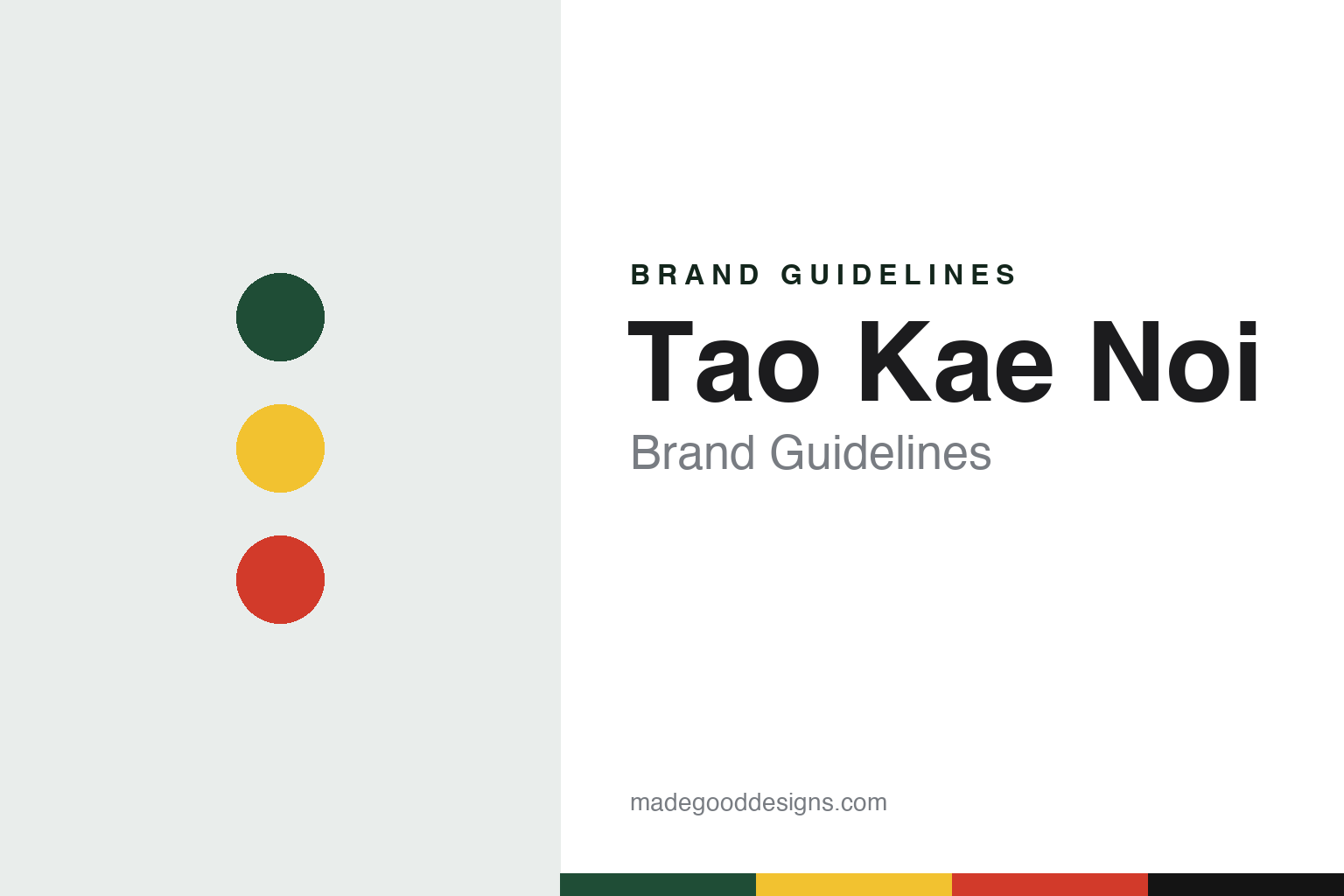
Tao Kae Noi Brand Guidelines
The “little boss” seaweed snack and The Billionaire.
Aa
Two constants: a nori green, snack yellow and chilli red palette and a Thai-Latin sans register. Abstract homage — not a Tao Kae Noi product or mark; no pack, sheet or logo is reproduced.
Little Boss
A teenage founder and a seaweed factory.
Tao Kae Noi began as a young man’s seaweed business in Thailand. Taokaenoi Food & Marketing, the company behind it, says it was registered with Thailand’s Ministry of Commerce on 21 September 2004, with registered capital of one million baht, to produce and sell processed seaweed under the brand name Taokaenoi. Its founder is Itthipat Peeradechapan, known as Tob; Thai Wikipedia lists him under an earlier surname, Kulpongwanich. English Wikipedia says the name means “little boss,” because he set up the business at 19, and that before seaweed he had run a chestnut franchise that grew to about thirty branches, which he sold at 20 to invest in a seaweed factory. It also says the snacks went into 7-Eleven stores across Thailand in 2004.
The company’s own list of milestones sets out what followed. The first factory was at its Tha It office in 2004. In 2005 it exported for the first time, with Singapore as the first market. In 2006 production moved to a new factory in Bang Bua Thong, and in 2007 a second factory opened in Noppawong, the year, the company says, that sales passed one billion baht. A restaurant and franchise subsidiary was set up in 2009 to run Taokaenoi Land snack and souvenir shops; Thai Wikipedia dates the first branch to 2010, at CentralWorld in Bangkok. In 2010 and 2011 the company bought a health-products distributor and NCP Trading and Supply, a seasoning-powder maker, and it says sales passed two billion baht in 2011.
Colour
From cinema screen to stock exchange.
The founding story reached cinemas before the shares reached the stock exchange. Top Secret, released in English as The Billionaire, opened in Thailand on 20 October 2011. Thai Wikipedia says it was directed by Songyos Sugmakanan, starred Pachara Chirathivat as Tob, follows a teenager who goes from heavy gaming to building a fried-seaweed snack business, was inspired by events from 2004, and took 38.69 million baht at the box office. English Wikipedia also says the 2011 film was inspired by Tob’s story.
Taokaenoi became a public company on 10 May 2013. In 2015 it sold 360 million new shares to the public to pay for machinery and working capital, and its shares were listed on the Stock Exchange of Thailand on 3 December 2015 under the symbol TKN; English Wikipedia puts the offering at 1.4 billion baht. Construction of a new factory in Rojana Industrial Park, in Phra Nakhon Si Ayutthaya province, began the same year, and production there started in 2016. In 2017 the company bought GIM Factory Inc., a seaweed-roasting factory in California, and renamed it Taokaenoi USA; in 2019 it turned the business from a factory into a sales office. The company says Taokaenoi USA now distributes its seaweed snacks in the United States and Canada under the Taokaenoi and Nora brands.
The range is wider than one snack. The company’s investor website groups its seaweed into five types: fried or crispy, grilled, roasted, tempura, and a topping to sprinkle on rice, sold under names that include Taokaenoi Big Sheet, BigRoll and Hi-Tempura. Beyond seaweed it lists corn snacks, a whey-protein line called My Whey and a milk-tea drink. English Wikipedia also records a collaboration with Glico on Pretz products made with Tao Kae Noi nori.
Typography
Design and documentation.
The seven brands in this group all make sauces, snacks or pantry staples, and all of them come from Thailand: Mae Ploy, Tao Kae Noi, Healthy Boy, Squid Brand, Golden Mountain, Lobo and Chaokoh. Thai food brands in general sit at many different points in the trade, from family firms that still carry a founder’s surname to names that now belong to much larger food groups, and a single brand can be sold everywhere from a fresh market to a supermarket shelf abroad.
A food brand’s identity is usually carried less by a single product than by a pack, a name and the dish or snack it promises, because the company behind the name may have changed hands, moved its factory or grown far beyond the town where it started. That makes the questions behind each name worth asking plainly: who started it, who owns it now, and where its products are actually made and packed.
Each guide separates what independent sources record from what the company says about itself — its founding story, its owners over time, where its products are made and how its packaging has changed — and marks plainly what rests only on the company’s own word.
Aa
A Thai-Latin sans for a Bangkok snack brand. (Specimen set in Kanit, a Thai-Latin sans STAND-IN that the company’s investor website also loads; NOT the Tao Kae Noi logo.)
Tao Kae Noi
Founder-controlled, made in Thailand.
Control has stayed with the founder. The company’s list of major shareholders, dated 28 August 2026, puts Peeradechapan Holding first with 26.09 per cent and Itthipat Peeradechapan second with 22.48 per cent, followed by the cinema chain Major Cineplex Group with 10.45 per cent. In 2025, the company’s annual report says, Taokaenoi and Major Cineplex formed TKN & Major Popcorn, 51 per cent owned by Taokaenoi, to make packaged popcorn that it had previously produced for Major under contract; the same year it set up PT Taokaenoi Food Indonesia.
The snack is made in Thailand from imported raw material. The 2025 annual report says nori, a red alga of the genus Pyropia, is cultivated and processed mainly in South Korea, Japan and China, and that the company buys in its seaweed as dried sheets. The company lists two factories, Noppawong in Pathum Thani province and Rojana in Phra Nakhon Si Ayutthaya, although its milestone list also says that in 2020 it began merging the two and would move all production to Rojana. Exports carry much of the business. Revenue in 2025 was 5,307.91 million baht, down 7.1 per cent from a record 5,712.32 million in 2024; sales abroad made up 55.91 per cent, and the company put the fall down to weaker demand overseas, more competition, a stronger baht and higher United States import tariffs. English Wikipedia says the snacks are exported to more than 40 countries.
For a design guide, Tao Kae Noi shows a brand whose founder’s story was told in a feature film within seven years of the company’s registration. Compare it with Glico, its partner on Pretz, and with Seabrook, a crisp maker now owned by Japan’s Calbee. For this guide we use nori green, snack yellow and chilli red with a sans, an unofficial interpretation; no product or logo is reproduced.
Explore & save
Keep Tao Kae Noi’s identity on hand — save it to a board in the Made Good inspiration library.
Tao Kae Noi identity set
Pin the Tao Kae Noi nori green, snack yellow and chilli red palette and the Thai-Latin sans register to your own board.