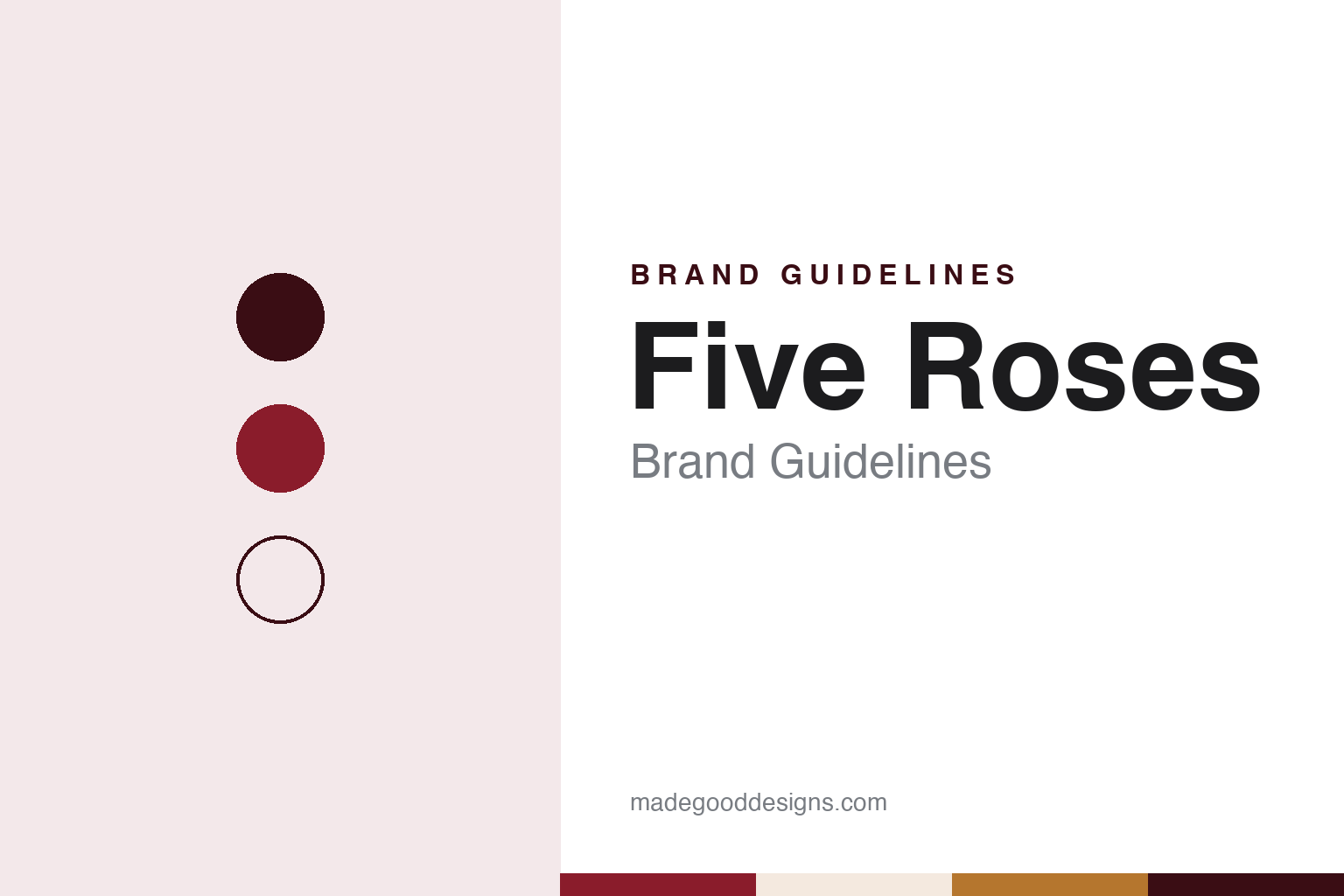
Five Roses Brand Guidelines
AVI’s premium tea, blended by a line of Tea Masters.
Aa
Two constants: a rose red, maroon and amber palette and a warm serif register. Abstract homage — not a Five Roses product or mark; no pack, logo or label is reproduced.
A century of blending
A tea that measures its age in Tea Masters.
Five Roses is one of South Africa’s best-known tea brands, and its owner tells its story through continuity rather than through a founding date. AVI Limited, the Johannesburg consumer-goods group that owns the brand, says that “for over 100 years, Five Roses has been masterfully blended” to produce what it calls a “distinctively rich, smooth, luxurious taste.”
The company’s account rests on a single figure: the Tea Master. AVI says that only the best Ceylon tea leaves are selected by its Tea Master for the original Five Roses blend, and that since the tea was first produced “only seven known Tea Masters have been charged as custodians” of the blend, to keep it consistent from one generation to the next. Those are the company’s claims; the names and dates of the seven are not given on its brand page.
AVI also calls Five Roses “South Africa’s favourite tea,” and its brand line runs: “nobody makes better tea than you and Five Roses.” The company describes an extensive range with “a wide variety of tea blends and flavours,” and it has extended the name into iced tea, which has its own page on AVI’s website.
Colour
Inside AVI, beside Freshpak and Trinco.
Five Roses belongs to AVI Limited, which has its primary listing on the Johannesburg Stock Exchange and a secondary listing on A2X. AVI describes itself as a branded consumer products company with more than 50 brands across hot beverages, biscuits and snacks, frozen foods, personal care, cosmetics, footwear and fashion; its fact sheet lists Five Roses first among its leading brands, ahead of Freshpak, Ellis Brown and Bakers. English Wikipedia records that when the old Anglovaal group was split up, AVI kept National Brands, the food business in which brands such as Bakers sit.
AVI’s own annual reports show how the tea business is organised. In its Integrated Annual Report for 2014 the group placed tea inside its Entyce Beverages division and named three master brands — Five Roses, Freshpak and Trinco — all of which, it said, had grown their market shares. It credited competitive pricing, “active consumer and retailer promotions and effective advertising support” for the result; two years earlier, its 2012 report had described the same three brands as improving their position and “further cementing” the division’s leadership of the tea market. The same report blamed pressure on margins on “particularly Sri Lankan and Malawian tea prices” and a weaker rand.
Ten years later the roles were spelled out more sharply. AVI’s 2024 Integrated Annual Report called Trinco “our value brand” and Five Roses “our premium brand” in black tea, and reported growth in both: black-tea revenue rose, it said, on price increases and market-share gains, with “a strong performance” from Trinco and “pleasing growth” in Five Roses. It set rooibos out as a separate line, adding that a new rooibos value brand had been launched in the last quarter of that financial year.
The same report names the place where the tea is made. Among its capital projects AVI listed utility back-up and security upgrades at its “Durban Tea” site, and new compressors at the Durban Tea factory. That is the company’s own documentation that its tea is produced in Durban.
Rooibos, the red-bush infusion that sits next to black tea in AVI’s portfolio, has its own story in the report. AVI writes that in 1904 a Russian immigrant from a family of tea traders introduced rooibos to the wider world, and that by 1930 a local doctor and botanist had worked out how to germinate its seeds; the plant is native to the Cederberg mountains around Clanwilliam, “Rooibos/Red Bush” is registered as a protected designation of origin in the European Union, and in 2019 the industry signed a benefit-sharing agreement with the South African San Council and the National Khoi & San Council.
Typography
South African food and drink.
The seven brands in this group are all food and drink brands, and all of them come from South Africa: Mrs Ball’s, Ouma, Jungle Oats, All Gold, Five Roses, Joko and Iwisa. South African food and drink brands in general sit at many different points in the trade, from names that still carry a founder’s or a family’s story to names that now belong to much larger food groups, and a single brand can be sold everywhere from a corner shop to a supermarket shelf.
A food or drink brand’s identity is usually carried less by a single product than by a pack, a name and the meal or cup it promises, because the company behind the name may have changed hands, moved its factory or grown far beyond the town where it started. That makes the questions behind each name worth asking plainly: who started it, who owns it now, and where its products are actually made and packed.
Each guide separates what independent sources record from what the company says about itself — its founding story, its owners over time, where its products are made and how its packaging has changed — and marks plainly what rests only on the company’s own word.
Aa
A warm serif — the register of a premium everyday tea. (Specimen set in Fraunces, a serif STAND-IN; NOT the Five Roses logo.)
Five Roses
A tea brand that challenged a phone network.
Five Roses has also shown a knack for public campaigns. In February 2014 a social-media craze called NekNomination, which had begun as a drinking game, was being turned in South Africa into a challenge to do something useful. Five Roses Tea nominated the mobile operator MTN, and on 14 February 2014 MTN answered with a YouTube video announcing that its customers could reach Wikipedia without data charges, as reported by BizTechAfrica on the same day. English Wikipedia records the episode in its article on Sinenjongo High School in Cape Town, whose grade 11 class had lobbied the country’s mobile networks in 2012 to give pupils free access to Wikipedia on their phones.
The name has a namesake abroad that is a different business entirely. Five Roses Flour is a Canadian flour brand, established by the Lake of the Woods Milling Company in 1888 and owned since 2006 by The J.M. Smucker Company, according to English Wikipedia; its “Farine Five Roses” sign has stood over Montreal since 1948. It has no connection with the South African tea.
For a design guide, Five Roses shows how a mass-market brand can borrow the language of craft — a named Tea Master, a lineage of seven, a blend kept constant — and pair it with a line that gives credit to the person making the cup. Compare Joko, another long-running South African tea, and Mrs H.S. Ball’s, a South African pantry staple. For this guide we use rose red, maroon and amber with a serif, an unofficial interpretation; no product or logo is reproduced.
Explore & save
Keep Five Roses’s identity on hand — save it to a board in the Made Good inspiration library.
Five Roses identity set
Pin the Five Roses rose red, maroon and amber palette and the warm serif register to your own board.