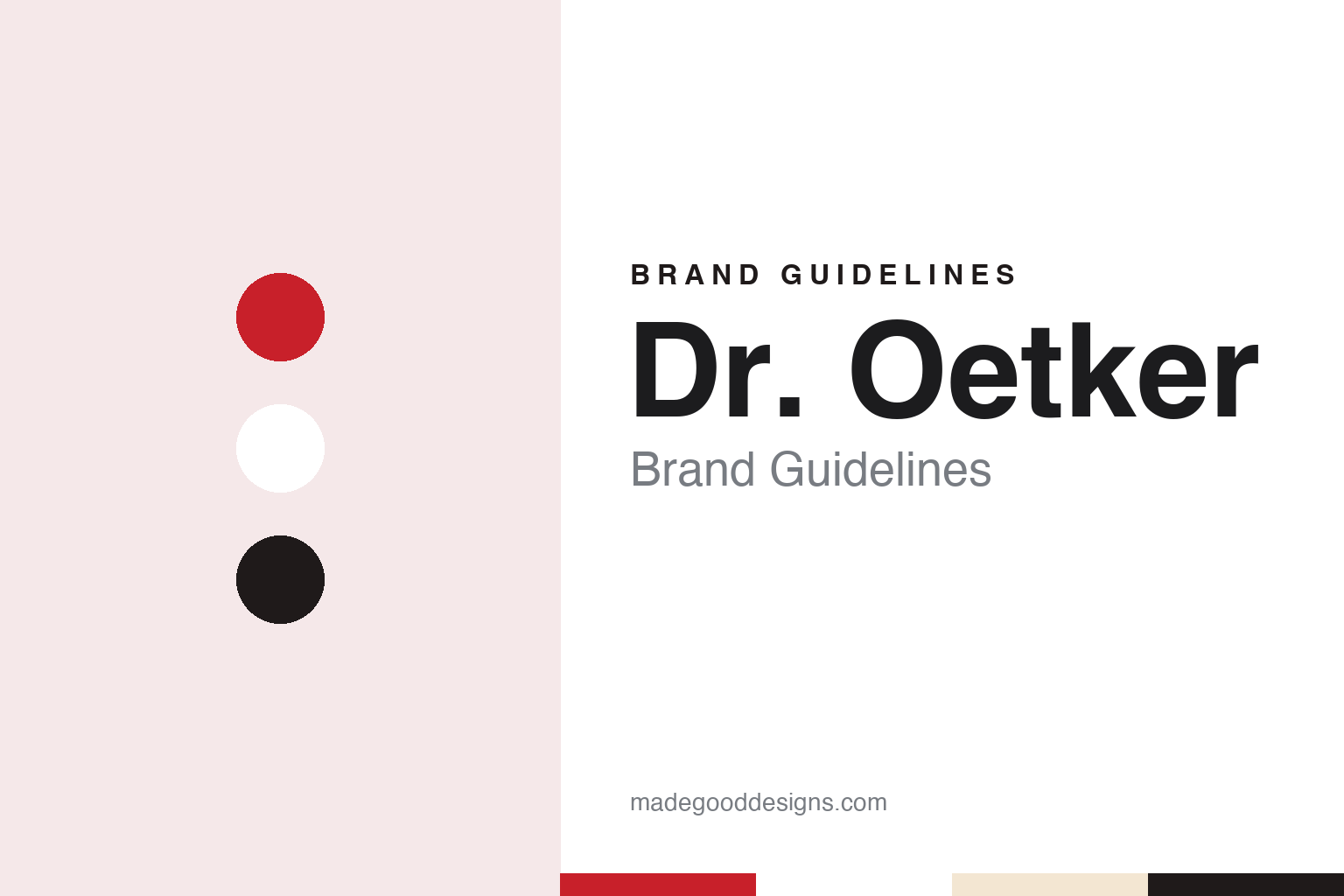
Dr. Oetker Brand Guidelines
The Bielefeld pharmacist’s baking powder and the red-and-white Hellkopf.
Aa
Two constants: a Dr. Oetker red and white palette and a pharmacy serif register. Abstract homage — not a Dr. Oetker product or mark; no packet, logo or Hellkopf is reproduced.
Backin
A pharmacist’s baking powder in Bielefeld.
Dr. Oetker began with a pharmacist. August Oetker, born in 1862 in Obernkirchen, trained as a pharmacist and in 1888 completed a doctorate in botany at the University of Freiburg, German Wikipedia says, citing Rüdiger Jungbluth’s 2006 history of the family. In January 1891 he took over the Aschoff pharmacy in Bielefeld, one of four in the town, and fitted out its laboratory for experiments.
There, and at a local bakery, he worked on a baking powder. The product itself was not new: German Wikipedia, citing the historian Uwe Spiekermann, notes that Eben Norton Horsford had developed one in the United States more than thirty years earlier, and that Oetker heard of it from a cousin living there. Oetker’s idea was the application — a small, ready-measured packet for the home baker. He called it Backin; each packet was measured for 500 grams of flour, and recipes were printed on the pack. On 21 September 1903 he patented a process for making durable baking powder.
Sales grew quickly. In 1900 Oetker opened a factory on the Lutterstraße in Bielefeld, still the company’s headquarters, and by 1906 he had sold 50 million packets of Backin, German Wikipedia says. Pudding powder, flavourings and starch followed. He brought in his brothers: Eduard to run the laboratory in 1904 and Louis to run the sales force and advertising in 1906.
German Wikipedia describes the doctor’s title as a deliberate piece of marketing, presenting the powder as a professionally developed and tested product, and calls the advertising strategy Oetker’s real “invention.” In 1908 he set up an advertising department, with the aim of placing advertisements in every newspaper in towns of more than 3,000 people.
Colour
A bright head, a cookbook and a pudding tower.
The doctor’s name became the mark. German Wikipedia’s article on the founder says the “Dr. Oetker” trademark has been used since 1899. Around the turn of the century, when competitors appeared, the company adopted a logo built on the slogan “Ein heller Kopf verwendet nur Dr. Oetker’s Backpulver” — roughly, “a bright head uses only Dr. Oetker’s baking powder.” The red-and-white Hellkopf, a head in silhouette, is said to be the silhouette of a graphic artist’s daughter, according to German Wikipedia, which cites the Markenlexikon.
The Dr. Oetker Schulkochbuch, first published in 1911, became one of the most successful cookbooks on the German market, German Wikipedia says, and the founder’s article records a cinema advertising film, Backpulver, was sonst. A cookery book under his name, Dr. A. Oetkers Grundlehren der Kochkunst, dated 1895, is held by Project Gutenberg.
In 1950, German Wikipedia says, Oetker sold 400 million packets of baking powder and 350 million packets of pudding powder. The pudding-powder tower on the Bielefeld site, in use from 1914 and producing until 2001, was converted in 2005 into the Dr. Oetker Welt, with a permanent exhibition on the company’s history designed by TRIAD Berlin.
Abroad, the brand often travels under other names. German Wikipedia lists Cameo and Paneangeli in Italy, Koopmans in the Netherlands, Chicago Town in the United Kingdom, Mavalério in Brazil, D’Gari and Rexal in Mexico and, in North America, Wilton, the cake-decorating company whose sale to Dr. August Oetker KG was announced in September 2018. After Dr. Oetker left Russia in 2022, its former Russian business was renamed “Dr. Bakers” with only a slightly changed logo, Business Insider reported in October 2022.
Typography
Design and documentation.
The seven brands in this group all make food, and all of them come from Germany or France: Dr. Oetker, Hengstenberg, Leibniz, Kühne, Seitenbacher, Bonduelle and Lesieur. German and French food brands in general sit at many different points in the trade, from family firms that still carry a founder’s surname to names that now belong to much larger food groups, and a single brand can be sold everywhere from a village grocer to a supermarket shelf.
A food brand’s identity is usually carried less by a single product than by a pack, a name and the meal or snack it promises, because the company behind the name may have changed hands, moved its factory or grown far beyond the town where it started. That makes the questions behind each name worth asking plainly: who started it, who owns it now, and where its food is actually made and packed.
Each guide separates what independent sources record from what the company says about itself — its founding story, its owners over time, where its products are made and how its packaging has changed — and marks plainly what rests only on the company’s own word.
Aa
A warm pharmacy serif — the register of a doctor’s name on a baking packet. (Specimen set in Fraunces, a serif STAND-IN; NOT the Dr. Oetker logo.)
Dr. Oetker
A family firm, divided in 2021.
After the First World War the firm was run first by Fritz Behringer and, from 1921, by Richard Kaselowsky, who had married Rudolf’s widow, Ida, as a trustee for the grandson, Rudolf-August Oetker. In 2013 a study the family had commissioned from the historians Jürgen Finger, Sven Keller and Andreas Wirsching, Dr. Oetker und der Nationalsozialismus, concluded that the family and the firm had been “pillars” of Nazi society that sought closeness to the regime and profited from its policies, the Süddeutsche Zeitung reported in October 2013.
Under Rudolf-August Oetker the group diversified into shipping, sparkling wine — Söhnlein in 1958, Henkell in 1986 — and breweries later gathered as the Radeberger Group. His son August Oetker led it from 1981 to 2009, his brother Richard from 2010 to 2016, and in 2017 Albert Christmann became the first head from outside the family, the Frankfurter Allgemeine reported. In July 2021 the owners announced that the group would split in two; from 1 November 2021, Henkell, Martin Braun and Budenheim went to Geschwister Oetker Beteiligungen KG, while Dr. August Oetker KG kept the Dr. Oetker food business, Coppenrath & Wiese and Radeberger.
The food business is run by Dr. August Oetker Nahrungsmittel KG in Bielefeld, and frozen pizza has replaced baking powder as its biggest-selling product, German Wikipedia says. Six plants in Germany make Dr. Oetker products; the pizza plant at Wittlich produced about 1.5 million pizzas and snacks a day for some 50 countries, the Rhein-Zeitung reported in April 2025. Other plants are in France, Italy, the Netherlands, the United Kingdom, Poland, Hungary, Romania, Slovakia and Turkey, and outside Europe in Canada, the United States, Mexico, Brazil, Tunisia, South Africa, India, Malaysia and Australia; Czech production ended in 2025, Radio Prague reported.
For a design guide, Dr. Oetker shows how a single head in profile and a doctor’s title can carry a brand for more than a century. Compare Chicago Town, its British pizza brand, and Bahlsen, another German family baking name. For this guide we use red, white and a cream with a serif, an unofficial interpretation; no product or logo is reproduced.
Explore & save
Keep Dr. Oetker’s identity on hand — save it to a board in the Made Good inspiration library.
Dr. Oetker identity set
Pin the Dr. Oetker red and white palette and the pharmacy serif register to your own board.