Nidar Brand Guidelines
The Trondheim chocolate maker behind Stratos, Laban and Smash!
Aa
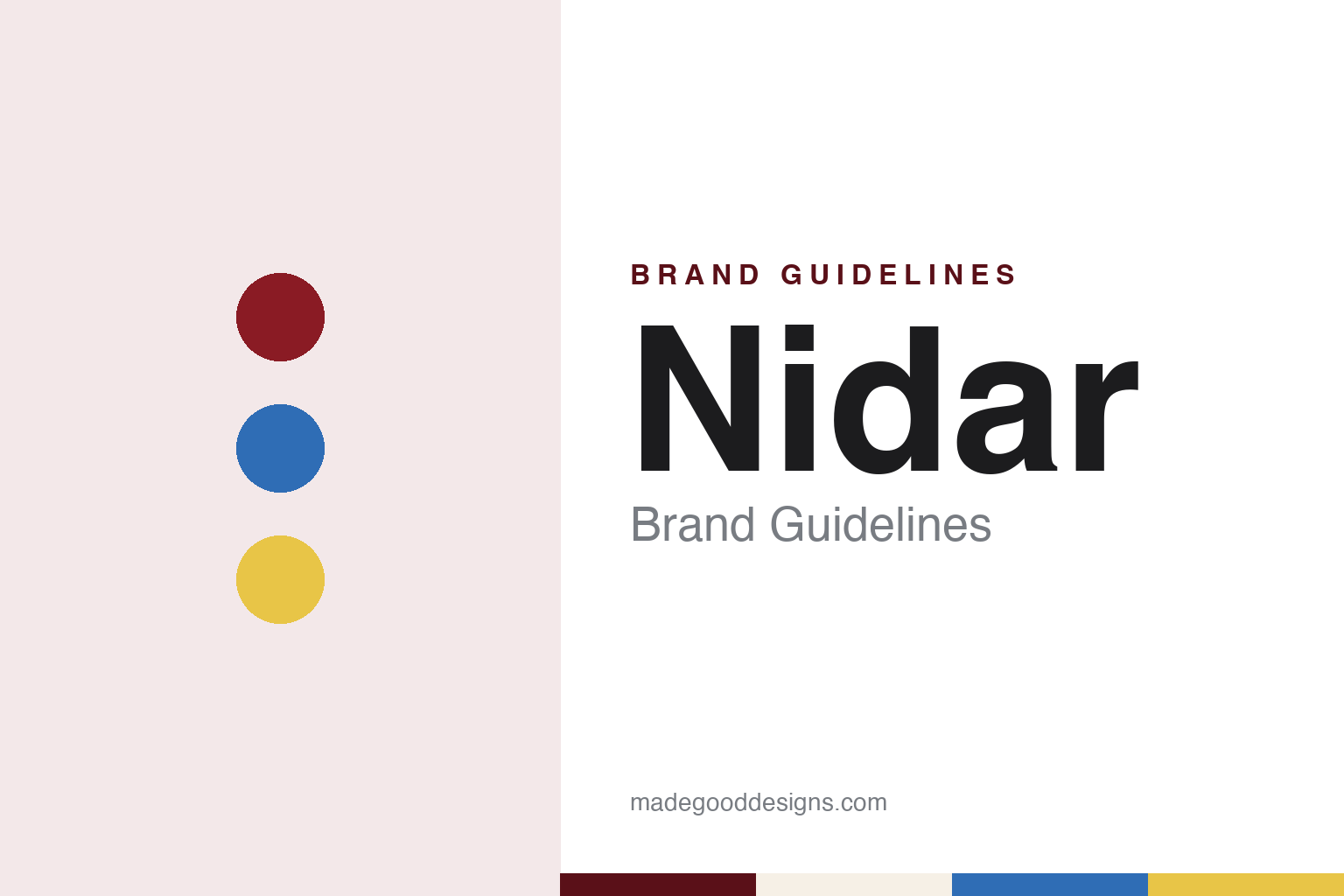
Two constants: a Nidar red, Stratos blue and corn gold palette and a warm confectioner’s serif register. Abstract homage — not a Nidar product or mark; no pack, logo or sweet is reproduced.
A Freia salesman in Trondheim
Two founders, German machines and a factory on Lademoen.
Nidar is a Trondheim company, and it has been one since its first day. Norwegian Wikipedia, citing the company and its owner Orkla, dates its founding to 2 May 1912 and names two founders: Emil Nilsen, who had worked as a sales representative for the Oslo chocolate maker Freia, and Hans Bell, a stockbroker. Between them they raised a share capital of 100,000 kroner. The company itself says simply that Nidar was set up in 1912 as a business from Trøndelag, the region around Trondheim, and it marked its centenary in 2012.
The first factory stood on Lademoen in Trondheim and was equipped with up-to-date German machinery, Norwegian Wikipedia says. Chocolate production began there in 1915, the year the same source gives for Gullbrød, one of the company’s earliest lines; Mokkabønner, chocolate coffee beans, followed in 1917.
Over the next decades Nidar became a broad confectioner rather than a chocolate maker alone. English Wikipedia says that through mergers and acquisitions in the 1970s it took in three older Norwegian sweet makers: Kiellands Fabrikker of Oslo, founded in 1891; Lorentz Erbe & Søn of Trondheim, founded in 1899; and Bergene of Oslo, founded in 1906. Norwegian Wikipedia records the last of those steps as a 1980 merger in which Nidar-Erbe of Trondheim joined the Bergene chocolate factory in Oslo to form A/S Nidar Bergene. English Wikipedia lists its lines today as chocolate, sugar confectionery, marzipan and pastilles.
Colour
An airy bar, sugared gums, a foam bear and a salty corn snack.
Nidar’s oldest headline product is Stratos, launched in 1936. It is an aerated milk chocolate, and Norwegian Wikipedia says the name comes from the stratosphere and that the bar followed two earlier aerated chocolates, Bros in 1934 and Aero in 1935. The company says its bubbles come from what it calls the “Stratos cannon,” a step that blows air into the chocolate mass before it cools, and that the process makes bubbles of different sizes. Stratos has a mascot, a blue cow; Norwegian Wikipedia says the cow first appeared in 1979, was redrawn in 1987 and was relaunched in 2007.
Troika came in 1939, originally under the name Geletrøffel, English Wikipedia says, and Crispo in 1958, Norwegian Wikipedia says. In 1965 Nidar launched Laban, according to Norwegian Wikipedia. The company describes Laban as soft jelly figures rolled in sugar, made by casting the jelly in cornstarch moulds, drying it, brushing it clean and coating it; in 2020, it says, female figures joined the male ones in the bag for the first time. Bamsemums, a bear-shaped foam sweet coated in chocolate, followed in 1975; Norwegian Wikipedia describes the foam being poured into bear-shaped moulds dusted with cornstarch and left for two days before being brushed and coated.
The youngest of the best-known names is Smash!, from 1988: salted corn kernels covered in Nidar milk chocolate, as the company describes it. Norwegian Wikipedia, citing the trade papers Handelsbladet FK and Dagligvarehandelen, says sales started slowly and took off in the mid-2000s, and that by 2006 Smash! was Norway’s third best-selling chocolate product. It has also travelled: Adresseavisen reported its 2008 launch in Finland through the Finnish confectioner Panda, and in Sweden it is marketed by the snack maker OLW, Norwegian Wikipedia says.
Typography
Design and documentation.
The seven brands in this group are all Nordic food and dairy names: Kalles Kaviar, Felix, Estrella, Valio, Arla, Stabburet and Nidar. Nordic food brands in general sit at many different points in the trade, from names that still carry a founder’s story to brands that now belong to much larger food groups or farmer-owned co-operatives, and a single brand can be sold everywhere from a corner shop to a supermarket shelf.
A food brand’s identity is usually carried less by a single product than by a pack, a name and the meal or snack it promises, because the company behind the name may have changed hands, moved its factory or grown far beyond the town where it started. That makes the questions behind each name worth asking plainly: who started it, who owns it now, and where its food is actually made and packed.
Each guide separates what independent sources record from what the company says about itself — its founding story, its owners over time, where its products are made and how its packaging has changed — and marks plainly what rests only on the company’s own word.
Aa
A warm confectioner’s serif for a century-old Trondheim chocolate house. (Specimen set in Fraunces, a serif STAND-IN; NOT the Nidar logo.)
Nidar
From Nidar Bergene to Nora and Orkla, still made in Trondheim.
Nidar’s independence ended in the 1980s. Norwegian Wikipedia says the company was taken over by Nora Industrier in 1987, under the name Nidar AS; through that decade Nora also owned the food brands Idun and Stabburet, the same source says. Nora in turn merged with Orkla: Norwegian Wikipedia dates the merger to 1991, citing Dagens Næringsliv of January that year, while English Wikipedia gives 1992.
Inside Orkla, Nidar has been folded into larger units. In 2013, Norwegian Wikipedia and the company both say, Nidar became part of Orkla Confectionery & Snacks Norge, a combination of Nidar with the snack maker KiMs and the biscuit maker Sætre. Norwegian Wikipedia describes Nidar today as a brand within Orkla Snacks Norge, part of Orkla’s Orkla Snacks division.
Its production has stayed in Trondheim. Norwegian Wikipedia places the factory at Leangen, in the east of the city, describing a site of about 39,000 square metres of production and office space with eight production lines. The company says thousands of chocolates, gums and caramels are made there every day, and calls Nidar one of Norway’s largest chocolate and confectionery brands.
For a design guide, Nidar shows how a regional confectioner can carry a family of distinct product brands — an airy bar with a blue cow, sugared jelly figures, a foam bear and chocolate-coated corn — under one Trondheim name for more than a century. Compare Freia, the Oslo chocolate maker where Emil Nilsen once worked, and Panda, the Finnish confectioner that took Smash! to Finland. For this guide we use a Nidar red, a Stratos blue and a corn gold with a warm serif, an unofficial interpretation; no product or logo is reproduced.
Explore & save
Keep Nidar’s identity on hand — save it to a board in the Made Good inspiration library.
Nidar identity set
Pin the Nidar red, Stratos blue and corn gold palette and the warm confectioner’s serif register to your own board.