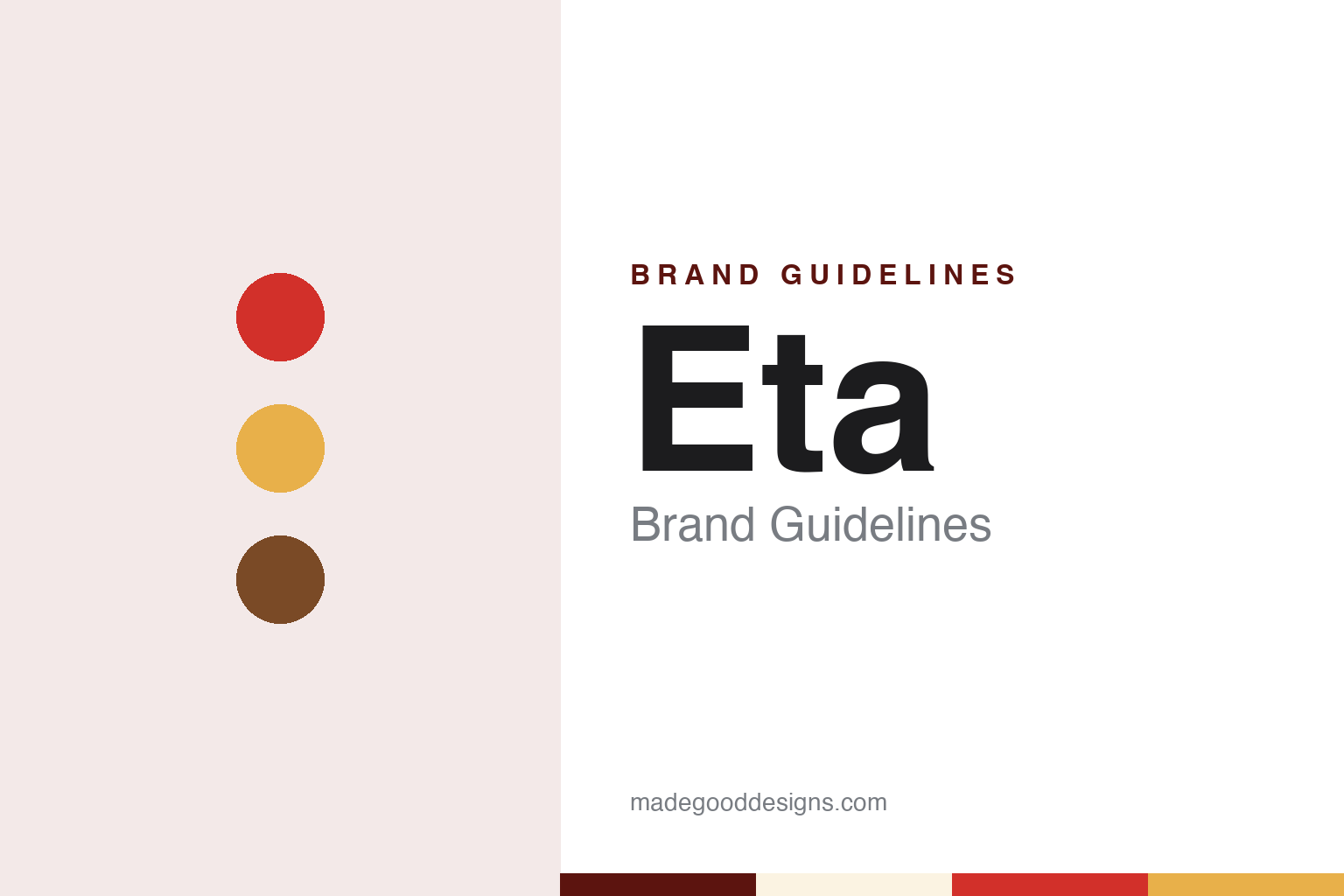
Eta Brand Guidelines
The Auckland “Eat a nut” brand that grew into chips.
Aa
Two constants: a packet red, chip gold and peanut brown palette and a rounded friendly sans register. Abstract homage — not an Eta product or mark; no packet, jar or logo is reproduced.
Eat a nut
A family, a factory in Newmarket and a short name.
Eta is one of the more unusual names on the New Zealand supermarket shelf, because one brand now belongs to several companies. Its own account of its beginnings, published on the Eta website in 2004, says the name is short for “Eat a nut” and that it first appeared on New Zealanders’ shopping lists in 1949, “after starting in Australia.” In New Zealand, the website said, the brand was introduced by the Abel family of Auckland, who opened the first factory in Newmarket, Auckland, that year.
The early range matched the name. The company said Eta started with packaged nuts and peanut butter, and that the range later grew to take in potato chips and salad dressings, reaching 217 products by 2004. As demand grew it needed a bigger plant: the website said a factory at Wiri, in south Auckland, opened in 1971, and that from 1974 production, management and distribution moved there in stages. In 2004 Eta said it employed more than 900 New Zealanders and that all the potatoes in its chips were grown in New Zealand. It also promised an unconditional guarantee: a dissatisfied customer could return the unused portion of a product for a replacement and a refund of the postage.
By 2004 the website named the French food group Danone as the owner of Eta in New Zealand. The route there runs through Griffin’s, the Nelson-founded biscuit company, and through a decision in 1998 that divided the brand by product.
Colour
Griffin’s, Heinz and a divided pantry.
Griffin’s’ own pictorial timeline, published for its 150th anniversary in 2014, says that in 1987 Griffin’s acquired ETA Foods, “including its range of chips, peanuts, peanut butter and salad dressings.” At the time Griffin’s belonged to Nabisco, which the timeline says had bought all of it in 1962.
The split came in July 1998. The 2004 Eta website said Eta sold its peanut butter and salad dressings business to Heinz that month; Heinz Wattie’s own history, as published in 2019, describes the 1998 deal as taking on the ETA brand salad dressings and peanut butter under licence. Either way, the result is visible today: Kraft Heinz New Zealand runs an ETA salads and dressings website, while the Eta snack site, eta.co.nz, carries the line “Eta – Griffin’s Snacks.”
On the snack side, Eta is a family of potato-chip and nut ranges. The current Eta website groups products under names including Ripples, Ridgies, Uppercuts and Crunches, alongside nuts, and lists Eta beside three sister snack brands from the same business: SnackaChangi Snacks, the Kettle Chip Company and The Natural Chip Co. The website describes a partnership with Surf Life Saving New Zealand, under which a donation is made for each specified bag of Ripples sold. Griffin’s’ timeline also records that it bought the Sancho corn-chip and salsa ranges from Cerebos Greggs in 2000, and the Nice & Natural wrapped-snacks business in 2007.
Typography
Design and documentation.
The seven brands in this group all make food, and all of them come from New Zealand and Australia: Cottee’s, Griffin’s, Wattie’s, Eta, Bluebird, Anchor and Mainland. Food brands from the two countries in general sit at many different points in the trade, from names that still carry a founder’s surname to names that now belong to much larger food groups, and a single brand can be sold everywhere from a corner dairy to a supermarket shelf.
A food brand’s identity is usually carried less by a single product than by a pack, a name and the meal or snack it promises, because the company behind the name may have changed hands, moved its factory or grown far beyond the town where it started. That makes the questions behind each name worth asking plainly: who started it, who owns it now, and where its food is actually made and packed.
Each guide separates what independent sources record from what the company says about itself — its founding story, its owners over time, where its food is made and how its packaging has changed — and marks plainly what rests only on the company’s own word.
Aa
A rounded friendly sans for a brand that began as “Eat a nut.” (Specimen set in Nunito, a sans STAND-IN; NOT the Eta logo.)
Eta
Owners on both sides of the Tasman.
The New Zealand snack business has changed hands with Griffin’s. According to Griffin’s’ timeline and English Wikipedia, ownership passed from Nabisco to Britannia Foods in 1990 and, in December that year, to Danone; on 7 June 2006 the private-equity firm Pacific Equity Partners bought Griffin’s Foods from Danone. English Wikipedia says the Philippine company Universal Robina bought Griffin’s in July 2014; that in 2019 Universal Robina and the German snack maker Intersnack formed a joint venture, Unisnack ANZ, with Intersnack holding 40%; and that Intersnack became sole owner in August 2021 by buying the remaining 60%. The careers link on the Eta website now points to Intersnack ANZ. Griffin’s’ timeline says its Lower Hutt factory closed in December 2008, with investment going into its plants at Papakura and Wiri in Auckland.
In Australia, where the Eta website said the brand started, ETA belongs to Goodman Fielder. The company’s brand page lists ETA as available in Australia and New Caledonia, with ranges of dressings, sauces and spreads, and calls it “a true Aussie legend.” English Wikipedia says Goodman Fielder was formed in 1986, was taken over by a joint venture of Wilmar International and First Pacific in March 2015, and became wholly owned by Wilmar in 2019 when Wilmar bought First Pacific’s half. Wikipedia’s article on the Australian sweet Lolly Gobble Bliss Bombs says Goodman Fielder sold that brand in 1991 together with the ETA and Daffodil nuts brands to Southern Cross Foods. The Australian domain eta.com.au belongs to an unrelated Queensland gearbox supplier.
For a design guide, Eta shows how a short, memorable name can outlive the company that coined it, travelling separately on chip packets, dressing bottles and peanut-butter jars under different owners. Compare Griffin’s, which has owned the snack side since 1987, and Wattie’s, which took on the dressings and peanut butter in 1998. For this guide we use packet red, chip gold and peanut brown with a rounded sans, an unofficial interpretation; no product or logo is reproduced.
Explore & save
Keep Eta’s identity on hand — save it to a board in the Made Good inspiration library.
Eta identity set
Pin the Eta packet red, chip gold and peanut brown palette and the rounded friendly sans register to your own board.