Daoxiangcun Brand Guidelines
The Beijing pastry shop of 1895 and the name it shares with Suzhou.
Aa
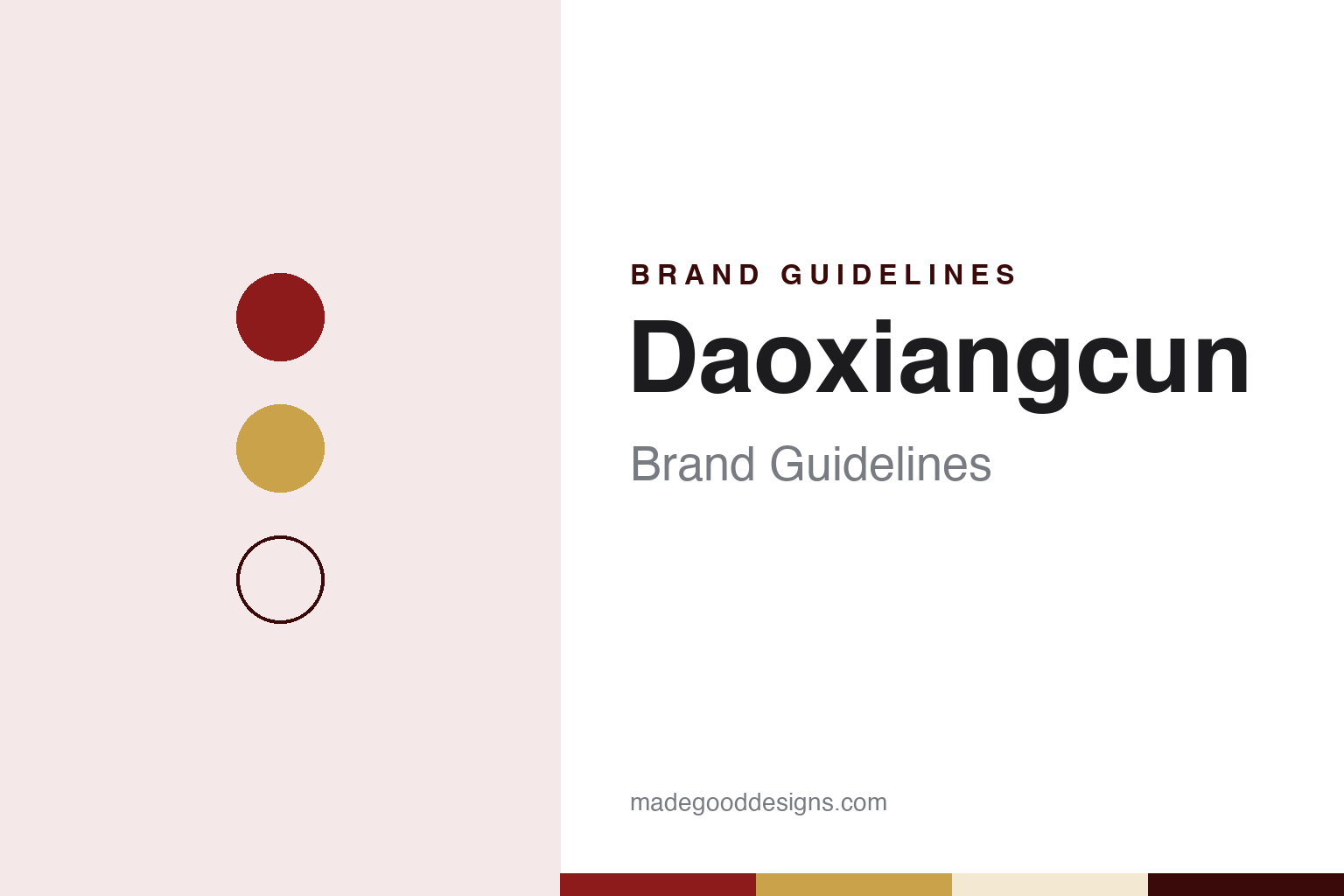
Two constants: a Daoxiangcun red, gold and cream palette and a calligraphic serif register. Abstract homage — not a Daoxiangcun product or mark; no signboard, logo or pack is reproduced.
A southern shop in Beijing
Nanjing pastry cooks move north.
The name Daoxiangcun — 稻香村, “village of fragrant rice” — belongs to more than one Chinese pastry business, and this guide is mainly about the Beijing one. Beijing Daoxiangcun dates itself to 1895. The company says that in that year Guo Yusheng, a man from Jinling — the old name for Nanjing — came north and settled at Guanyinsi, near Qianmen, the front gate of the old city. Chinese Wikipedia describes the shop as a southern-style food store that brought pastry cooks and techniques from the south to the capital.
That first shop did not last. Chinese Wikipedia says rival southern-style shops opened in Beijing in 1911 and 1916, and that the original Daoxiangcun closed in 1926, amid the fighting and economic decline of the warlord period.
The revival came more than half a century later. The company says its former manager, Liu Zhenying, took on the work of reopening the business in 1983 in a small hutong; Chinese Wikipedia dates the new business licence to April 1983 and the reopening of the shop to January 1984, with Liu leading it. The business became a food group in 1994 and, Chinese Wikipedia says, was restructured in October 2005 as Beijing Daoxiangcun Food Co., Ltd., the limited company that runs it today. The company names its current chairman as Bi Guocai.
Official recognition followed. Chinese Wikipedia says the brand was named a China Time-honoured Brand (中华老字号) by the then Ministry of Domestic Trade in October 1993, a status confirmed by the Ministry of Commerce in 2006, and a Beijing time-honoured brand in 2014.
Colour
Pastries for the seasons and festivals.
Beijing Daoxiangcun’s range is built around the Chinese calendar. Chinese Wikipedia describes it as organised by “four seasons and three festivals,” and the company’s range runs from Beijing-style pastries to mooncakes for the Mid-Autumn Festival, zongzi for the Dragon Boat Festival and yuanxiao, the filled rice balls of the Lantern Festival, along with cooked meats, frozen dumplings, bread and snacks. The company says it makes more than 600 products in 15 categories.
The company says production takes place at a modern factory in the Beiqijia area of Changping district, on Beijing’s northern edge, and it describes a model handed down from the old shops of making goods itself and selling them through its own outlets. In July 2025, it says, it had 231 chain stores in Beijing, as well as counters in supermarkets and sales points in other provinces, and flagship stores on Tmall and JD.com. In 2008 it was a food supplier to the Beijing Olympics, the company and Chinese Wikipedia both say.
The company’s registered mark, Chinese Wikipedia says, is known as “Three He” (三禾), from the character for growing grain. In recent years the company has used its shops as design projects: it says it opened a fresh-baking format called the “Zero Store” in August 2021, a second store themed on the 24 solar terms in March 2023, and in July 2024 a third new-format shop on Longfusi street, which it describes as bringing food, tableware and interior design together. In November 2025 it launched a Western-style pastry line, which it says reworks older Beijing products.
The company also says its Beijing-style mooncake and pastry techniques are listed as district-level intangible cultural heritage.
Typography
Design and documentation.
The seven brands in this group all make food or drink, and all of them come from China or Taiwan: Three Squirrels, Daoxiangcun, I-Mei, Kuai Kuai, Uni-President, Wei Chuan and C’estbon. Food and drink brands from China and Taiwan in general sit at many different points in the trade, from family firms that still carry a founder’s name to names that now belong to much larger groups, and a single brand can be sold everywhere from a corner shop to a supermarket shelf.
A snack or drink brand’s identity is usually carried less by a single product than by a pack, a name and the treat or refreshment it promises, because the company behind the name may have changed hands, moved its factory or grown far beyond the city where it started. That makes the questions behind each name worth asking plainly: who started it, who owns it now, and where its products are actually made and packed.
Each guide separates what independent sources record from what the company says about itself — its founding story, its owners over time, where its products are made and how its packaging has changed — and marks plainly what rests only on the company’s own word.
稻香村
A calligraphic serif — the register of a time-honoured shop sign. (Specimen set in Noto Serif SC, a serif STAND-IN; NOT the Daoxiangcun signboard or logo.)
Daoxiangcun
Two companies, one name.
The name has an older holder. Suzhou Daoxiangcun dates itself to 1773, in the reign of the Qianlong emperor, and Chinese Wikipedia says it began on Guanqian Street in Suzhou. The same article says the Suzhou shop was badly damaged during the Taiping war around 1860 and that its workers scattered to other cities, where shops of the same name grew up without a formal link. It went through state ownership and several names after 1956, became the Suzhou Daoxiangcun Food Factory in 1986 and was reorganised as a company in 2004; Chinese Wikipedia says it was named a time-honoured brand by the Ministry of Commerce in 2006. Its website, which describes it as a group, says it has more than 800 dedicated stores and that its Suzhou-style mooncake technique is on Jiangsu’s provincial intangible heritage list.
The two companies have contested the name in the courts since Suzhou applied to register a Daoxiangcun mark in 2006. In September 2017, during the mooncake season, the Beijing Intellectual Property Court briefly ordered the Suzhou company to stop selling Daoxiangcun-branded goods online, then lifted the order four days later after a counter-guarantee, English and Chinese Wikipedia record.
For readers and designers the practical point is that the two are separate businesses with separate identities. The websites differ too: daoxiangcun.com is Beijing Daoxiangcun’s, while daoxiangcun.cn is the Suzhou group’s.
For a design guide, Daoxiangcun shows how a time-honoured shop name can be revived, extended through the festival calendar and refreshed through the design of its stores, and how one name can carry two identities. Compare White Rabbit, the Shanghai milk candy with its own long history, and Wahaha. For this guide we use lantern red, rice gold and pastry cream with a serif, an unofficial interpretation; no product or logo is reproduced.
Explore & save
Keep Daoxiangcun’s identity on hand — save it to a board in the Made Good inspiration library.
Daoxiangcun identity set
Pin the Daoxiangcun red, gold and cream palette and the calligraphic serif register to your own board.