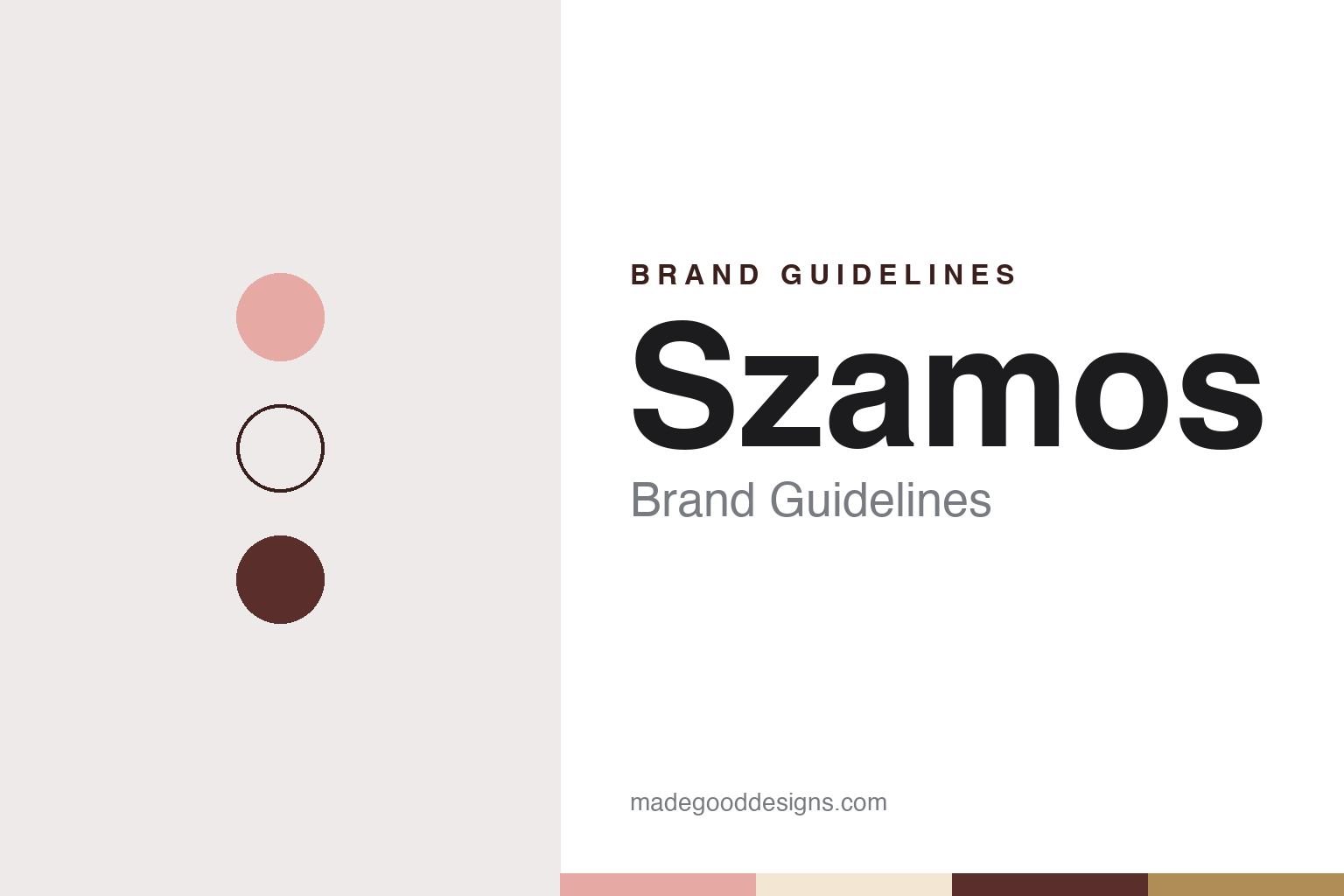
Szamos Brand Guidelines
The Budapest marzipan house that began with a rose.
Aa
Two constants: a Szamos rose, almond and cocoa palette and a confectioner’s serif register. Abstract homage — not a Szamos product or mark; no confection, logo or pack is reproduced.
A rose
An apprentice, a Danish confectioner and a lump of marzipan.
Szamos tells its own beginning as a story about a single flower. According to the company’s history, a poor, fatherless boy from a Serbian family in Szentendre, the Danube town north of Budapest, was serving his apprenticeship as a confectioner in the well-known shop of Auguszt E. József on Krisztina körút in Buda. The company’s English-language history, archived from its old website between 2013 and 2016, gives the boy’s name as Szavits Mladen; the business that grew from his work carries the name of Mátyás Szamos, the confectioner the company calls its founder.
In the early 1930s, the story goes, a Danish confectioner visited the shop and showed that, with skill, attention and a great deal of practice, the sweet almond paste called marzipan could be shaped into pretty roses. The apprentice watched closely and learnt. Szamos’s own history describes its start in those years: a version of its company-history page archived in 2018 says the firm was founded by Mátyás Szamos in the 1930s, without giving a year, and that “everything began with marzipan.”
The same history says Szamos widened his range little by little with the same enthusiasm he brought to his marzipan, adding cakes and tortes made to traditional recipes and bonbons from his own chocolate workshop. The company also says the recipes and methods have passed from generation to generation inside the family; its old English history describes a wife met in the confectionery, children, grandchildren and a son-in-law who all learnt to make the roses. Today Szamos describes itself as one of Hungary’s best-known family businesses.
Colour
From a shop on Párizsi utca to cafés, a museum and a workshop.
The company dates its chocolate story to 1986, when, it says, Mátyás Szamos opened his first shop on Párizsi utca in central Pest. The confectioner, still working at the time, made his first marzipan-and-brandied-cherry sweet there, and the street was where Szamos’s handmade chocolates were first sold. A Szamos confectionery on Párizsi utca still appears in the company’s current list of shops.
Growth followed in the 1990s. The 2018 version of the company’s website says the Szamos family opened its first Budapest café at the start of that decade together with the Austrian confectioner Haderer, and that there were by then twenty Szamos cafés. The old English history says that by the middle of the 1990s the marzipan business employed more than 200 people at Pilisvörösvár, a town just outside Budapest, where Szamos still lists a confectionery today. Hungarian Wikipedia, citing a Budapest Castle district website, says that by their own account Szamos’s sons and grandchildren leased and then, in 1994, bought the Ruszwurm, the old confectionery in Buda’s Castle district. In November 2008, according to Hungarian Wikipedia citing a local news report of the time, Szamos took over the running of the Központi Kávéház, the central coffee house in Esztergom, where a 1:200 marzipan model of the town’s basilica is on show.
The family has also turned its craft into something to visit. In Szentendre, the founder’s home town in the company’s story, Szamos lists a marzipan exhibition and viewing workshop on Dumtsa Jenő utca, next to its Múzeum Cukrászda. In Budapest, the Szamos Chocolate Museum occupies six rooms on the upper floor of the Szamos Cafe on Kossuth tér, the square in front of the Parliament. The company says it shows a 1920s sweet shop and a turn-of-the-century chocolate workshop, marzipan sculptures including a miniature Parliament and the Hungarian coronation regalia, and a work made from 78 kilograms of marzipan after Jean-Étienne Liotard’s painting La Belle Chocolatière, which Szamos describes as the world’s largest marzipan creation. A chocolate school runs alongside.
Typography
Hungary’s sweet trades.
The seven brands in this group all make food or drink, and all of them come from Hungary: Szamos, Tibi, Sport, Dreher, Borsodi, Unicum and Pöttyös. Hungarian food and drink brands in general sit at many different points in the trade, from family firms that still carry a founder’s surname to names that now belong to much larger food or drinks groups, and a single brand can be sold everywhere from a corner shop to a supermarket shelf.
A food or drink brand’s identity is usually carried less by a single product than by a pack, a name and the treat or the drink it promises, because the company behind the name may have changed hands, moved its factory or grown far beyond the town where it started. That makes the questions behind each name worth asking plainly: who started it, who owns it now, and where its products are actually made and packed.
Each guide separates what independent sources record from what the company says about itself — its founding story, its owners over time, where its products are made and how its packaging has changed — and marks plainly what rests only on the company’s own word.
Aa
A confectioner’s serif, chosen to suit a house built on marzipan roses. (Specimen set in Cormorant Garamond, a serif STAND-IN; NOT the Szamos logo.)
Szamos
Marzipan roses, cakes and a family name.
Marzipan remains at the centre of what Szamos sells. Its online shop offers marzipan figures, flowers and marzipan paste for decorating cakes alongside whole tortes, cake slices, figure cakes and cakes for special occasions. The confectionery side covers boxed bonbons, dragées and bars of chocolate, gift boxes and made-to-order bonbon selections, and a “free-from” range of cakes and sweets. The 2018 website said its desserts and café pastries were also sold nationally through retail chains and petrol-station networks.
Most of the business is in and around Budapest. The company’s current list of shops includes the Szamos Gourmet Ház on Deák Ferenc utca, cafés in shopping centres across the city, a sweet shop at the airport and the Szamos Marcipán Téka in Buda, with further outlets in Eger, Esztergom, Pilisvörösvár, Székesfehérvár and Szentendre. The company calls itself a family business, and the people named in its own history are Mátyás Szamos and his descendants. Its current website credits the agency Positive Adamsky for design.
The name needs care when searching. Szamos is also the Hungarian name of a river, and of unrelated businesses and people; the confectioner’s own website is szamos.hu, which replaced the older szamosmarcipan.hu. The founder’s first name and surname appear in the Hungarian order — Szamos Mátyás — throughout the company’s Hungarian material.
For a design guide, Szamos shows how a single handmade object, the marzipan rose, can carry a family business from an apprentice’s bench to cafés, a museum and a visitor workshop. Compare Niederegger, Lübeck’s marzipan house, and Anthon Berg, the Copenhagen marzipan maker. For this guide we use rose, almond cream and cocoa brown with a serif, an unofficial interpretation; no product or logo is reproduced.
Explore & save
Keep Szamos’s identity on hand — save it to a board in the Made Good inspiration library.
Szamos identity set
Pin the Szamos rose, almond and cocoa palette and the confectioner’s serif register to your own board.