Harrisville Designs Brand Guidelines
The New Hampshire mill village yarn maker that kept spinning after the mills closed.
Aa
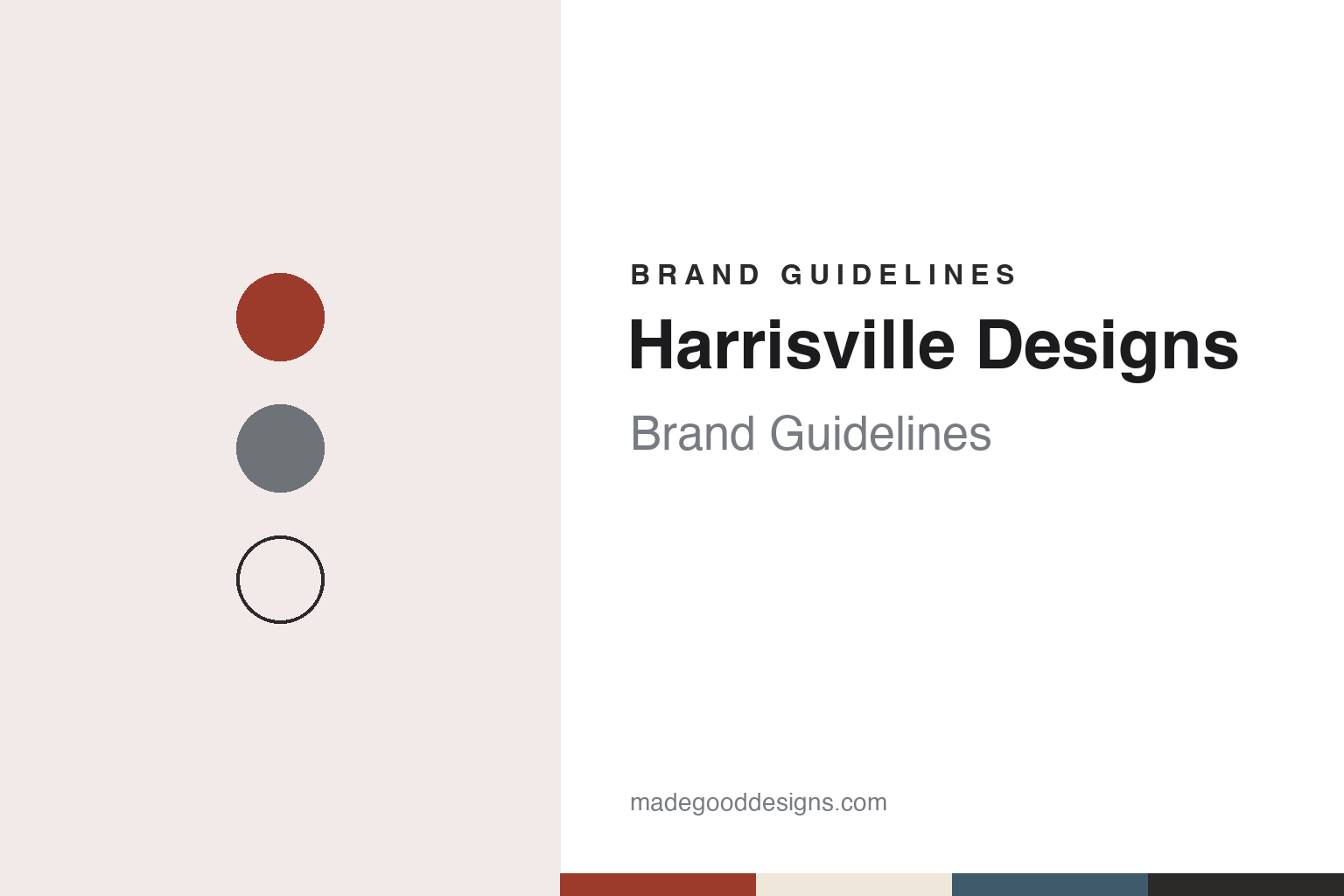
Two constants: a brick, granite and fleece palette and a mill-town serif register. Abstract homage — not a Harrisville Designs product or mark; no yarn label, loom or logo is reproduced.
Cheshire Mills
A mill village and the family that ran it.
Harrisville Designs makes yarn in Harrisville, New Hampshire, a small town in the south-west of the state. Wool has been worked there for more than two centuries: the company dates the first woollen mill to 1794, and English Wikipedia, citing an 1886 town history, describes how members of the Harris family built brick mills on the stream for making woollen cloth in the 1820s and 1830s. The town takes its name from one of them, Milan Harris.
The second family in the story is the Colonys. According to Historic Harrisville, the preservation group that owns many of the village’s buildings, the Colony family and their Cheshire Mills followed the Harrises in about 1850, and by 1900 the Harris family had sold its holdings to Cheshire Mills. Cheshire Mill No. 1, with its bell tower, was built of New Hampshire granite in 1848, English Wikipedia says. Cheshire Mills was one of the last textile mills operating in New England when it closed in 1970.
The closure left the village with empty mills. Historic Harrisville, Inc. was set up in 1971 as a preservation organisation and bought core buildings to restore and let. The company says that, as machinery was being cleared out and sold for scrap, John J. “Chick” Colony III, of the mill family, saw that textiles could vanish from the village altogether, and in 1971 started Harrisville Designs “to keep the textile tradition alive and to create jobs in Harrisville,” renting space from Historic Harrisville. English Wikipedia, citing the Keene Sentinel, gives the same year and founder; Modern Daily Knitting, in 2025, credited the founding to John and Pat Colony together.
In 1977 the village was designated a National Historic Landmark — the Harrisville Historic District, about 135 structures on some 200 acres, according to English Wikipedia. The company describes it as the only 19th-century American textile village that survives in its original form.
Colour
Woollen-spun yarn and maple looms.
Harrisville Designs spins woollen-spun yarn, in which carded fibre is spun without first being combed straight, giving a light, airy thread. On a mill tour for Modern Daily Knitting in August 2025, the spinning teacher Jillian Moreno described the process: fibre, both American and imported, arrives in bales, dyed or natural; a picker that has been working since the 1900s opens and blends it; a carding machine draws it into thin strips; and it then goes to one of the company’s two spinning machines before being plied and wound into skeins or onto cones.
The company’s two core yarns are Highland and Shetland, Moreno wrote. Shetland takes its name from its weight and its two-ply woollen structure rather than from the breed: it is a blend of Australian and New Zealand wool, in 64 colours. The range also includes Nightshades and Daylights, and Shear, an undyed yarn that the company says is spun from the wool of a flock of California Variegated Mutant and Romeldale sheep in Idaho and Oregon. Harrisville Designs also sells carded fleece for felting and spinning.
Yarn is only part of the business. The company says it has made floor looms since 1972, built from hard rock maple in its own woodshop in Harrisville; its Model A and Model T looms weave up to 22 and 36 inches wide and are sold assembled or as kits, a format it says was designed in the 1970s for weavers to put together at home. Under the Friendly Loom name it makes weaving, knitting and felting products for children, including metal potholder looms and cotton loops. It also teaches weaving and other textile classes on site. The Harris Mill, built in 1832–33 and owned by Historic Harrisville, houses the company’s Weaving Center and retail store, according to Historic Harrisville.
Harrisville has spun for other brands too. The brand book of Brooklyn Tweed named Harrisville Designs among the mills that carded and spun its woollen-spun yarns.
Typography
Spinners and their places.
The seven brands in this group all sell yarn for hand knitting and crochet, and they come from six countries on two continents: Filcolana from Denmark, Kelbourne Woolens and Harrisville Designs from the United States, Rosários 4 from Portugal, La Bien Aimée from France, Koigu from Canada and Atelier Zitron from Germany. Most knitters meet them first as a name on a ball band or a skein tag in a yarn shop, rather than as a company.
Behind those labels the yarn trade takes several shapes. Some brands own the mill that spins their fibre; others design a yarn and its colours and have it spun, dyed or finished by partners; still others dye undyed yarn by hand in small batches. A label’s country is not always the country where every step happened, and “made in” can mean spinning, dyeing or only the final winding.
Each guide sets out what independent sources record about the brand — who founded it, who owns it and where its yarn is made — and separates that from what the company says about itself, marking plainly what rests only on the company’s own word.
Aa
A mill-town serif — set in a bookish register. (Specimen set in Libre Baskerville, a serif STAND-IN; NOT the Harrisville Designs logo.)
Harrisville Designs
Back under one roof.
For about fifty years the spinning was done down the road. The company says that after 1970 the old mill buildings were occupied by a non-textile manufacturer, so it put up a new building on Skatutakee Road, about 0.7 miles away, and moved the original Cheshire Mills machines there. Over the years its woodshop, Friendly Loom production, finishing and skeining moved into the mill buildings in the village centre. In the early 2020s the company brought the spinning machines back to Mill No. 6, a 1924 building on Mill Alley; it says the move itself took three weeks and needed three-phase power brought down the alley. In December 2022 the Keene Sentinel reported on the story under the headline “Harrisville company brings textile manufacturing back to mill building.”
The new power supply led to a second project. The company says it worked with ReVision Energy, a New England installer, from June 2021 on a solar array of 186 panels on the roof of Mill No. 6, switched on on 16 May 2022 by Pat, Chick and Nick Colony, and that under optimal conditions it can generate about 80,000 kilowatt-hours a year — enough, it hopes, to power all its operations. It also says it worked with Historic Harrisville, its landlord, to re-establish hydroelectric power beneath the buildings it occupies.
We found no outside investor or acquisition in the sources we checked. The company says it is still owned and operated by John and Patricia Colony, who have been joined by two of their sons, Timothy and Nicholas.
For a design guide, Harrisville Designs shows how a brand can be built on a place: brick mills, a mill pond and a two-century trade, with the yarn and the looms both made in the same village. Compare Brooklyn Tweed, which named Harrisville among its spinners, and West Yorkshire Spinners, another mill that spins under its own name. For this guide we use brick red, granite grey, pond blue and undyed cream with a serif, an unofficial interpretation; no product or logo is reproduced.
Explore & save
Keep Harrisville Designs’s identity on hand — save it to a board in the Made Good inspiration library.
Harrisville Designs identity set
Pin the Harrisville Designs brick, granite and fleece palette and the mill-town serif register to your own board.