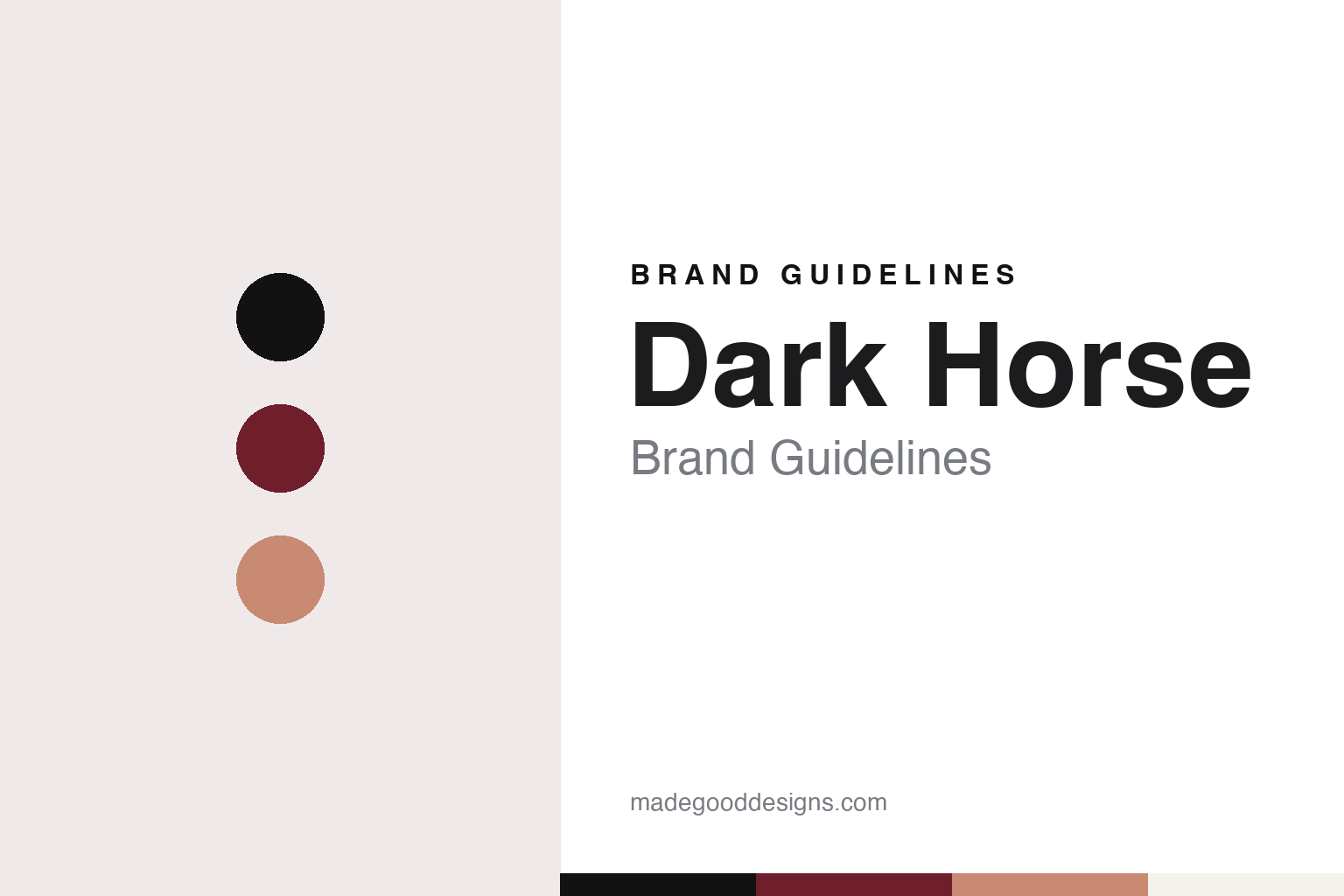
Dark Horse Brand Guidelines
Gallo’s Californian wine with a horse-head icon.
Aa
Two constants: a night black, cabernet and copper rosé palette and a condensed bold sans register. Abstract homage — not a Dark Horse product or mark; no label, logo or bottle is reproduced.
A Gallo brand from Trader Joe’s shelves
Twelve states first, then the whole country.
Dark Horse is a Californian wine brand made by E. & J. Gallo Winery, the family-owned company that English Wikipedia says the brothers Ernest and Julio Gallo founded in Modesto, California, in 1933. Its start date is reported differently. The British trade site The Buyer said in June 2019 that Gallo introduced Dark Horse in 2010. Shanken News Daily reported in December 2014 that the brand had reached 50,000 cases in its debut the year before, which earned it a “Hot Prospect” award from its sister title Impact.
The brand grew in stages. In that December 2014 report Shanken News Daily said Dark Horse was sold in 12 states, in liquor stores and in every Trader Joe’s in the country, and that Gallo planned to take it into grocery and club stores nationally from March 2015. Stephanie Gallo, the company’s vice president of marketing, called it one of Gallo’s most anticipated new brands. Valley News wrote in May 2016 that until about a year earlier the wines had sold only in those 12 states, mostly in Trader Joe’s.
The idea behind it was value. The wine writer Robert Whitley reported in August 2016 that the concept was known inside Gallo as the “20-7 project”: a wine meant to taste like a bottle at the first price while selling at the second. He wrote that the target proved too tight and that Gallo raised the price rather than drop the project. Shanken News Daily described Dark Horse in 2014 as California-sourced, with Cabernet Sauvignon as its lead wine alongside a Chardonnay, a Merlot and a Big Red Blend, which it said combined fruit from Argentina, California and Australia.
The winemaker is Beth Liston. The Buyer reported in 2019 that she studied at Cal Poly in San Luis Obispo, minoring in wine and viticulture, later took a graduate food science programme focused on winemaking, had worked for Gallo for 14 years and had worked harvests in Napa and South Australia. Whitley wrote that she oversees Gallo’s production facility in Livingston, California, and that most of the grapes come from the Lodi region.
Colour
A horse’s head with a wine glass hidden inside it.
The brand’s emblem is a horse’s head. A design study by the research firm Designalytics, published in September 2021, notes that the horse icon contains a wine glass drawn in negative space, a detail Gallo’s 2020 redesign kept while giving the icon more prominence.
The redesign was the work of forceMAJEURE, a New York design agency that Designalytics says Gallo hired in 2018. The new labels reached shelves in the United States in May 2020, and the trade site just-drinks reported the same month that Gallo was extending the new packaging to the United Kingdom. The Dieline credited Pierre Delebois as creative director and Melanie Brown as art director, and described labels printed on premium paper in metallic and matte finishes.
Designalytics listed the main changes. Each wine was given its own background colour; the smoky graphic around the horse was removed; the wordmark went from outlined letters to solid ones; the words “The Original” were dropped from the name; the names of the grape varieties were made larger, with short taste notes added; and the rosé broke with category habit with a copper-pink label and a black cap.
The firm also published results. Designalytics reported that sales rose 15 percent in the six months after the redesign compared with the same period a year earlier, and that in its own testing the distance at which shoppers could recognise the bottle more than doubled. The redesign won a Designalytics Effectiveness Award in 2021. Those figures come from the research firm that gave the award, not from an independent audit.
Typography
Design and documentation.
The seven brands in this group are all wine names: Chateau Ste. Michelle, Bogle, 14 Hands, Dark Horse, Cupcake, Ménage à Trois and Chandon. Wine brands in general sit at many different points in the trade, from family houses that still carry a founder’s name to labels that now belong to much larger drinks groups, and a single brand can be sold everywhere from a corner shop to a restaurant list.
A wine brand’s identity is usually carried less by a single bottle than by a label, a name and the place it promises, because the company behind the name may have changed hands, moved its production or grown far beyond the place where it started. That makes the questions behind each name worth asking plainly: who started it, who owns it now, and where its wine is actually made and bottled.
Each guide separates what independent sources record from what the company says about itself — its founding story, its owners over time, where its wine is made and how its labels have changed — and marks plainly what rests only on the company’s own word.
Aa
A condensed bold sans for a solid wordmark and large varietal names. (Specimen set in Oswald, a sans-serif STAND-IN; NOT the Dark Horse logo.)
Dark Horse
A value brand that travelled abroad.
Dark Horse has also been built outside the United States. The Buyer reported in 2019 that a Dark Horse rosé had launched in the UK in 2018 and a Malbec in 2019, and that the range sold there included Cabernet Sauvignon, Merlot, Chardonnay, Sauvignon Blanc and Pinot Grigio. Gallo told the publication that the brand was performing well in Germany, Poland and Denmark, and described Dark Horse as the number-one premium wine brand in the United States; those rankings are the company’s own.
The same interview set out how Gallo describes the winemaking. Liston said she adjusts fermentation temperatures, oak, skin contact and blending, and that drawing on many growers and many grape varieties helps keep the wine consistent from year to year, according to The Buyer. Gallo frames this as using techniques more often found in smaller-scale winemaking, which is the company’s own description.
Dark Horse sits in a large stable of Gallo wines. Its sister brand Barefoot, which began in Sonoma, has belonged to Gallo since 2005, English Wikipedia says. Both are built around a single, simple emblem that can be read at a distance across a supermarket aisle.
The name needs a little care online. Dark Horse is also the name of a Michigan craft brewery and of an American comics publisher, neither of which is connected to the wine; earlier bottles carried the longer name The Original Dark Horse, which the 2020 redesign shortened.
For a design guide, Dark Horse shows how a value wine can lean on one icon and a colour for each grape to stand out from a shelf full of dark labels. Compare Barefoot, Gallo’s footprint wine, and 14 Hands, the Washington wine named for wild horses. For this guide we use night black, cabernet and copper rosé with a condensed sans, an unofficial interpretation; no product or logo is reproduced.
Explore & save
Keep Dark Horse’s identity on hand — save it to a board in the Made Good inspiration library.
Dark Horse identity set
Pin the Dark Horse night black, cabernet and copper rosé palette and the condensed bold sans register to your own board.