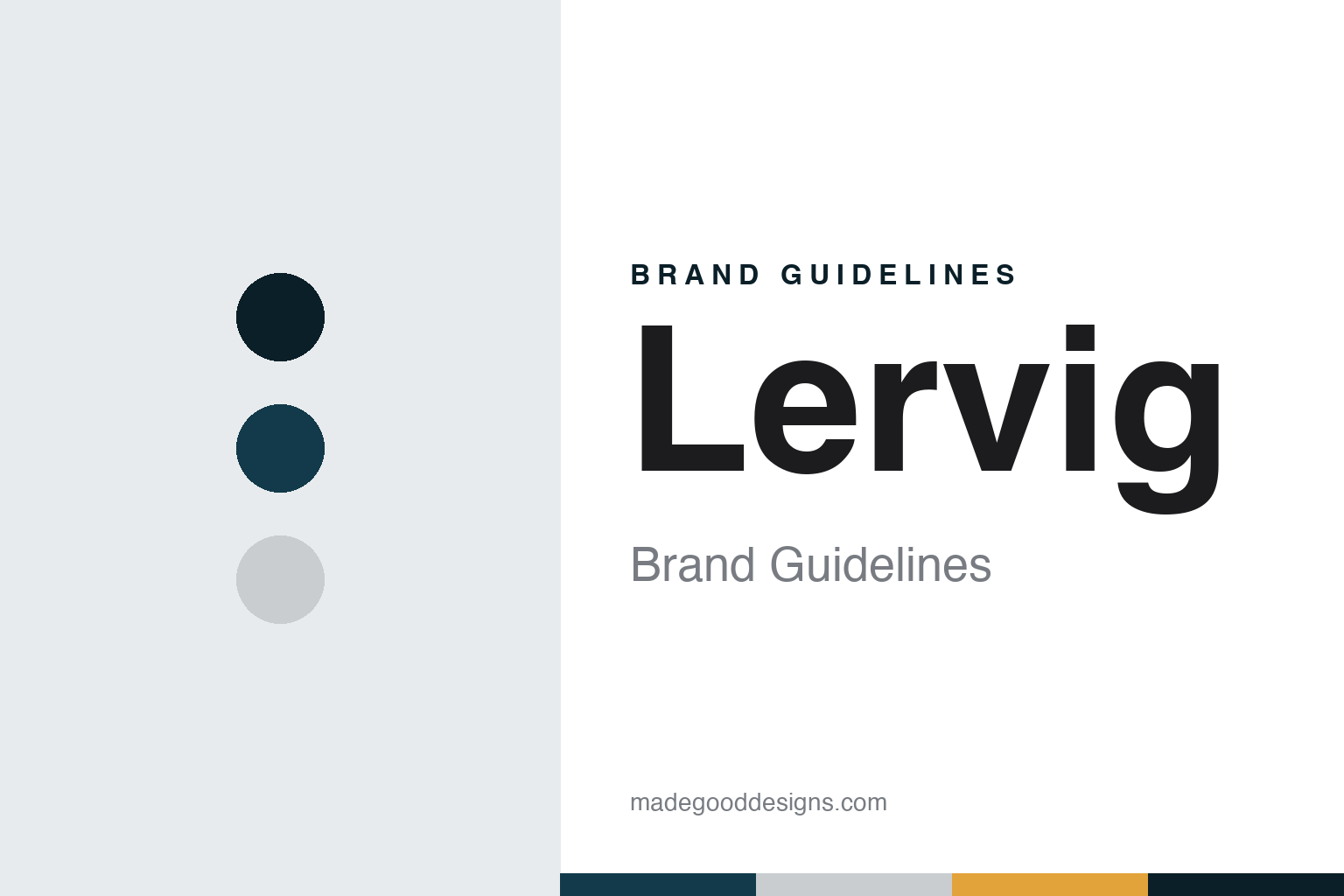
Lervig Brand Guidelines
The Stavanger brewery built to replace a lost one.
Aa
Two constants: a fjord blue, silver and gold palette and a grotesque sans register. Abstract homage — not a Lervig product or mark; no label, can or logo is reproduced.
Stavanger, 2003
A brewery built to replace a lost one.
Lervig is a brewery in Stavanger, on Norway’s south-west coast. It was founded in the early summer of 2003 as a response to Ringnes closing the Tou brewery and moving its production to Oslo, the regional newspaper Rogalands Avis reported in 2009. According to that report, quoted by Norwegian Wikipedia, eight local companies from Stavanger’s restaurant and nightlife trade, together with Macks Ølbryggeri, the Tromsø brewer, stood behind the new company, which was registered as Lervig Aktiebryggeri. English Wikipedia, citing the business directory Proff, credits the fund manager Kristoffer Stensrud with starting the brewery; Stavanger Aftenblad reported in July 2013 that he was by then its largest shareholder, alongside Mack and local investors, Norwegian Wikipedia says.
The first Lervig beers were not brewed in Stavanger at all. Rogalands Avis reported that Mack produced them in Tromsø, in the far north; English Wikipedia says Mack brewed for Lervig from 2003 to 2005, when production moved to Hillevåg, a district of Stavanger. Norwegian Wikipedia dates the move to 15 September 2005 and places it on Vierveien, where the brewery’s website still gives its address. In those first years, English Wikipedia says, the brewery mostly made pilsner, as a substitute for the Tou pilsner the city had lost. Mike Murphy, its later brewmaster, told the British beer magazine Ferment in 2025 that local people had built Lervig to much the same specification and capacity as the brewery that closed, which left it with a very large brewhouse for a company that, at first, made only pilsner.
Colour
Mike Murphy and Lucky Jack.
The turn to craft beer came with a brewer. In 2010 Lervig hired the American Mike Murphy as head brewer, English and Norwegian Wikipedia both say, and the brewery moved towards specialty beers. In an interview published in 2025 by Ferment, the magazine of the beer club Beer52, Murphy — a former home brewer from Philadelphia who had previously brewed in Denmark — said Lervig had made nothing but pilsner when he arrived, and that the first beer he created there was a pale ale that became Lucky Jack. The company’s website now says all Lucky Jack Original brewed this year follows a fully gluten-free recipe.
Collaboration became part of the brewery’s identity. Norwegian Wikipedia says that after Murphy’s arrival Lervig began brewing for the Danish brewer Mikkeller, including the stout Beer Geek Brunch Weasel, and English Wikipedia lists collaborations with To Øl, Põhjala, Evil Twin and Beavertown. Murphy told Ferment that, for a relatively small brewery with a small marketing budget, collaborating made sense, because each brewery gained exposure to the other’s customers.
Today the company describes a range that runs from easy-drinking pilsners and pale ales to barrel-aged stouts, barley wines and sours. Its website groups the beers into lines including Rackhouse, a barrel-ageing programme, and No Worries, an alcohol-free series; it also runs a brewpub in Stavanger, Lervig Local, and a brewery shop, and distributes fritz-kola in Norway. Lervig says it exports to more than 30 countries. At home, English Wikipedia says, citing the beer site Ølportalen, the dairy cooperative Tine began carrying Lervig’s beer in its refrigerated trucks from June 2017.
Typography
Nordic craft and its neighbours.
The seven brands in this group are all Nordic beer names: Mikkeller, To Øl, Nøgne Ø, Aass, Karhu, Lervig and Amager Bryghus. They span two centuries of brewing. Aass was founded in Drammen in 1834 and is still owned by the Aass family, English Wikipedia records; Karhu is a Finnish beer brand that belongs to the brewer Sinebrychoff, part of the Carlsberg Group. The rest are products of the craft-beer wave that began around the turn of this century: Nøgne Ø in Grimstad in 2002, Lervig in Stavanger in 2003, Mikkeller in Copenhagen in 2006, Amager Bryghus on the island of Amager in 2007 and To Øl in Copenhagen in 2010.
A beer brand’s identity is usually carried less by a single bottle than by a name, a label and the place it promises, because the company behind it may have changed hands, taken on investors or moved its brewing somewhere else entirely. Some of these names began as “gypsy” brewers that rented other breweries’ equipment before, in some cases, building their own; others became part of larger brewing groups. That makes the questions behind each name worth asking plainly: who started it, who owns it now, and where its beer is actually brewed.
Each guide separates what independent sources record from what the company says about itself — its founding story, its owners over time, where its beer is brewed and how its labels and cans have changed — and marks plainly what rests only on the company’s own word.
Aa
A grotesque sans — a stand-in for the Lervig wordmark. (Specimen set in Archivo, a sans STAND-IN; NOT the Lervig logo.)
Lervig
Silver on black for ten years.
Lervig’s packaging has one well-documented design credit. In June 2013 the packaging-design site Dieline published the brewery’s limited 10th-anniversary beer, designed by Daniel Brokstad, then a graphic designer at the agency Procontra. Adobe’s blog, profiling the Norwegian designer in 2016 after he won one of its Nordic Creative Talent Awards, repeated his description of the work and said his main focus was packaging, branding and typography. According to that statement, the beer was sold only at the brewery, and its typography told the story of where Lervig started and where it had arrived through changing key words, in an old-style manner similar to the brewery’s earlier beers. The four-pack held two 2003 and two 2013 editions, with “Enjoy your lervig” printed under the closing mechanism, and the design was printed in silver on pure black to stress the edition’s exclusivity.
Ownership changed in 2018. On 19 September that year Dagens Næringsliv reported that an American company was investing in Lervig, whose shareholders were led by Kristoffer Stensrud, and pictured the managing director Anders Kleinstrup with Murphy, the brewmaster, inspecting a tank sample; English and Norwegian Wikipedia, citing that report and the Norwegian beer site Brewolution, name the investor as Orkila Capital and its stake as half the company, and English Wikipedia notes that Orkila already held part of Mikkeller. The company is now Lervig AS, and its website describes Lervig as “an independently owned and operated craft brewery located in Stavanger.”
For a design guide, Lervig shows a brewery that began as a local substitute for a lost pilsner and rebuilt its range, and its packaging, around craft beer. Compare Ringnes, whose closure of the Tou brewery set Lervig in motion, and Nøgne Ø, another Norwegian craft brewery. For this guide we use fjord blue, silver and a pale-ale gold with a sans, an unofficial interpretation; no product or logo is reproduced.
Explore & save
Keep Lervig’s identity on hand — save it to a board in the Made Good inspiration library.
Lervig identity set
Pin the Lervig fjord blue, silver and gold palette and the grotesque sans register to your own board.