Liverpool FC Brand Guidelines
A club born of a rent dispute at Anfield that took the city’s bird for its badge.
Aa
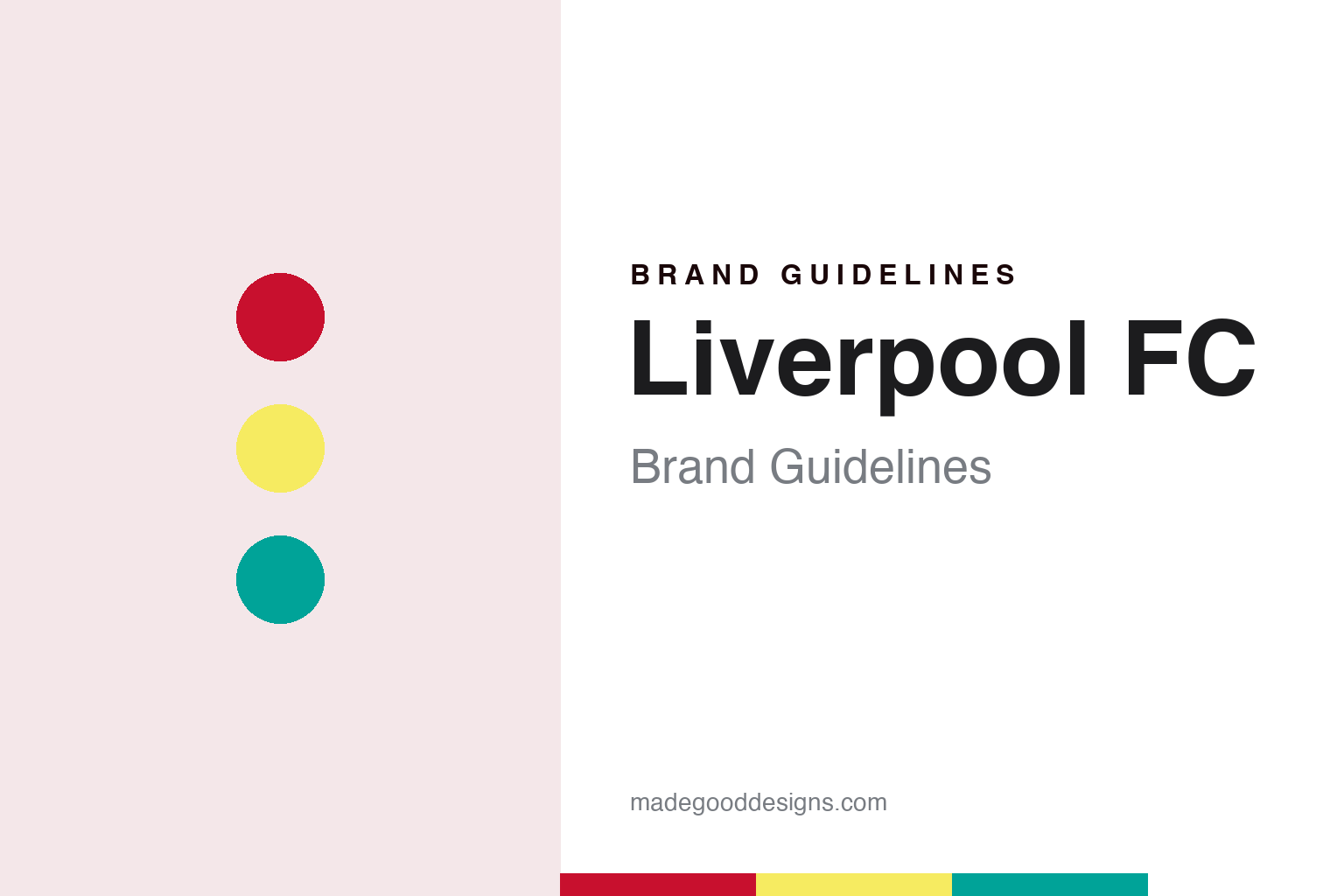
Two constants: a red, gold and teal palette and a condensed sans register. Abstract homage — not a Liverpool FC crest, kit or mark; no logo is reproduced.
Anfield
A ground without a team, a name, and a change to red.
Liverpool FC was created to fill a stadium. English Wikipedia says the club was founded after a dispute between the Everton committee and John Houlding, the club president who owned the land at Anfield. Everton had played at Anfield for eight years before moving across Stanley Park to Goodison Park in 1892, leaving Houlding with a ground and no tenant. He founded a new club to play there.
The name took a few months to settle. Wikipedia says the club was registered as “Everton F.C. and Athletic Grounds Ltd,” known as Everton Athletic for short, and became Liverpool F.C. in March 1892. The Football Association had refused to recognise it as Everton, and gave official recognition to the new name three months later. Houlding served as chairman from 1892 until 1904, and John McKenna, who had recruited the early playing squad, succeeded him. Liverpool played its opening match on 1 September 1892 and has used Anfield as its home ever since.
The early colours were not red. Wikipedia says the club wore blue and white quartered shirts from its founding until 1896, when it adopted red, the colour of the city. For the next six decades the standard home kit was red shirts with white shorts.
The decisive change came in 1964. Wikipedia says manager Bill Shankly decided to change to an all-red strip, and that the team wore all red against Anderlecht. The forward Ian St John later recalled in his autobiography that Shankly believed the colour would carry a psychological impact, and that the idea of adding red socks to the red shorts came from the dressing room. The all-red home strip has been used since.
Away kits have moved more freely. Wikipedia describes them as usually all yellow, or white shirts with black shorts, with an all-grey kit introduced in 1987, green shirts with white shorts for the 1991–92 centenary season, and a run of gold and navy, bright yellow, black and grey, and ecru designs in the 1990s before grey returned in 2008–09.
Colour
A cormorant with seaweed, a gate and two flames.
The badge comes from the city. The Liverpool Echo reported in April 2017 that the Field Sport newspaper of 19 September 1892 described a flag over Anfield bearing the letters “L.F.A.” beneath the liver. The Echo traced the liver bird to the town’s seal: after the original seal was lost in 1644, the eagle on it was redrawn as a cormorant holding seaweed, and that bird became known as the liver bird on the city’s coat of arms, granted in 1797.
For decades the club used the city’s arms directly. The Echo says Liverpool printed the coat of arms on match programmes from September 1935 and stopped using it after the Second World War, and that on 13 December 1961 the paper reported the city council had turned down the club’s request to use the arms as its crest. A crest dominated by a red liver bird appeared on the Liverpool jersey in 1955. Wikipedia adds that the bird had already been worn on the white away shirts at the 1950 FA Cup final, and that a simpler liver bird inside a shield came to dominate from the 1970s. The Echo reported that the club secured a trademark for the liver bird in 2010.
The modern crest added architecture. Wikipedia says that in 1992, for the club’s centenary, a new badge was commissioned that included a representation of the Shankly Gates, the memorial gates to the former manager unveiled at Anfield on 2 August 1982. Their ironwork carries the title of the club anthem, “You’ll Never Walk Alone,” and that wording is reproduced on the badge.
A year later, in 1993, twin flames were added on either side of the crest. Wikipedia says they represent the Hillsborough memorial outside Anfield, where an eternal flame burns in memory of the victims of the Hillsborough disaster of 15 April 1989.
In 2012 the shirt badge was simplified again. Wikipedia says Warrior Sports’ debut Liverpool kit removed the shield and the gates, returning to the plain liver bird the club wore in the 1970s, and moved the flames to the back of the shirt collar. In 2017 the club marked its 125th anniversary with a commemorative crest unveiled alongside a new kit, the Echo reported.
Typography
Clubs, crests and colours.
A football club’s identity works across a wide range of surfaces. The crest sits at the centre of it: a compact mark that has to read on a shirt seen from the far side of a stadium, on a television scoreboard graphic, on a phone app icon and on a stitched scarf. Clubs revise their crests from time to time, usually simplifying detail, tightening outlines or redrawing lettering so the mark reproduces cleanly at small sizes and in a single colour.
Kit colours carry the identity as much as any logo. A club’s home colours are often older than its crest, and supporters recognise them at a glance, so designers tend to treat them as fixed while the cut, trim and pattern of the shirt change from season to season. Away and third kits give more room for experiment.
Shirt sponsors add a second brand to a highly visible surface a club owns, which means the crest, the kit maker’s mark and the sponsor’s wordmark have to sit together without crowding. Stadium signage, from gate numbers to the name on the stand roof, extends the same system into architecture, wayfinding and the backdrop of every broadcast.
Aa
A condensed sport sans — the register of a shirt number and a stand sign. (Specimen set in Oswald, a sans-serif STAND-IN; NOT the Liverpool FC logo.)
Liverpool FC
Local owners, an American takeover and a Boston group.
For much of the twentieth century the club was locally controlled. Wikipedia says the Moores family had owned the club for more than fifty years by the time David Moores became chairman in August 1991. Moores sold the club to the American businessmen George Gillett and Tom Hicks on 6 February 2007.
That ownership ended in court. The Guardian reported on 15 October 2010 that the sale of Liverpool to New England Sports Ventures, the owners of the Boston Red Sox, had gone through after a week of legal action on both sides of the Atlantic, overseen by chairman Martin Broughton. The company’s principal founder, John W. Henry, appeared outside the London offices of the club’s lawyers that afternoon. New England Sports Ventures later became Fenway Sports Group, which has owned the club since 2010.
The shirt itself has changed suppliers many times. Wikipedia says the kits were made by Umbro until 1985, by Adidas from 1985 to 1996, by Reebok for the following decade and by Adidas again from 2006 to 2012. Warrior Sports took over at the start of the 2012–13 season; its parent company, New Balance, then outfitted the club directly from 2015. Nike became kit supplier at the start of the 2020–21 season, and Wikipedia says the club returned to Adidas in 2025.
Shirt sponsors have been part of the front of the kit since 1979, when Wikipedia says the club agreed a deal with Hitachi. Crown Paints, Candy, Carlsberg and Standard Chartered followed, with Carlsberg’s association running from 1992 to 2010.
The ground carries the identity beyond the shirt. Wikipedia says the “This is Anfield” sign was installed by Shankly in 1972 and restored to the new players’ tunnel after the Main Stand was rebuilt, and that the Kemlyn Road Stand, rebuilt for the 1992 centenary, was renamed the Sir Kenny Dalglish Stand in 2017. The club competes in the Premier League, where its crest sits beside the league’s lion on sleeve badges.
For a design guide, Liverpool FC shows how a club can take a civic symbol, lose the right to the city’s full arms, and build its own badge around the bird alone. Compare Manchester United, whose crest also starts from city heraldry, and Arsenal, whose cannon came from Woolwich. For this guide we use Anfield red, liver gold and gate teal with a condensed sans, an unofficial interpretation; no product or logo is reproduced.
Explore & save
Keep Liverpool FC’s identity on hand — save it to a board in the Made Good inspiration library.
Liverpool FC identity set
Pin the Liverpool FC red, gold and teal palette and the condensed sans register to your own board.