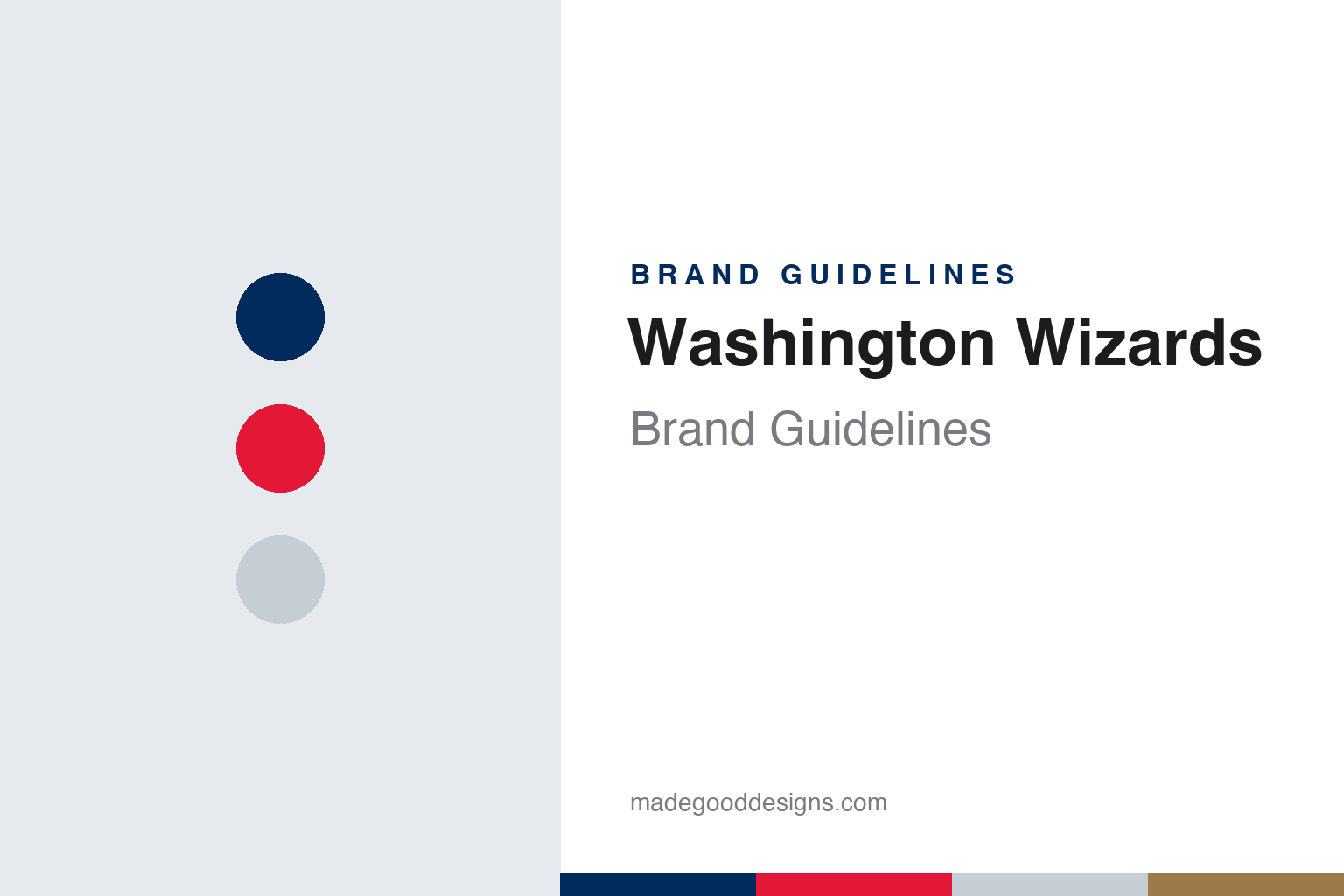
Washington Wizards Brand Guidelines
A name dropped for a reason, a palette brought back on purpose.
Aa
Two constants: a navy, red and silver palette and a condensed athletic sans register. Abstract homage — not a Washington Wizards mark; no logo, jersey or wordmark is reproduced.
Packers, Zephyrs and Bullets
Three cities and four names before the Wizards.
The Washington Wizards have answered to several names in three cities. English Wikipedia says the franchise was established in 1961 in Chicago as the Chicago Packers, a name that referred to the city’s meatpacking industry; the team’s arena, the International Amphitheatre, stood next to the Union Stock Yards. The name was unpopular, Wikipedia says, because it was shared with the NFL’s Green Bay Packers, rivals of the Chicago Bears. After one season the club became the Chicago Zephyrs and moved to the Chicago Coliseum.
In 1963 the franchise moved to Baltimore. Wikipedia says it took the name Bullets from an earlier Baltimore Bullets team of the 1940s and 1950s and played at the Baltimore Civic Center. Jerry Bembry of The Baltimore Sun confirmed on 16 May 1997 that the franchise took the Bullets name when it moved from Chicago to Baltimore in 1963, and that the Baltimore Bullets played ten seasons at the Civic Center. Jacob Bogage of The Washington Post wrote on 14 April 2018 that the Washington developer Abe Pollin bought the team in 1964 and that its motto in Baltimore was “faster than a speeding bullet.”
The Baltimore colours were taken from the city’s other teams. Wikipedia says the Bullets began in a blue and orange scheme that matched the Orioles’ orange and the Colts’ blue, wearing blue and white with orange trim before making orange the main colour in the early 1970s. Uniforms of that era carried three thick stripes running diagonally from the right leg up to the left side of the jersey.
A move toward the capital followed. Wikipedia says the club announced in February 1973 that it would move to the new Capital Centre in Landover, Maryland, and played the 1973–74 season as the Capital Bullets before taking the name Washington Bullets a year later. With the move came red, white and blue to match the American flag, large horizontal stripes across the chest and three stars on the shorts. That “Stars and Stripes” look lasted until 1987, when, Wikipedia says, a new logo and red and white uniforms arrived, with the lettering switched from a Serpentine face to block letters in 1990–91.
Colour
A rename announced in 1995, and a wizard in bronze.
The Post has set out how the decision to drop “Bullets” came about. Bogage reported that in November 1995, within a week of the death of Pollin’s close friend, the Israeli prime minister Yitzhak Rabin, on 4 November, Pollin declared that his basketball team would no longer carry the name, saying it was no longer appropriate for a sports team. The Post noted that team executives had already expected a new logo and uniforms ahead of a move to a new arena.
The public helped choose the replacement. Wikipedia says the team invited suggestions, narrowed them to Dragons, Express, Stallions, Sea Dogs and Wizards, and ran a telephone vote whose proceeds went to charity, before Pollin announced “Wizards”. The new name became official on 15 May 1997. Bembry described the event in Bethesda for The Baltimore Sun: the Bullets logo appeared on two screens and dissolved into a yellow brick road that led to the planned MCI Center and the new mark. Pollin told the crowd the change had been planned for more than a year with fans, players and the city involved, and that the priority was a statement against violence.
The new look was a clean break. The Sun reported a colour scheme of blue, black and bronze, close to the redesigned colours of the Washington Capitals, the hockey team Pollin also owned. The primary logo showed a bronze-faced wizard sweeping past a crescent moon, with “a burst of magic” in his right hand and a spinning basketball in his left, while a secondary logo used a modern face to form the letters “DC”. The Sun said the logo design was provided by the NBA, and that forward Juwan Howard sat on the committee that chose it. Wikipedia adds that the team moved into the MCI Center on 2 December 1997, and that in 2007 bronze was replaced by metallic gold as the secondary colour.
Typography
Design and documentation.
Professional clubs carry names that can outlast the cities, owners and ballparks attached to them. When a club changes its name, the new identity usually arrives as a complete set rather than a single swap: a wordmark, a cap or helmet insignia, a primary logo, home and road uniforms and a colour palette, all launched together so that signage, merchandise and broadcast graphics can switch on the same date. Leagues often supply design support, and clubs commonly test options with supporters before an announcement.
Relocation works differently. A club that moves may keep its nickname, colours and lettering while the city name on the road jersey changes, so the visual system becomes the thread that links one home to the next. Some clubs play for a period in an interim home, such as a smaller ballpark or a shared stadium, before a permanent building is ready, and their identity then has to read clearly in surroundings designed for another team.
Many clubs also keep a single element through every change: a script wordmark, a letter monogram or an animal mascot. Such elements are often redrawn rather than replaced, with thicker strokes, revised serifs or a simplified outline, so that supporters can recognise them on a cap, a sleeve patch or a scoreboard across several decades.
Aa
A condensed athletic sans — the register of a jersey number and an arena sign on F Street. (Specimen set in Oswald, a condensed sans STAND-IN; NOT the Washington Wizards logo or wordmark.)
Washington Wizards
Monument ball, three stars and the colours of the Bullets.
Ownership passed to Ted Leonsis. Bogage noted in the Post that Pollin died in 2009 and that the Wizards were by then owned by Leonsis. Wikipedia says Leonsis, who already owned the Capitals and the WNBA’s Washington Mystics, completed his takeover of the Wizards and their arena in June 2010 through his holding company, Monumental Sports & Entertainment. Leonsis has owned the Wizards since 2010.
The colours changed next. Wikipedia says Leonsis wrote a list of changes he hoped to make, including a return to the red, white and blue of the Bullets era, and that team president Ernie Grunfeld confirmed the switch for the 2011–12 season. On 10 May 2011 the Wizards unveiled the new scheme, uniforms and logo. The uniforms closely followed those worn from 1973 to 1987, a deliberate throwback that Leonsis acknowledged, according to Wikipedia; a lowercase “wizards” wordmark echoed the lowercase “bullets” logo of 1969 to 1987, and the Washington Monument appeared as an alternate logo. The same colours run through Leonsis’s Capitals and Mystics.
A new primary mark followed on 15 April 2015. Wikipedia says it set the Monument ball in a roundel with the striping from the uniforms, the team wordmarks and three stars standing for Washington, D.C., Maryland and Virginia, a device also used by the Capitals. The club said at the time that it would stop using the wizard and moon logo, in use since 1997.
Nike’s uniforms since 2017 keep a white Association, red Icon and navy Statement set, Wikipedia says, while the City editions have turned to the capital’s landscape: a white 2017–18 uniform reading “The District of Columbia” as a tribute to the Washington Monument, a black 2018–19 set with orange trim for the National Mall, and a largely pink 2022–23 uniform for the city’s cherry blossoms, unveiled alongside the Washington Nationals’ City Connect uniform. The team’s website has a “Meet G-Wiz” page for its mascot, G-Wiz. Home games are played at Capital One Arena, which the Wizards share with the Capitals.
For a design guide, the Washington Wizards show how a team can drop a name for a stated reason and later reclaim the colours that came with it. Compare the Washington Capitals, the Washington Nationals and the NBA. For this guide we use navy, red and silver with a condensed sans, an unofficial interpretation; no product or logo is reproduced.
Explore & save
Keep Washington Wizards’s identity on hand — save it to a board in the Made Good inspiration library.
Washington Wizards identity set
Pin the Washington Wizards navy, red and silver palette and the condensed athletic sans register to your own board.