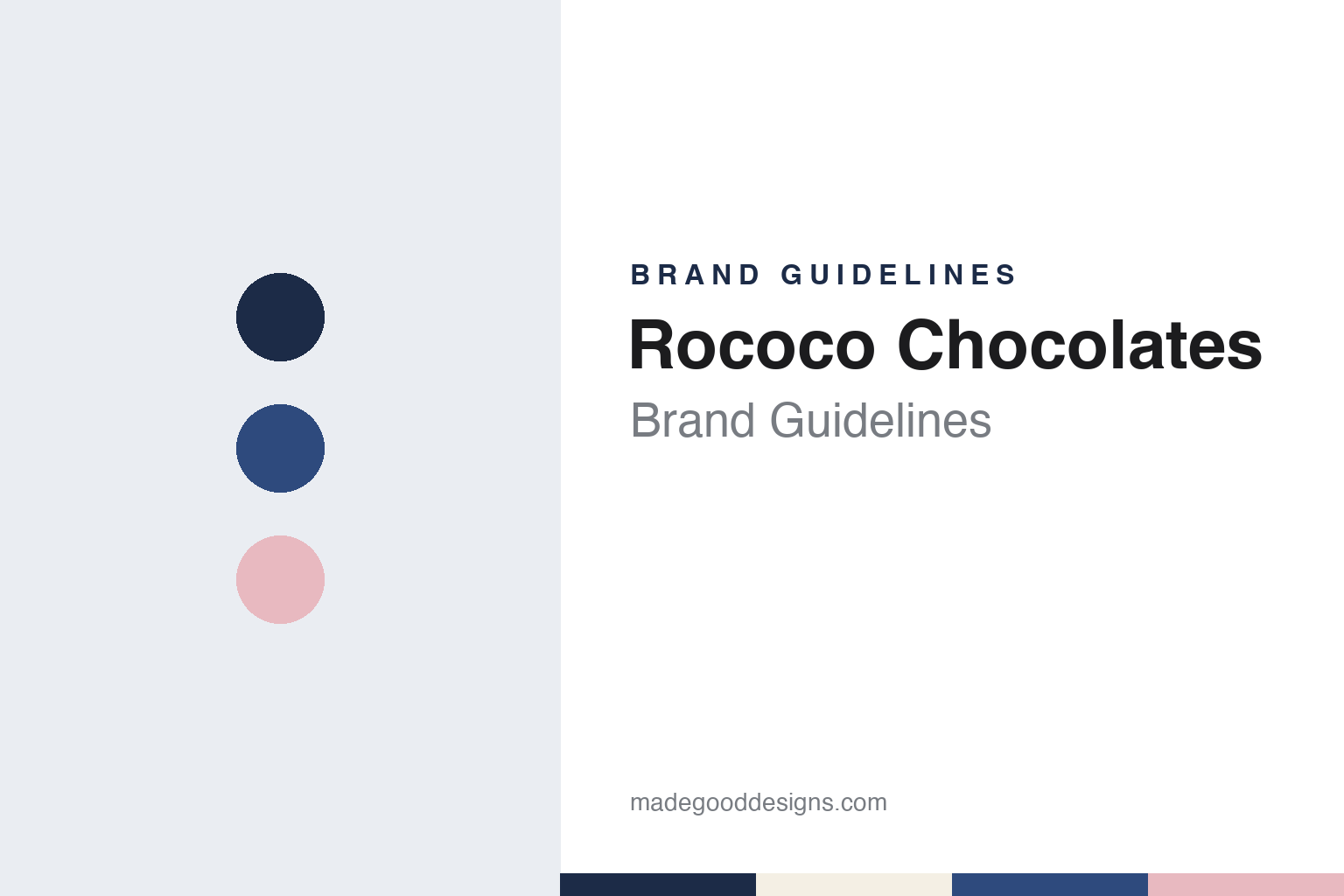
Rococo Chocolates Brand Guidelines
A King’s Road chocolate shop dressed in blue-and-white toile.
Aa
Two constants: a Rococo toile blue, paper cream and candyfloss pink palette and an engraved serif register. Abstract homage — not a Rococo Chocolates product or mark; no box, pattern, logo or photograph is reproduced.
From art school to the King’s Road
An art student opens a chocolate shop.
Rococo Chocolates is a London chocolatier founded in 1983 by Chantal Coady, who opened its first shop on the King’s Road in Chelsea. English Wikipedia, citing a 2016 profile by the workspace provider Workspace, says she started the business soon after leaving art school; she studied at Camberwell College of Arts, which the company’s own story page says was a course in textile design. The company says chocolate was first made in the basement of the King’s Road shop, and that Coady “wanted to change the way fine chocolate was perceived” at a time when British shoppers mostly knew sugary confectionery.
The name came quickly. In a 2018 interview with the Marylebone Journal, Coady said she chose it during a three-week business studies course — “Rococo just tripped off my tongue” — and only later learned it was a French word for shell work, scroll work and florid ornament. She described the first shop as having “pink candy floss walls, sugar chandeliers and Botticelli on the ceiling.” The company says it later opened shops in Belgravia, Notting Hill, St John’s Wood and Marylebone Village.
Coady was appointed OBE in the Queen’s Birthday Honours of June 2014 “for services to chocolate making,” as The Guardian listed it, and Workspace called her the first person to receive the honour for that reason. Wikipedia records that she was named co-chair of the Academy of Chocolate in 2021.
Ownership has changed several times since 2019. Wikipedia says the original company, Rococo Chocolates Ltd, went into administration in 2019, after which Coady set up a separate venture called The Chocolate Detective. Companies House shows a new company formed in June 2019 under a private investor; Confectionery Production later referred to a “turbulent” period under a previous individual investor, and that company was itself placed in administration and dissolved in 2024. A further company, Rococo Chocolatier Ltd, was incorporated in May 2022 with Prestat Group as its controlling shareholder. Prestat, the Piccadilly truffle maker, had been bought in March 2019 by the Italian chocolate maker Domori, part of the illy group, as Reuters reported at the time. In July 2023 Confectionery Production reported that Coady was returning as creative director, brand ambassador and board member of both Prestat and Rococo, quoting her: “I am returning to Rococo, four years after losing the company in difficult circumstances.” Companies House records her stepping down as a director of Rococo Chocolatier in July 2024.
Colour
A Grenada farm and an outsourced kitchen.
For much of its history Rococo tied its name to Grenada. Workspace wrote that Coady worked with the Grenada Chocolate Company on its “tree to bar” approach, under which finished bars, rather than beans, cross the ocean by sail. In a diary entry on its blog dated January 2014, Rococo’s then chairman described a month in Grenada helping that company with organic certification and a business plan after the death of its co-founder, Mott Green, the previous year, and harvesting beans from Rococo’s own farm, which the post called Grococo and described as a ten-acre part of a larger cooperative. A June 2014 post described a barter in which Rococo took knife-sharpening files to Grenadian farmers in exchange for dried organic Trinitario beans. Coady told the Marylebone Journal in 2018 that she had invested in a plantation to keep “more of the value of the bar” in the farmers’ local economy. The company’s current story page does not mention Grenada, and the sources we checked do not say whether the farm link continues.
Where the chocolate is made has also changed. The company’s story page, as it read in October 2026, says its fresh chocolates are handmade in small batches in a London chocolate kitchen using Domori couverture made with beans from Côte d’Ivoire, that its gift boxes are made by partners in the UK to its own recipes, and that some confectionery comes from partners in France and Belgium. The administrators’ statement of proposals for Rococo Chocolatier Ltd, filed at Companies House in March 2026, described a more “asset-light” model: product development and brand management were kept in-house, while manufacturing was outsourced to a connected company.
That statement also explains the most recent change of owner. It says three years of steep rises in the price of cocoa squeezed margins, that support from the Italian parent company and supplier had fallen, and that a sale of the group’s shareholdings had been tried through 2025. Joint administrators were appointed on 6 February 2026, and a pre-packaged sale of the business and assets to an unconnected buyer, L’Artisan du Chocolat Limited, was completed on 9 February 2026. Companies House shows Prestat Group in administration in the same month.
Typography
High street, ethical and royal warrant.
The seven brands in this group are all British chocolate names: Thorntons, Green & Black’s, Montezuma’s, Divine Chocolate, Charbonnel et Walker, Prestat and Rococo Chocolates. Between them they cover most of the ways chocolate is sold in Britain, from the high street and the supermarket shelf to the small shop with a box tied in ribbon.
Some are high-street makers, known for shops in town centres and for the boxes people buy as presents at Easter and Christmas. Some built their names on ethics, putting organic farming, fair trade or the cocoa growers themselves at the centre of the story told on the wrapper. Others are London houses whose identity rests on age, address and patronage: shops in Mayfair and the West End, hand-finished truffles, and, in some cases, the royal warrant that allows a firm to display the royal arms on its packaging.
British chocolate brands have also changed hands often, and several of the best-known names now belong to larger groups at home or abroad. Each guide separates what independent sources record from what the company says about itself — who founded it, who owns it now, where its cocoa comes from and where its chocolate is made — and marks plainly what rests only on the company’s own word.
Aa
An engraved serif — catalogue plates, scrollwork and a handwritten note. (Specimen set in Cormorant Garamond, a serif STAND-IN; NOT the Rococo Chocolates logo.)
Rococo Chocolates
A pattern cut from an old catalogue.
Rococo’s packaging is the part of the brand most people recognise. Coady told the Marylebone Journal that the blue-and-white pattern came from a 19th-century French chocolate catalogue: she photocopied its engravings, cut them out and laid them out “as a random repeating design,” and the handwriting on the packaging is her own. The company’s story page says the pictures were chocolate moulds from a famous Parisian mould maker and compares the result to toile de Jouy, the French printed fabric with repeated scenes. The administrators’ 2026 statement described Rococo as known for its “distinctive artistic packaging” and a gifting-led range of boxed chocolates, truffles, bars, thins and dragées, and named the Marylebone store as its flagship; the company’s own story page still names the King’s Road shop.
Coady’s shops carried the same idea into rooms. She told the Marylebone Journal that Persian design, from her birthplace in Iran, shaped choices such as the Moorish garden at the Belgravia shop and a Moroccan mint chocolate bar. Wikipedia records a 2017 range made with the estate of Roald Dahl, inspired by his children’s books.
For a design guide, Rococo Chocolates shows how a borrowed engraving, recut by hand, can carry a brand through several changes of owner: the pattern has stayed while the companies behind it have changed. Compare Prestat, its former sister company under the same Italian group, and the Grenada Chocolate Company, the island maker it once worked beside. For this guide we use toile blue, paper cream and candyfloss pink with an engraved serif, an unofficial interpretation; no product or logo is reproduced.
Explore & save
Keep Rococo Chocolates’s identity on hand — save it to a board in the Made Good inspiration library.
Rococo Chocolates identity set
Pin the Rococo toile blue, paper cream and candyfloss pink palette and the engraved serif register to your own board.