Alvan Blanch Brand Guidelines
The sheep shearer’s Wiltshire grain-dryer maker of 1952.
Aa
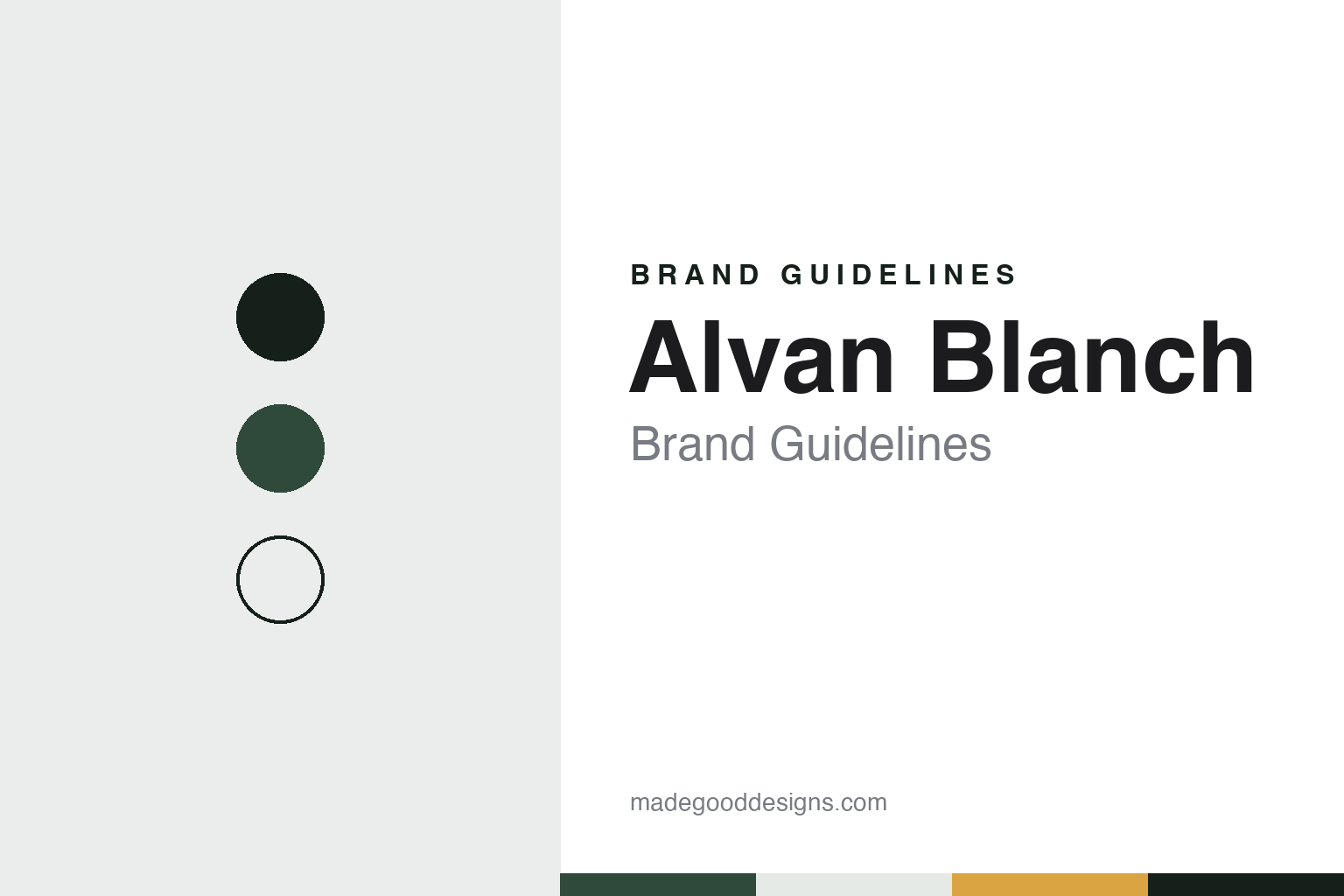
Two constants: an Alvan Blanch green, steel and harvest yellow palette and an engineering sans register. Abstract homage — not an Alvan Blanch product or mark; no machine, logo or nameplate is reproduced.
The Lister demonstrator
A sheep shearer who turned to engineering.
Alvan Blanch is a family-run maker of grain dryers and crop-processing machinery at Chelworth, near Malmesbury in Wiltshire. It carries the name of its founder, Alvan Blanch, whose first career had little to do with sheet steel. Farmers Weekly, in a 2015 history of the firm, described him as an agricultural contractor and sheep shearer whose skill made him chief demonstrator for Lister, then Britain’s leading maker of sheep-shearing equipment; in 1938 he took part in an early television farming programme on the subject.
His lasting interest was engineering. According to Farmers Weekly, he began making machinery in 1946, designing and building hay equipment that sold locally and then across the country. In 1952 he formed Alvan Blanch Development Co.; the UK Companies House register records Alvan Blanch Development Company Limited as incorporated in May 1952, with its registered office at Chelworth. Farmers Weekly read the word “development” in the name as an early sign of the inventive approach the company would follow.
From the start the founder looked abroad. Farmers Weekly wrote that he travelled widely to build overseas markets, designed some machines specifically for export — including machines for crops not grown in Britain — and was appointed OBE for “services to international trade.” A holding company, Alvan Blanch Holdings Limited, was incorporated in 2012, Companies House records show.
Colour
Dryers, mills and three export awards.
Grain dryers sit at the centre of the range. Farmers Weekly reported in 2015 that most of its UK sales were grain drying, handling and storage equipment, led by the Double-Flow continuous dryer series, which the magazine said was claimed to be the UK’s top-selling continuous-flow range. Alongside these sit the multipurpose CD conveyor dryers, built for materials that do not flow like grain — the magazine listed digestate, paper sludge and wood waste — and a range of feed-preparation machines including mixers and roller and hammer mills. The company also plans, installs and commissions complete drying plants and supplies mobile dryers, the same report said. The magazine added that the CD dryers heat at a lower temperature than most dryers for such materials, which suits low-grade heat recovered from boilers, and that their sales were growing fast overseas and, increasingly, at home.
Exports have shaped the business. Farmers Weekly said in 2015 that more than four-fifths of its sales came from specialist crop-processing machinery sold to about 100 countries; a later profile in South Africa’s ProAgri, quoting the company’s sales manager for Africa, put the reach at more than 150 countries. In 2005 the company — listed as Alvan Blanch Development Company of Malmesbury, Wiltshire, for crop processing equipment — received the Queen’s Award for Enterprise in International Trade. It won again in 2012 and, in April 2019, for a third time, in the International Trade (Outstanding Achievement) category, Bioenergy News and African Farming reported. Both said it was the only company in the agricultural sector to have received an award in that category.
The 2019 coverage also described a wider footprint: sales offices and service centres opened over the previous five years in Asia, Australia, Africa and Europe. Managing director Andrew Blanch said the workforce had doubled to 120 and that the company had invested heavily in manufacturing automation and a larger factory, crediting a fourfold growth in export sales over the 14 years between the first and third awards. African Farming added that, besides the grain-dryer business, the company keeps dedicated engineering and design teams working on product development.
Typography
Grain storage and handling.
Grain storage and handling is a trade whose products are buildings as much as machines. Its makers sell corrugated steel bins that stand in rows on prairie farms, hopper tanks for wet grain and load-out, tall bucket elevators and the towers and catwalks that link them, and dryers that run through the weeks of harvest. Further along the chain sit seed-cleaning plants, conveyors for fertiliser and pulse crops, and, in Asia, rice mills.
That shapes how the makers present themselves. Catalogue covers and websites lean on photographs of finished sites rather than single products: a cluster of galvanised bins against a wide sky, an elevator leg rising above a farmyard, a dryer tower lit up at dusk. Galvanised steel is the shared material, so a maker’s colour usually lives in its logo, its decals and its painted parts rather than in the structures themselves.
The business is also one of brands inside groups. Many of the names a farmer sees on an auger or a bin began as family workshops and were later bought by larger companies, which often keep the old name next to a group prefix. Ownership can change several times, through private-equity funds, listed companies and machinery groups, while the product names carry on.
This guide sets out what can be checked about each maker — when and where it began, who owns it now, where it says its products are made and which ranges it is known for — and marks clearly what rests only on the company’s own word.
Aa
An engineering sans for a family name on farm machinery. (Specimen set in Archivo, a sans STAND-IN; NOT the Alvan Blanch logo.)
Alvan Blanch
A family name made at Chelworth.
Alvan Blanch remains a family business. Farmers Weekly reported in 2015 that the founder’s son, Andrew Blanch, ran the company, and he was quoted as managing director in 2019; ProAgri has quoted Christabel Blanch as its sales manager for Africa. In June 2024 TheBusinessDesk described the firm as a Wiltshire manufacturer “based in Chelworth,” with more than 70 years of experience in large-scale equipment for the post-harvest industry, and reported an investment in what it called the largest bending machine of its kind in the UK.
On where the machines are made, the company is direct: its Africa sales manager told ProAgri that all of its products are British engineered and manufactured at its factory in the UK. That is the company’s own account; the independent reports cited here describe it as a Wiltshire manufacturer, and the 2019 award coverage tied its export growth to investment in the factory itself.
The name has stayed constant through seven decades: the founder’s own name, followed for most of that time by the word “Development,” and carried on dryers sold from Wiltshire to markets on several continents.
For a design guide, Alvan Blanch shows how a founder’s name can become the brand of a whole export trade without changing hands. Compare Cimbria, the Danish grain and seed processing maker from Thisted, and PETKUS, the seed-processing maker from Thuringia. For this guide we use a deep field green, steel grey and a harvest yellow with a sans, an unofficial interpretation; no product or logo is reproduced.
Explore & save
Keep Alvan Blanch’s identity on hand — save it to a board in the Made Good inspiration library.
Alvan Blanch identity set
Pin the Alvan Blanch green, steel and harvest yellow palette and the engineering sans register to your own board.