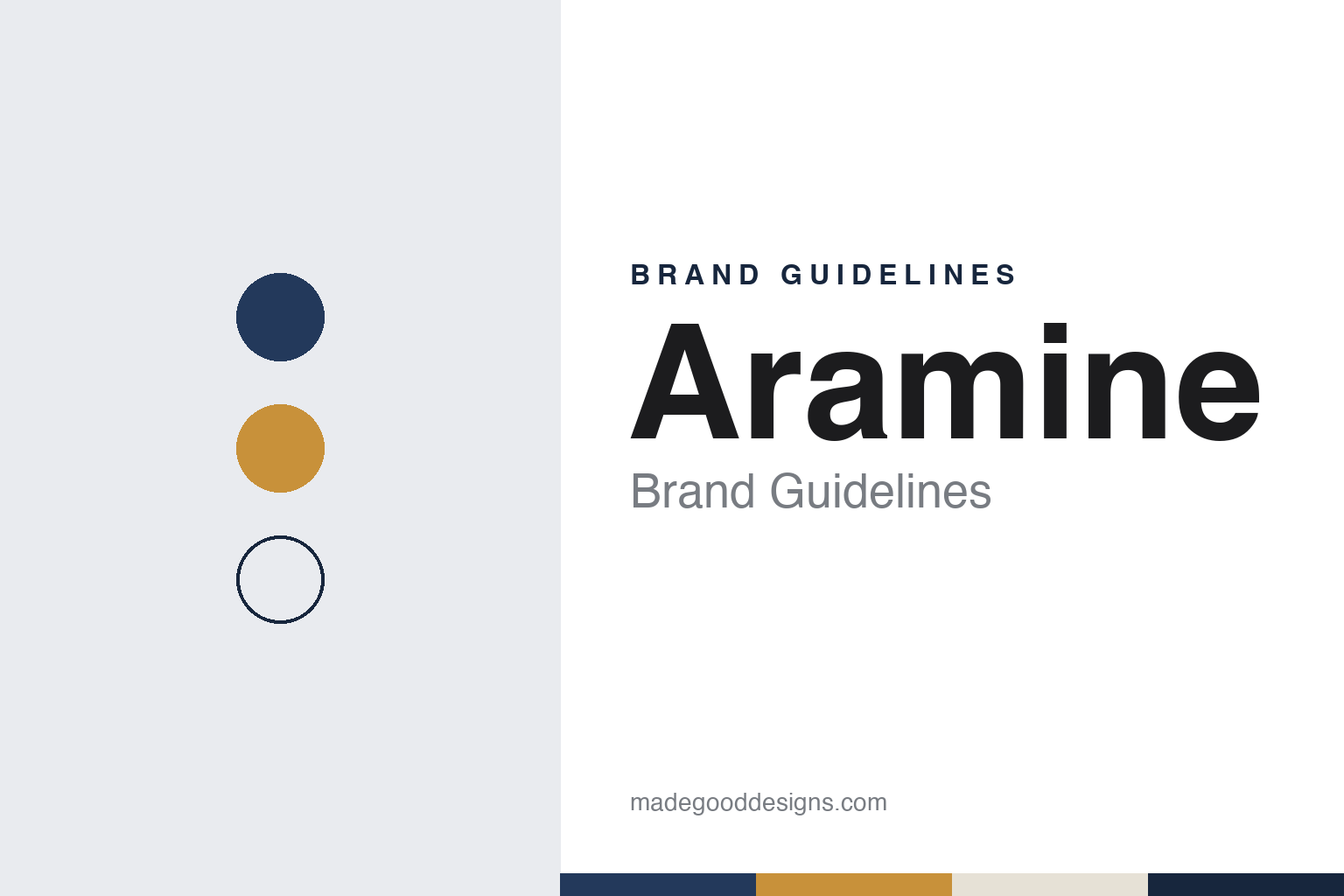
Aramine Brand Guidelines
The Provence family firm behind narrow-vein loaders and ARAMAC.
Aa
Two constants: a navy, ochre and limestone palette and a grotesque sans register. Abstract homage — not an Aramine or ARAMAC product or mark; no machine, logo or nameplate is reproduced.
Gardanne, 1975
From a coal town in Provence.
Aramine traces its roots to Gardanne, the former coal-mining town between Aix-en-Provence and Marseille. The regional news site Gomet reported in June 2024 that the company was founded there in 1975, and that its founders, Jacques and Angèle Melkonian, had opened their first Citroën garage in Gardanne in 1970. French Wikipedia says the business began in 1975 as Continental Industrie, making axles for mining machines.
The second generation reshaped it. French Wikipedia, citing Les Echos and L’Usine Nouvelle, says the founders’ children bought Continental Industrie in 1994 to build up its international business after the closure of France’s mines, and that the company took the name Aramine in 2000. Aramine’s own history says that in the 1990s Geneviève, Marc and Christophe Melkonian set up the Melkonian Group with the aim of becoming a French maker of mining machines. French Wikipedia, citing Le Point in 2019, says the three siblings, who co-chair the company, share most of its capital; in 2021, it adds, the regional fund Sofipaca and Crédit Mutuel Equity invested alongside them.
Parts and service for other makers’ machines remain a large part of the business. Aramine describes itself as a multi-brand specialist in spare parts, components and services for underground mines, with new and remanufactured components and a parts programme it calls SmartParts, and it says it is an authorised service centre for Dana, Bosch Rexroth and Parker. French Wikipedia illustrates this side of the business with a Sandvik underground loader shown before and after reconditioning by Aramine.
Colour
Small loaders for narrow veins.
Aramine’s own machines were built for one corner of mining: narrow-vein underground mines, where ore bodies are thin and tunnels small. International Mining reported in August 2026 that the equipment story began in 2008 with the L130E, a cable-electric loader designed for narrow-vein work and the company’s first machine; French Wikipedia dates the first underground loader to 2007. The range grew into loaders, mining trucks and drill rigs, and French Wikipedia’s photographs show a battery loader, an articulated truck and a drill rig.
One model is the L140B, a small battery-electric loader the company calls the miniLoader. International Mining and the company date its launch to 2016, while French Wikipedia gives 2014 for the first battery machine. The company says the L140B has an onboard charger that plugs into a wall socket and an optional quick-replacement battery module, which it calls QRS. In 2021 Aramine was one of two companies from Aix distinguished at the Grande Exposition du Fabriqué en France, held in the gardens of the Élysée Palace on 3 and 4 July, La Marseillaise reported; French Wikipedia says the L140B was the machine shown there.
By 2026 the battery-electric range ran to three loaders, from 1.3 to 6.2 tonnes, with a battery truck planned, International Mining reported, and the company said its autonomous equipment was already working in production mines. The group also sells other makers’ machines: the company names Lorenzana explosive-charging and concrete-spraying equipment and, in West Africa, Atlas Copco air compressors and Astec crushing equipment.
Typography
How mining equipment makers present themselves.
Mining equipment makers sell machines that most people never see at work. Their customers are mine operators, tunnelling contractors and quarry owners, and the machines spend their working lives underground or at the far end of an open pit. So the trade’s imagery tends to bring the site to the viewer: a drill rig in a floodlit tunnel, its booms reaching towards a rock face; a loader or haul truck in yellow or orange, picked out against grey stone; the beam of a headlamp in the dark.
Above ground, the favoured view is from high up. Photographs of open-pit mines show stepped benches cut into the earth, with trucks and drill rigs reduced to small bright shapes on the terraces. Underground pictures work the other way, close and cramped, with the machine filling the frame and the rock wall just beyond it.
Much of the rest of the visual language comes from proving that the machines work. Makers show equipment in test mines and at customer sites, and show it to the trade at fairs such as MINExpo International, which is organised by the US National Mining Association and describes itself as the industry’s largest global mining event; its next edition is scheduled for September 2028. Stands at such fairs put full-size rigs and loaders on display, often alongside screens showing the same machines below ground.
Behind the pictures sit very different companies. Some are divisions or spin-offs of large listed engineering groups; others are family firms or privately owned specialists built around one process, such as spraying concrete or charging explosives. This guide sets out what can be checked about each brand — who founded it, who owns it and where it says its machines are made — and marks clearly what rests only on the company’s own word.
Aa
A sturdy grotesque for a family firm with a new equipment name. (Specimen set in Archivo, a sans STAND-IN; NOT the Aramine or ARAMAC logo.)
Aramine
One family, two companies.
In August 2026 the business split in two. International Mining reported on 6 August that Aramine had launched ARAMAC, a company dedicated to designing, making and distributing underground mining equipment, while Aramine itself would keep the spare-parts and components business. Both remain owned by the Melkonian family: Marc Melkonian leads ARAMAC, Christophe Melkonian heads Aramine, and Geneviève Melkonian is co-president of both, the magazine reported. ARAMAC says it aims at underground mines with tunnel cross-sections of up to 16 square metres, and that it has delivered more than 500 machines in 34 countries.
The split came with a brand change. International Mining reported that ARAMAC introduced a new visual identity, to be rolled out step by step across communication materials, technical documentation and sales tools, with a dedicated website to follow. For now the group’s site carries both names, with sections for ARAMAC equipment and for Aramine parts.
The family is also returning to Gardanne. Gomet reported in June 2024 that Aramine had signed promises to buy plots at the Pôle Yvon Morandat, a business park on the site of a coal shaft that operated from 1986 to 2003, for a head office, a showroom and a research centre including assembly of electric mining machines and a battery workshop; at the time the head office was in Aix-en-Provence and the company had about 130 staff. In August 2026 International Mining reported that ARAMAC planned to open a new headquarters in 2027 near its existing production site in Gardanne, on a former mining site. The company says it holds ISO 9001 certification and is a member of the UN Global Compact.
For a design guide, Aramine shows a family firm separating a parts name from a new equipment name, each with its own identity. Compare Sandvik, another maker of underground loaders, and MacLean, a Canadian maker of underground mining vehicles. For this guide we use a navy, a deep night blue, an ochre and a limestone with a grotesque sans, an unofficial interpretation; no product or logo is reproduced.
Explore & save
Keep Aramine’s identity on hand — save it to a board in the Made Good inspiration library.
Aramine identity set
Pin the Aramine navy, ochre and limestone palette and the grotesque sans register to your own board.