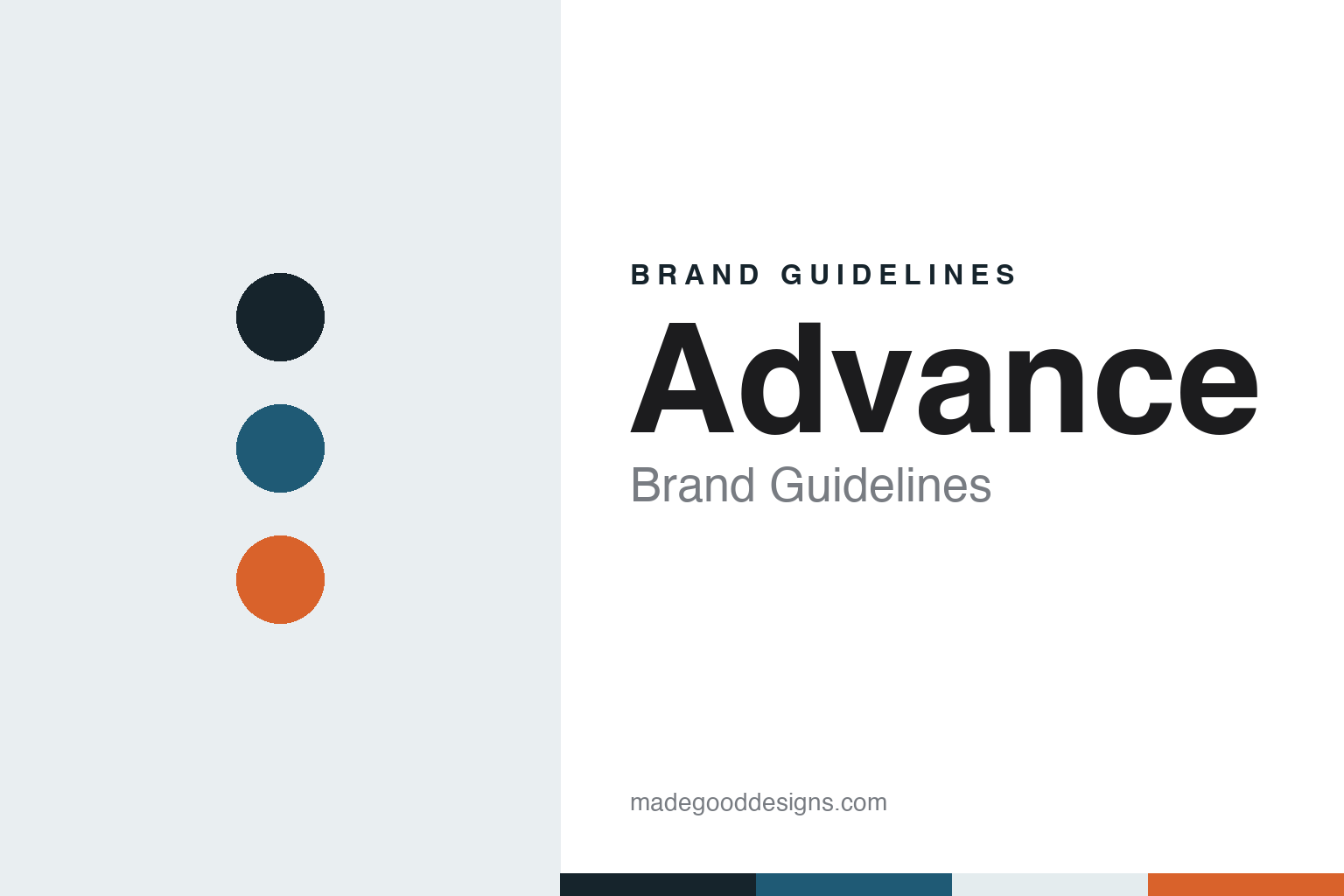
Advance Brand Guidelines
The Thun paraglider maker with a Greek alphabet of wings.
Aa
Two constants: an Advance slate, lake blue and orange palette and a Swiss sans register. Abstract homage — not an Advance product or mark; no wing, logo or nameplate is reproduced.
Advance Since 1988
A Swiss name from the sport’s first years.
Advance is a Swiss paraglider maker based in Thun, in the Bernese Oberland. Its brand story carries the line “Advance since 1988” and names Rolf Zeltner as founder and chief executive. The date is the company’s own, but it fits a dated record: in a joint statement of February 2013, reported by Cross Country, Advance and Nova described their brands as established since the end of the 1980s, and Zeltner signed for Advance. The legal name on the website’s imprint is Advance Thun AG. English Wikipedia, citing the World Directory of Leisure Aviation 2003–04, lists a share-held company making paragliders, harnesses, bags and clothing.
The website tells its early competition history through its ambassadors. Kari Eisenhut won the 1999 Paragliding World Cup as an Advance team pilot and became European champion in 2000, his profile says. He writes there that, as co-owner and part of the management team, he was responsible for the development team for more than 25 years, and that he now keeps only a small consulting mandate. Andy Hediger, once a test and competition pilot, says he has been part of Advance since 1995 and is now its importer in Argentina.
The design desk has changed hands over the years. In February 2010 Cross Country reported that Bruce Goldsmith, the 2007 world champion, had left Airwave for Advance, and Valéry Chapuis of Advance told the magazine the research and development workload was set to grow fast. A 2022 review in the same magazine named Silas Bosco as a former head of design, and said Christian Proschek took over the Sigma 11 from him. By March 2026 Cross Country was calling Proschek the company’s lead designer.
Advance has also shared work with another European maker. In February 2013 it and Nova, of Terfens in Austria, announced a “close strategic cooperation in development and production.” Both said they would stay “100% standalone,” with separate model series, marketing and sales, while jointly using their own factories in Hungary and Vietnam, Cross Country reported.
Colour
From Alpha to Omega, by way of the Alps.
Advance’s wings carry Greek letters. The range on its website runs from the Alpha series to the Omega ULS, with the Sigma DLS and Pi ULS among the models between. Harnesses take English names such as Lightness and Strapless, and reserves, bags and clothing fill out the line. English Wikipedia’s entry, drawn from the 2003–04 directory, gives the older shape of that ladder: the Alpha for beginners, the Epsilon and Sigma for intermediates, the Omega for competition and the Bi Beta for two people.
The Sigma has a long run in the trade press. Cross Country called it a “classic EN C Sports class glider” in a February 2022 review, dating the Sigma 9 to 2014 and the Sigma 10 to 2017, and said the Sigma 11 was drawn on a completely new profile. In February 2026 the magazine reported the Tau DLS, an EN-C two-liner for cross-country and sports-class competition pilots. DLS stands for “durable lightweight structure,” and the wing uses Skytex 38 on its leading edge and upper surface. It comes in two standard colour schemes, and Advance agreed to help sponsor the Mexico round of the Sports-Class Racing Series.
The company’s brand story says its sporting effort now goes mainly into cross-country competition and the Red Bull X-Alps, which it calls “the hardest paraglider race of all time.” Its X-Alps story runs through Chrigel Maurer, who grew up close to the Advance headquarters and flew for the brand for years, Cross Country reported in December 2014. He won in 2009 and 2011 on an Advance wing, flew Ozone in 2013, and came back that December to help develop Advance’s 2015 race equipment. At the time, the magazine noted, Advance did not make a competition paraglider, so he stayed free to fly another brand in competitions.
Maurer’s run continued. English Wikipedia records Maurer first and Sebastian Huber second in 2015, both on the Omega XAlps. In June 2019 the Thuner Tagblatt pictured a three-person delegation from Advance greeting him at the finish in Monaco after a sixth straight win. In May 2023 Advance released the Omega ULS, for Ultra Lightweight Structure, to replace the Omega XAlps, and that June Cross Country reported Maurer’s record eighth win, over a 1,223km course in six days, six hours and one minute.
Typography
Cloth, lines and the Coupe Icare.
A paraglider has no bodywork or badge plate, so most of what a maker shows the world is cloth. The wing is the largest thing it builds, and it is seen in two main ways: spread out on a launch slope before take-off, or overhead in the air. Makers’ websites and catalogues return to those two views again and again.
Colour comes in panels, because a wing is sewn from many pieces of sail cloth rather than painted. Makers often sell a small set of schemes: Cross Country reported in February 2026 that one new wing came in two standard colour schemes. The cloth is named as well, by mill and weight, in launch notes and reviews, and the stitched cell openings along the leading edge are among the details a close-up photograph tends to pick out.
Engineering drawing is part of the look. Manuals carry line plans and riser diagrams, and catalogues add feature tables and glossaries, so a brand’s printed material can read like technical documentation. Video does a similar job in a friendlier voice. Test pilots and designers appear on camera to explain what went into a new wing, and Cross Country has filmed one such session at a maker’s headquarters.
The trade’s shop window is the Coupe Icare festival. Cross Country describes its expo as a chance to see all the free-flight brands together in one space, and as the moment when companies celebrate their successes and announce next season’s gliders and harnesses. Stands there can be part of the brand: Ojo Volador reported that one maker marked its founder’s 40 years in free flight in 2018 with a party on its stand, a special red harness and live Korean folk music. This guide sets out what can be checked about each maker, and marks what rests only on the company’s own word.
Aa
A clean Swiss sans for a name the company writes in capitals. (Specimen set in Archivo, a sans STAND-IN; NOT the Advance logo.)
Reliable Paragliding Equipment
Swiss precision, built in Vietnam.
The website’s tagline is “Reliable Paragliding Equipment,” and the brand story leans on the phrase “Swiss precision” and on a stated motto: “Only those who leave the mainstream get ahead.” The company writes its own name in capitals, ADVANCE.
It is plain about where the work happens. Advance says its main base in Thun has a staff of around 30, covering development, marketing, operations, support and service, and that it has a service workshop in France. Production is elsewhere: “more than 300 production workers in our dedicated factory in Ho-Chi-Minh (Vietnam),” it says, make its paragliders, harnesses, rucksacks and accessories. It names Vinh Tran Huu as head of production. The Vietnamese plant also appears in dated reports: the 2013 Nova statement cites it, and Cross Country named it again in March 2026.
That new brand is Elevate, a paramotor label announced in 2026, with Simon Klemenc as its designer and Niki Kurcz as brand manager. Its first wing, an intermediate reflex model, was scheduled for summer 2026. Products will be made in Vietnam with orders running through the Advance system, and Advance says an international dealer network will be built specifically for the paramotor market.
Two studios list Advance as a client. BMCO Product Design says it designed the paraglider range, and argues that “less can be more in the sports industry too,” with “smart reduction” leading to “a high recognizability and a timeless appearance.” It adds that the complex materials make the job “way more than picking colors.” 3deluxe lists brand design, corporate design, product graphics, web design and magazine design, and describes a corporate design of clean lines, a clear colour palette and precise typography.
The brand’s softer side is its /advancedadventures campaign, a run of pilot stories on its website, with a printed collection. Advance says the campaign is not mainly about performance, but about human experience and the appeal of having ventured something new.
For a design guide, Advance shows how a plain name, a Greek alphabet of wings and a stated taste for reduction can hold a range together across generations of models. Compare Nova, its partner in the 2013 cooperation, and Ozone, the brand Maurer flew in 2013. For this guide we use a slate, a lake blue and a signal orange with a sans, an unofficial interpretation; no product or logo is reproduced.
Explore & save
Keep Advance’s identity on hand — save it to a board in the Made Good inspiration library.
Advance identity set
Pin the Advance slate, lake blue and orange palette and the Swiss sans register to your own board.