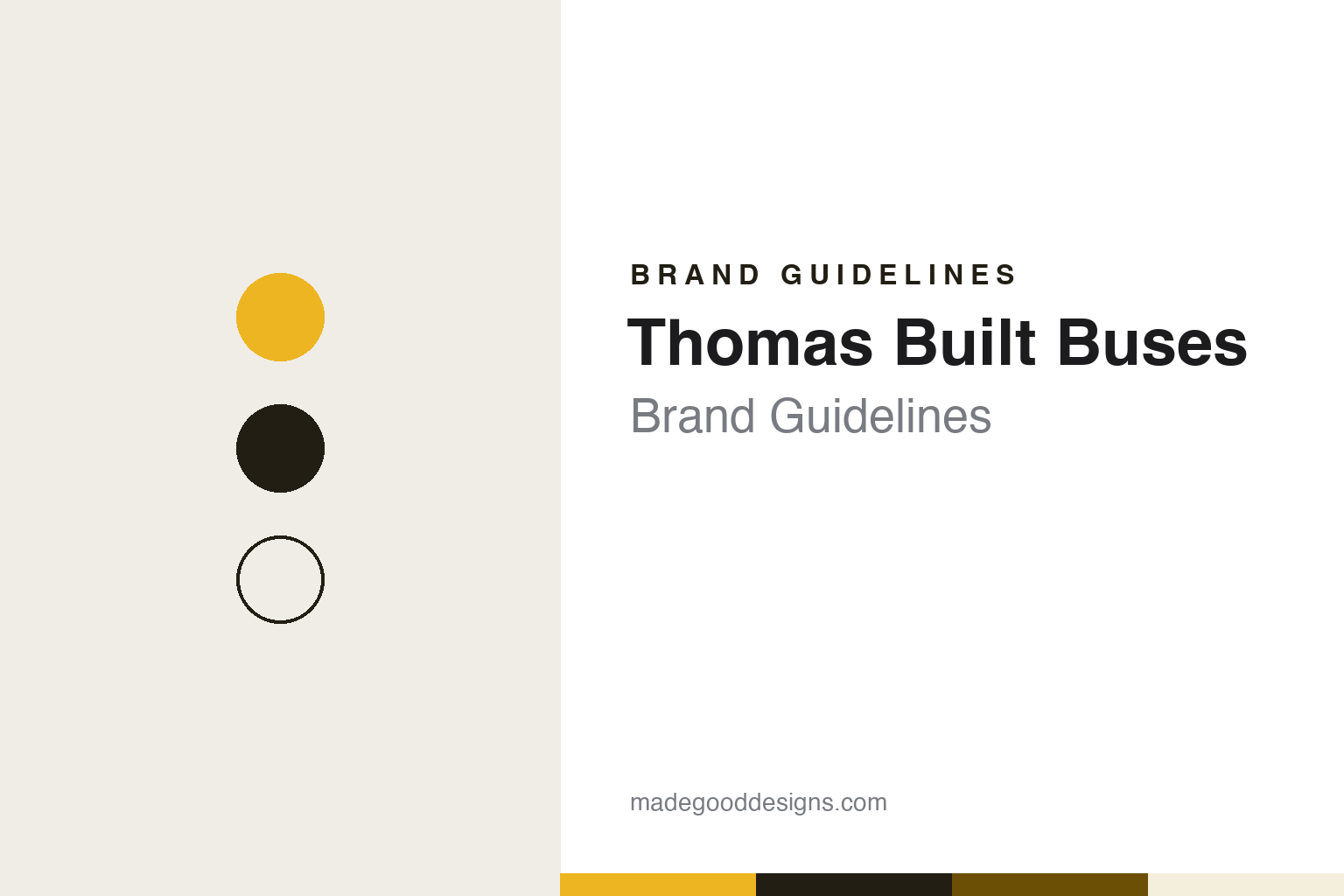
Thomas Built Buses Brand Guidelines
The High Point streetcar works that turned to yellow school buses.
Aa
Two constants: a route yellow and stop-arm black palette and a sturdy grotesque sans register. Abstract homage — not a Thomas Built Buses product or mark; no vehicle, logo or nameplate is reproduced.
Perley A. Thomas Car Works
A streetcar engineer in High Point.
Thomas Built Buses began as a streetcar business in High Point, North Carolina. Perley A. Thomas, born in Ontario, learned streetcar building in Detroit and became chief engineer of the Kuhlman Car Company in Cleveland, according to the Dictionary of North Carolina Biography. In 1909 he moved to High Point as chief engineer of the Southern Car Company.
Accounts of the new firm’s start differ. The company dates itself to 1916. It says hard times during the First World War closed Southern Car Works and cost Thomas his job, and that a few months later Southern Public Utilities asked him to gather a crew to renovate streetcars he had designed for his old employer. Within weeks, it says, he had hired former colleagues, bought a building in downtown High Point and opened Perley A. Thomas Car Works. School Bus Fleet also gave 1916 in its centenary pictorial of April 2016. The Dictionary of North Carolina Biography gives a different sequence: Southern closed in 1914, Thomas turned to replacement parts, at first in wood and linked to High Point’s furniture trade, and in 1917 he founded his own company to build streetcars, with thirty workers and a first order of four cars for Winston-Salem.
Streetcars made its name. Fire destroyed the works in 1921, the dictionary says, but Thomas rebuilt, and his biggest orders of the 1920s included 150 cars for New Orleans and 100 for Detroit. The company’s history page shows a 1923 streetcar and links the model to the film A Streetcar Named Desire. John Thomas II told School Bus Fleet in 2016 that the firm built the original car on New Orleans’ Desire line, and the magazine noted that Perley Thomas streetcars could still be seen in the city.
The streetcar market declined after 1930, and the firm moved towards road vehicles. The company says a 1934 commission from Duke Power for ten buses took it into transit buses; School Bus Fleet shows a 1934 bus built for Southern Public Utilities. In 1936 the company stopped making streetcars and launched school buses. That was the year Thomas first bid on them, the dictionary says, and he persuaded buyers to take all-steel construction rather than a composite of wood and steel, and introduced a door that swung outward.
The Second World War brought large orders from the U.S. Army, by then to a works largely converted from wood to metal. The dictionary lists metal pontoons for barges and bridges, metal bodies for radar equipment, buses, and body repairs on army vehicles, work that earned a citation from the army’s ordnance arm. The company adds that a Thomas ST6 served as General Patton’s personal quarters.
Colour
From family firm to Daimler subsidiary.
For decades this was a family company. Thomas gradually passed day-to-day operations to his children in the early 1940s while staying on as a design consultant, the company says, and the dictionary describes it as always a family corporation. By 1950 it ran a modern assembly line with 350 workers and could reach 1,700 buses a year at full production. The company’s history says it was then offering conventional bodies to fit the chassis of major auto brands such as Ford and Dodge. By 1978, under the third generation of family management, the High Point site covered 125 acres, output was about 6,000 units, and plants in Canada and Ecuador made buses for those markets, according to the dictionary.
The present name dates from 1972, when the company changed from Perley A. Thomas Car Works to Thomas Built Buses “to better reflect the core of its business.” The Mighty Mite, a smaller bus, appeared in 1972, and in 1977 Thomas introduced its first bus chassis and began producing the transit-style Saf-T-Liner, the company says. The smaller Minotour followed, shown on a Ford chassis in a 1980 example in School Bus Fleet’s pictorial, and in the 1980s the company entered the commercial transit market.
The company changed hands in 1998, when Thomas Built became a subsidiary of Freightliner LLC, then a unit of DaimlerChrysler, according to the company’s 2006 anniversary release and its history page. Freightliner is now known as Daimler Truck North America, based in Portland, Oregon, itself a subsidiary of Daimler Truck, and Thomas Built still names itself as a subsidiary of that business. An April 2026 company release adds a newer layer: Thomas Built and Freightliner Custom Chassis Corp. together form Daimler Truck Specialty Vehicles.
High Point is still the base. The company is headquartered in High Point, and it says it added a 275,000-square-foot plant there in 2004 to build the Saf-T-Liner C2; the last FS-65 conventional bus was made in November 2006 as the C2 took over. A May 2022 release, carried by School Transportation News, announced an added shift at the C2 plant with plans for 280 more hires, working on both the C2 and the electric Jouley, and said the company had been in High Point for more than a hundred years. The range also takes in the Saf-T-Liner EFX2 and HDX2, MyBus, launched in 2009 for childcare centres, churches and service groups, and activity buses. It sells through independently owned dealers across the U.S. and Canada.
Typography
Fleets and factory floors.
Bus and coach makers sell to operators, councils and school districts, so their brands reach most people second-hand. The maker’s badge often rides under someone else’s livery, and the passenger may never learn who built the vehicle. Even the badge can move: Wrightbus launched its Rightech midibuses in January 2025 with King Long building them, Sustainable Bus reported.
The trade shows how these companies present themselves when they do speak for themselves. Fleets lined up at depots, finished vehicles leaving the factory floor and milestone units rolling off the line are standard material. King Long’s own history counts its hundredth driverless Apolong and its 100,000th bus in that way. The stand at Busworld in Kortrijk, Belgium, is the other set piece, and King Long marks its first appearance there, in November 2005, as a step into international markets.
Vehicle form carries part of the identity. A cut-away van chassis gives the small school bus its proportions, and the destination blind gives a city bus a slot of type that the operator controls. In North America, colour is largely settled before a designer starts: English Wikipedia says Blue Bird engineers took part in a 1939 conference that helped select school bus yellow, the shade the whole industry shares. That leaves makers with details such as Blue Bird’s roof emblem, painted on many of its buses since the early 1960s.
Logos, typefaces and colour values are rarely documented for these makers. This guide sets out what can be checked: who founded each company, who owns it now, where it says its vehicles are made and which claims rest on the company’s own word. The palette and specimen here are ours, not the brand’s.
Aa
A sturdy grotesque sans — plain product names on a working vehicle. (Specimen set in Archivo, a sans STAND-IN; NOT the Thomas Built Buses logo.)
Forged in Yellow
A maker that writes about a colour.
Thomas Built leans on the colour of its product. A section of its website titled “Forged in Yellow” calls yellow “the bright symbol of our resilient spirit” and says it stands for the company “not just because it’s on our school buses, but because it’s strong and flexible in the face of great challenges.” The same text extends the idea to teachers, parents, drivers, dealers and transportation directors, and closes on the company’s line about making “every mile matter.” Elsewhere it says: “We build our buses as if our own children were riding on them.”
Its campaigns can also be direct. A short “If You Pass” campaign about drivers illegally passing stopped school buses ran during National School Bus Safety Week, using social messaging and a limited merchandise collection, and the company described it in February 2026 as intentionally direct. Proceeds went to Bryan County Schools in Georgia.
The vehicle that carries most of this design story is the C2. School Bus Fleet called it the first fully integrated conventional school bus when it recapped the 2004 launch, and the company says it was designed from the ground up. Thomas Built says the C2 looks different from other Type C buses, and that it chose the shape for the driver’s view, with a panoramic windshield and a low sloping hood. An “evolved” C2 now adds a new grille and air intake, which the company calls a sleeker, more modern design, and a digital instrument cluster.
The electric bus brought a lighter touch. Jouley debuted at a pupil-transportation press conference in Columbus, Ohio, in November 2017, and the chief executive of the day explained that it was named after the joule, the unit of energy, adding: “we are having fun with Jouley.” Proterra has supplied its batteries under a collaboration the companies date to 2018, renewed in May 2024 under Proterra’s new Volvo Group ownership. In March 2024 the 1,000th Jouley went to a Georgia school system, reported by Truck & Bus Builder. A second generation launched in January 2025 with an eAxle from Accelera by Cummins, an 800-volt Proterra battery system and a 219-inch wheelbase. In April 2026 the company added a gasoline C2, describing a range of diesel, electric and gasoline power.
Thomas Built also makes large claims for itself, and they should be read as such. It says one in three school buses on the road today is a Thomas Built bus; in 2006 it claimed more than one-third of the North American market. It says that in 2011 it became the first school bus maker to reach zero-waste-to-landfill operations.
For a design guide, Thomas Built Buses shows how a name can state exactly what a company does, and how a colour set by the product can become the brand’s own language. Compare Blue Bird, another American school bus maker, and Proterra, the battery name inside the Jouley. For this guide we use a route yellow, a near-black and a dark ochre with a sans, an unofficial interpretation; no product or logo is reproduced.
Explore & save
Keep Thomas Built Buses’s identity on hand — save it to a board in the Made Good inspiration library.
Thomas Built Buses identity set
Pin the Thomas Built Buses route yellow and stop-arm black palette and the sturdy grotesque sans register to your own board.