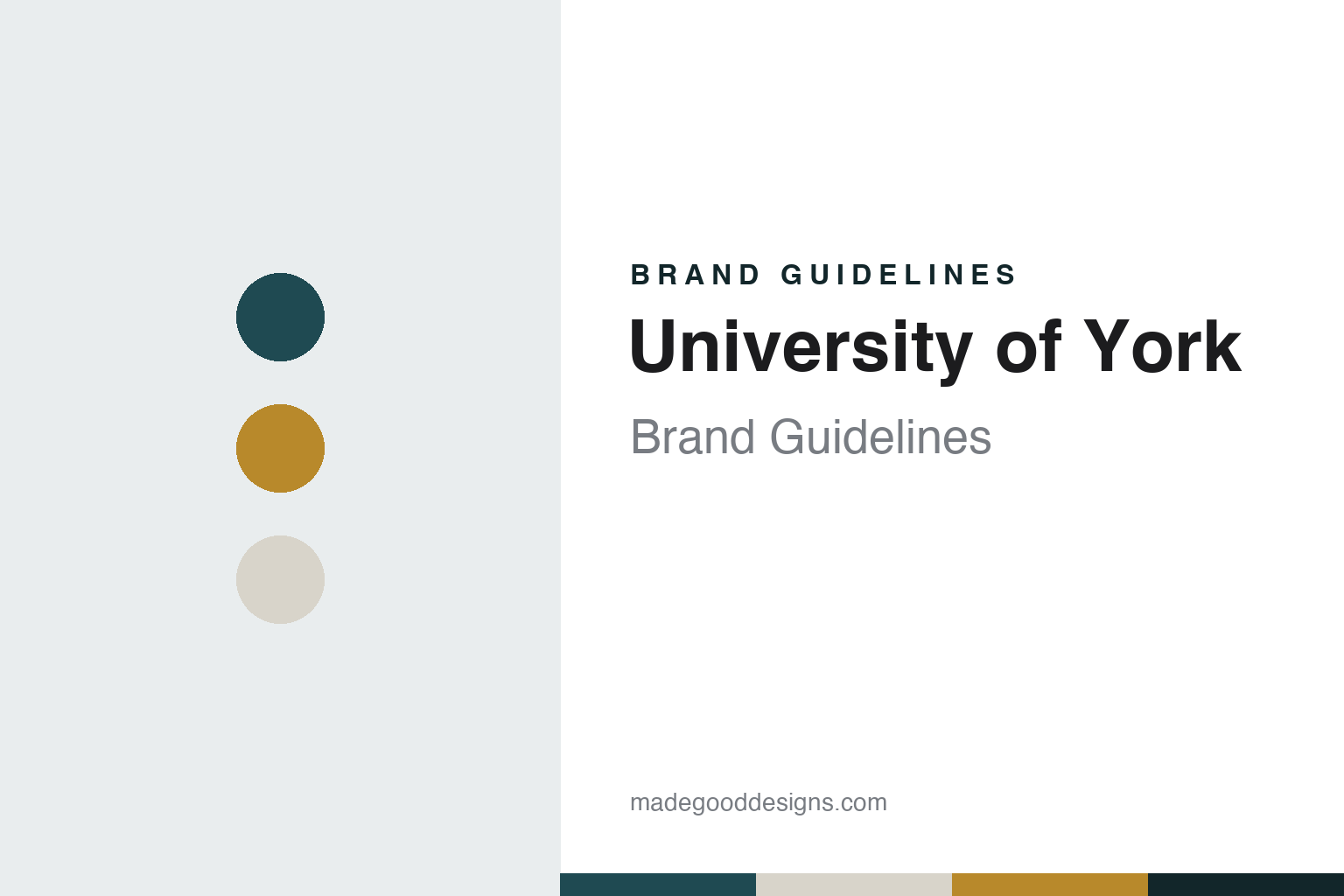
University of York Brand Guidelines
A university petitioned for in 1617 and built on a drained marsh in the 1960s.
Aa
Two constants: a York lake teal and reed gold palette and a plain sans register. Abstract homage — not a University of York mark; no shield, logo or crest is reproduced.
Three centuries of petitions
From James I to Heslington Hall.
The University of York has an unusually long prehistory. Plans for a university in the city go back to 1617, when, English Wikipedia says, a first petition went to James I. A later petition of 1641 was never sent to London because of the Civil War, the university says, and hopes raised in the 1820s faded when Durham University was founded in 1832.
The modern campaign grew in the twentieth century. English Wikipedia names Oliver Sheldon, a director of Rowntree’s and a co-founder of York Civic Trust, and John Bowes Morrell as driving forces, and the university’s history records a 1946 sermon by the Archbishop of York that argued the city’s case.
The site had its own past. Heslington Hall was built as a country house in 1568 and, the university says, was owned by the same family from 1708. During the Second World War the family left and the Royal Air Force took over, using the house as the headquarters of 4 Group Bomber Command.
In April 1960 the Government approved the new university, and on 9 October 1963 the first students walked through the gates of Heslington Hall. The university counts 216 undergraduates, 14 postgraduates and 28 academic and administrative staff in that first year. English Wikipedia gives six opening departments: Economics, Education, English, History, Mathematics and Politics. Lord James of Rusholme served as Vice-Chancellor from 1960 to 1973, and Lord Harewood as the first Chancellor. Lord James wanted a collegiate university with a limited range of subjects and much of its teaching in tutorials and seminars, English Wikipedia says. The motto, “In limine sapientiae,” means “On the threshold of wisdom.”
Colour
Prefabricated buildings and a lake with a purpose.
York’s look was fixed first by its campus. The original buildings were designed by Andrew Derbyshire and Stirrat Johnson-Marshall, with input from Lord James, Patrick Nuttgens and the Registrar, and were assembled with CLASP, a system of prefabricated construction, English Wikipedia says. It also lists York among the “plate glass” universities of the 1960s.
The buildings were linked by covered walkways, which the university calls an innovation of the time. It adds that eyebrows were raised at the CLASP buildings, and that students of the third year returned to find a university “adrift in a sea of mud.” When Queen Elizabeth II opened Derwent and Langwith Colleges on 22 October 1965, the university’s history records, she was impressed by Heslington Hall but “did not like the new colleges.”
The lake is the campus’s signature, and it had two purposes. English Wikipedia says the architects wanted it both to give the university a distinct image and identity and to serve as a drainage basin on flat farmland, and describes it as the largest plastic-bottomed lake in Europe. The university confirms the practical side, saying it was criticised as extravagant although it was needed to allow building on marshy land. By the end of the 1960s, the university says, five colleges, Central Hall, the Library and the Jack Lyons Concert Hall had been completed. Central Hall, a half-octagonal concert hall, is Grade II listed, as is the West campus landscape, English Wikipedia says.
The second phase came four decades later. After a public inquiry, the Secretary of State approved a campus extension in May 2007, and Campus East began coming into use in October 2009. York now has eleven colleges, the newest of them, David Kato, opened in 2022. The university was named University of the Year at the Times Higher Education Awards on 25 November 2010, and joined the Russell Group in 2012, it says.
The campus also produced an unplanned mascot. Long Boi, a very tall duck, lived on campus between 2018 and 2023, the university says, and became an internet sensation; it now tells his story on its own history pages. A bronze statue unveiled in September 2024 was damaged that November and removed, English Wikipedia says. Every summer York’s students meet those of Lancaster in the Roses Tournament.
Typography
Crests, concrete and open days.
Universities founded after 1950 could not borrow a medieval past, so their identities had to come from somewhere else. In Britain the buildings came first. The writer Michael Beloff chose the word “plateglass” for the new universities of the 1960s, for their modern design and wide expanses of glass in steel or concrete frames, and he wrote of the “grey or biscuit concrete massiveness” of most of their buildings and “the black towers of Essex.” The term set them apart from the Victorian redbrick universities and the ancient ones.
The marks followed a similar line, keeping the idea of a crest while simplifying it. Grafik described the Open University’s 1969 logo as a U with a crest-like structure and a punched-out O, respectful of heraldry while looking ahead. In 2022, campaign material said the same shield had become the starting point for a design system built with accessibility in mind.
Some of these universities reached the public through broadcast before most people could see a campus. The BBC dates the first Open University programme to 3 January 1971, on BBC Two, with academics as presenters and an animated logo and fanfare at the start. That late-night teaching ended in 2006. Monash University’s early fame in Australia came by a different route: Wikipedia says many people first heard of it through its student protests.
This guide follows these universities onto the surfaces where they meet the public: prospectus covers, banners on open days, degree certificates and national campaigns. For each one, it sets out what can be checked about the founding, the name and the identity, and it says who is making each claim, including when the claim comes from the university itself.
Aa
A plain sans, chosen by us for this page. (Specimen set in Libre Franklin, a sans STAND-IN; NOT a University of York typeface and NOT its logo.)
University of York
More than just a logo.
York’s current identity is recent. The University’s Communications blog said in April 2025 that the brand identity had been rolling out since 2022, with new colours, typefaces, tone of voice and visual devices. The last major channel was the website, which receives over 30 million page views a year and rests on legacy code going back nearly 20 years. Rather than rebuild from scratch, the team chose to redesign layouts and navigation while keeping the content, and on 14 July 2025 the main site moved to the new design with a site-wide menu.
The rules sit in a brand book, which the university says is available to staff, students and external agencies, alongside a staff-only brand platform of templates, photographs and video. The brand, it says, “is more than just a logo.” Its guidance covers logos, colour, typefaces, photos and videos, and a tone of voice summed up as “one voice, several tones.” Departments and faculties use a sub-logo, a fixed visual relationship between their name and the University logo, which the university says communicates equality among them; a co-brand architecture covers partners and affiliates. A true sub-brand is rare, and needs a conversation with Communications first.
The team’s recent work shows the system in use. Its February 2026 round-up described a recruitment campaign, “Find your…,” carried across an undergraduate course listing, a prospectus magazine and a stand for UCAS fairs, with a playbook covering both verbal and visual sides. The team’s notes also mention new branding for a deep geothermal energy project.
The university’s map has also changed. It said in June 2024 that it would stop using King’s Manor, a Grade I listed medieval building in the city centre, citing costs and accessibility; Times Higher Education reported a backlash in July 2024, and The Tab reported a petition of more than 1,000 signatures. York St John University said in July 2026 that it had taken a long leasehold on the site. Abroad, York announced on 9 June 2026 that University of York Mumbai, in the Powai district, had received its Letter of Approval from India’s University Grants Commission.
Staffing has fallen too. Figures published by The Times on 22 August 2026, The Tab reported, showed 660 fewer roles at York, a 12.5 per cent reduction. The university said most savings came from lower operating costs and voluntary severance, returning staffing to 2022 levels.
For a design guide, the University of York shows how an institution with a strong physical image can build a modular identity around departments. Compare Lancaster University, its Roses opponent, and University of Warwick, another 1960s foundation. For this guide we use a lake teal, a concrete grey and a reed gold with a sans, an unofficial interpretation; no product or logo is reproduced.
Explore & save
Keep University of York’s identity on hand — save it to a board in the Made Good inspiration library.
University of York identity set
Pin the York lake teal and reed gold palette and the plain sans register to your own board.