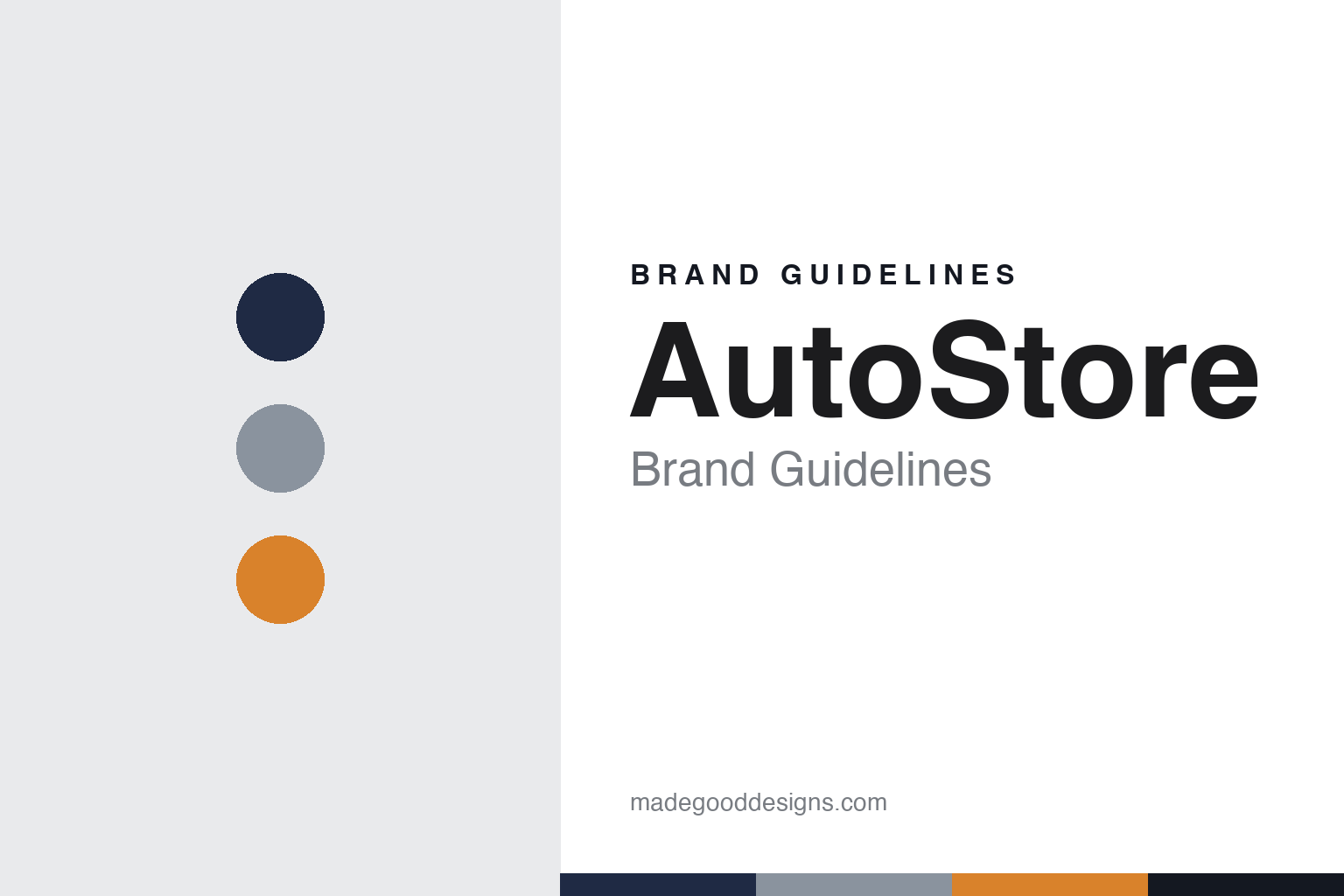
AutoStore Brand Guidelines
A full warehouse in Nedre Vats and a cube of bins worked from above.
Aa
Two constants: a navy, grey and orange palette and an engineered sans register. Abstract homage — not an AutoStore product or mark; no robot, grid, logo or nameplate is reproduced.
Nedre Vats
A full warehouse and a cube of bins.
AutoStore began in Nedre Vats, Norway, where it still has its head office. English and Norwegian Wikipedia both give its founding year as 1995; a June 2019 press release from the investment firm Thomas H. Lee Partners gave 1996, so the year depends on the source. English Wikipedia traces the idea to the Hatteland group of the entrepreneur Jakob Hatteland, which began by selling computer components from a barn in Nedre Vats and grew into a large distributor of electronic components. When a newly built warehouse filled up within a month, it says, the group’s technical director, Ingvar Hognaland, developed a compact robotic storage system, and that system became the basis of AutoStore.
English Wikipedia adds that Arrow Electronics bought Hatteland Electronic in 2000, which let the Hatteland group put more into the storage idea. The first commercial system went in during 2005 at Elotec, a Norwegian maker and distributor of security equipment. AutoStore’s own case study calls Elotec the first company in the world to install the system, says it was still using it sixteen years later, and names Element Logic as the partner on the project.
The principle has stayed the same since. On its website the company describes an aluminium Grid that holds stacked storage Bins and also serves as the rails for the Robots that run across the top. The robots lift bins out of the stacks and deliver them to workstations the company calls Ports, where people or robotic pickers take out the goods. The Bins come in three sizes and can be divided into compartments, and bins of different heights can sit side by side in one grid, the company says. English Wikipedia notes that the design needs no aisles or walkways, which is why the system looks from outside like a solid block rather than a set of shelves.
Colour
Private equity, SoftBank and Oslo.
Ownership changed several times in a few years. English and Norwegian Wikipedia say the investment firm EQT bought AutoStore in 2017. In June 2019 Thomas H. Lee Partners (THL), with offices in Boston, announced a definitive agreement to acquire the company; its press release said members of AutoStore’s management and EQT would keep minority holdings and that EQT would stay on the board. In April 2021 AutoStore announced that SoftBank had agreed to buy 40% of the company from funds affiliated with THL and EQT, among other shareholders, with THL remaining the majority shareholder and all three represented on the board, Modern Materials Handling reported.
On 20 October 2021 AutoStore shares began trading on Oslo Børs under the ticker AUTO. Euronext, which runs the exchange, called it the largest IPO in Norway in 20 years and described AutoStore as the pioneer of the cube storage segment. Karl Johan Lier rang the opening bell as chief executive; the company says Mats Hovland Vikse, who joined in 2017 as chief strategy officer, became chief executive in January 2023.
Its longest-running legal fight was with Ocado, the British online grocer and warehouse-technology group. In October 2020 AutoStore went to the UK High Court claiming that Ocado’s platform infringed six of its patents, later dropping two, and filed a complaint at the US International Trade Commission; Ocado answered with suits in the United States and Germany, JUVE Patent reported in July 2023. At the end of March 2023 the High Court found two AutoStore patents invalid and not infringed. On 22 July 2023 the two companies announced a complete settlement. According to Ocado’s announcement, all claims were withdrawn worldwide, each side licensed the other’s pre-2020 patents, both could keep selling their existing products, Ocado kept exclusive rights to its single-space robot, and AutoStore agreed to pay Ocado in instalments over two years. JUVE Patent noted that the settlement was also the first at the new Unified Patent Court, where Ocado had filed cases in June 2023.
Typography
Cubes, swarms and shuttles.
Warehouse automation is an industry that mostly sells to other businesses, and its companies present themselves through the machines they install. The images are familiar across the sector: a dense block of stacked storage bins with robots running across the top, a swarm of small mobile robots moving under or up tall racks, or long shuttle aisles feeding a line of conveyors and sorters inside a distribution centre.
Those images do a job that a product catalogue cannot. A storage grid or a robot fleet is usually built to fit one building, so the companies show finished sites, walk-through videos and case studies named after their customers. Many also describe themselves as software companies as much as machine builders, and show control-room screens and dashboards that track robots, orders and stock in real time.
Trade fairs are where the sector meets its buyers. LogiMAT in Germany, ProMat in the United States and CeMAT are among the logistics shows where makers build working demonstration systems on their stands, and where new robots and workstations are often launched. Many of the companies also sell through partners and system integrators, so the same system can appear under more than one name on a show floor.
This guide sets out what can be checked about each company — who founded it, who owns it, where it says its equipment is made, and what has happened to it — and marks clearly what rests only on the company’s own word. The palettes and typefaces shown are our own interpretation, not the companies’ official colours or logos.
Aa
An engineered sans for a modular system. (Specimen set in Inter Tight, a sans STAND-IN; NOT the AutoStore logo.)
AutoStore
One idea, many partners.
AutoStore says its systems are “distributed, designed, installed, and serviced by a network of qualified system integrators” it calls partners. Its global partners include Element Logic, which describes itself there as the first AutoStore partner, Swisslog, Dematic and Toyota Automated Logistics. On where the hardware is made, the company’s About page lists ISO 9001 and ISO 14001 certificates for production in Poland and in Thailand, and an ISO 45001 certificate for its production in Poland.
The range has widened around the original cube. English Wikipedia says AutoStore bought the Denver software company Locai in 2019 and renamed its product the Qubit Fulfillment Platform in 2022, and that the same year it launched Pio, a version for small and mid-sized businesses offered as robots-as-a-service. In 2025, it says, came a multi-temperature version for chilled and frozen goods and CarouselAI, a robotic picking system developed with Berkshire Grey, which TIME included in its list of the best inventions of 2025. The company’s site now also lists the Robot R5, the CubeVerse platform and CubeAnalytics, and says it has more than 2,050 systems in nearly 68 countries.
For a design guide, AutoStore shows how one storage idea — a cube of bins worked from above — can be named, modularised and sold around the world through other companies. Compare Ocado, its former opponent in court, and Swisslog, one of its listed partners. For this guide we use a deep navy, a rail grey and a warm orange with a sans, an unofficial interpretation; no product or logo is reproduced.
Explore & save
Keep AutoStore’s identity on hand — save it to a board in the Made Good inspiration library.
AutoStore identity set
Pin the AutoStore navy, grey and orange palette and the engineered sans register to your own board.