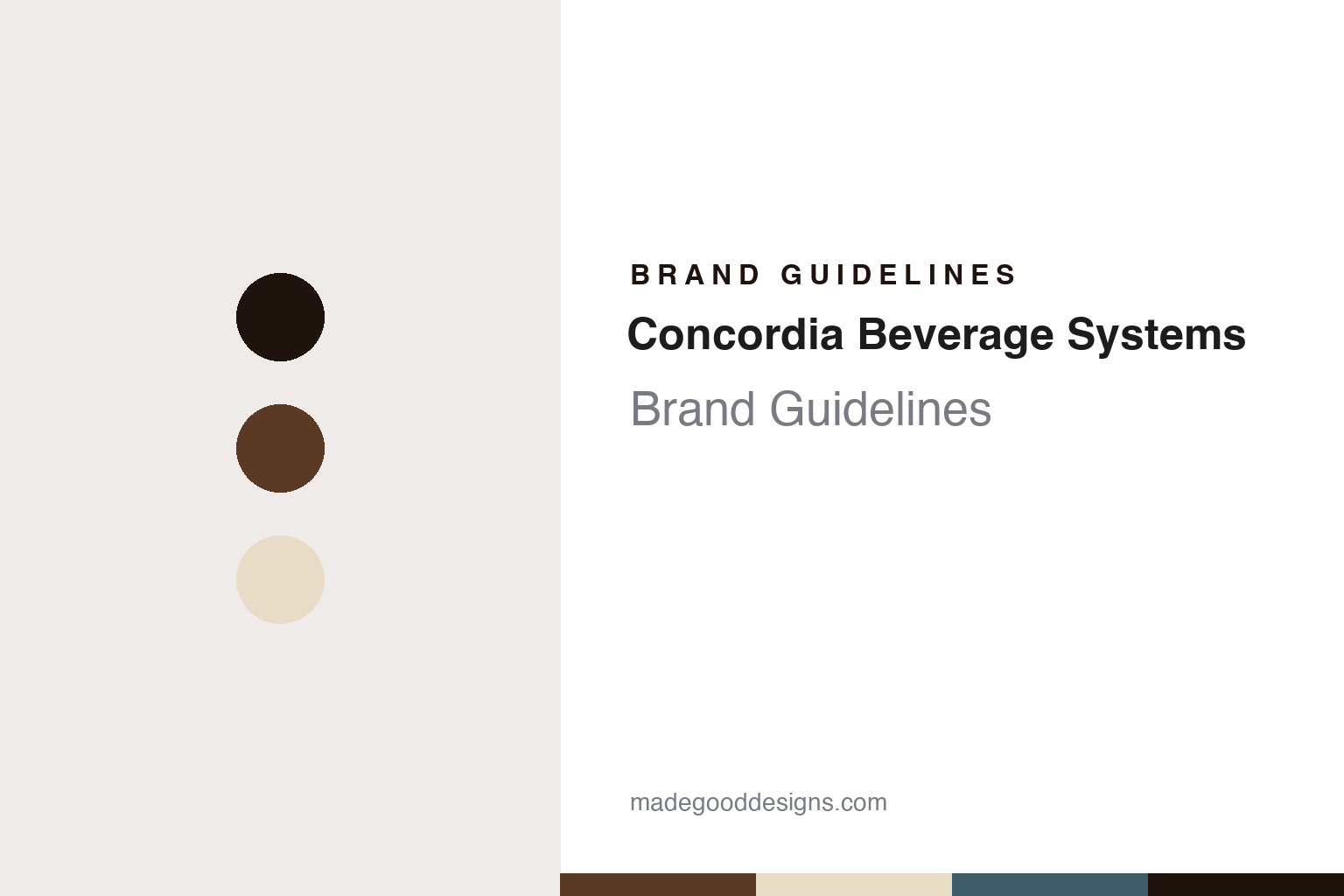
Concordia Beverage Systems Brand Guidelines
The Seattle-area espresso machine that grinds, brews and steams at one button.
Aa
Two constants: a roast brown, crema and slate palette and a plain industrial sans register. Abstract homage — not a Concordia product or mark; no machine, logo or nameplate is reproduced.
Acorto
A one-button espresso machine from the Pacific Northwest.
Concordia Beverage Systems tells its own story as a Pacific Northwest one. On its website the company says it started in 1989 as Acorto, Inc., and that its founders set out to bring “the manual skills of a professional Barista” to coffee equipment. The result, the company says, was a single-button automatic espresso machine that could grind, brew, steam and froth milk, which it calls “the world’s first super automatic espresso machine.” That is the company’s claim, and it is repeated on the brand page of its owner, the Middleby Corporation, which says Concordia was the first company to develop and patent a fully automatic espresso delivery system combining milk steaming with coffee grinding and brewing.
The company says Acorto kept growing through the 1990s as a maker of the new bean-to-cup machines, and that this growth led to a change of ownership and of name in 2004, when the business became Concordia Beverage Systems. Trade press agrees on the date in its own way: in January 2015 the trade journal Foodservice Equipment Reports described Concordia as a “10-year old Seattle-based firm.” The company’s home page now puts the two dates together, saying its machines have been “engineered and built in the Seattle area since 1989.”
The business has used more than one name along the way. The 2014 press release announcing its sale called it Concordia Coffee Company, Inc., and the web address it gave then, concordiacoffee.com, is still the brand’s site; the machines themselves are sold under the Concordia name, which Middleby lists among its trademarks. The company presents itself as an American manufacturer in a global coffee industry and closes its pages with a line it uses as a motto: “the proof is in the cup.”
Colour
Self-service coffee for stores, hotels and cafeterias.
Concordia makes machines for commercial coffee service, and its website sorts them by setting: convenience stores; offices, cafeterias and healthcare; restaurants; and hotels and hospitality. When Middleby bought the company, the trade journal Foodservice Equipment & Supplies reported on 9 September 2014 that its automated and self-service coffee and espresso machines suited convenience stores, hotels, restaurants and non-commercial operators, and described the company as Seattle-based.
The sale was announced by the Middleby Corporation, the foodservice equipment group based in Elgin, Illinois. Its press release, carried by Vending Market Watch on 10 September 2014, called Concordia “a leading manufacturer of automated and self-service coffee and espresso machines” serving convenience store, hotel, restaurant chain and institutional customers; Foodservice Equipment Reports later dated the announcement to 8 September. In the release Middleby’s chairman said the fully automated espresso machines “provide for thousands of beverage combinations,” and that the company expected to grow Concordia’s sales through Middleby’s existing global sales and service network. The release also named a product then due to launch: the Ascent, which it described as an on-demand brewer making coffee one cup at a time.
That product line continues today as the Ascent Touch, a bean-to-cup machine for black coffee. The company says it uses a patented Accelerated Low Pressure System, which it abbreviates A.L.P.S., and that its coffee meets the Specialty Coffee Association’s “Gold Cup” standard; both are the company’s own descriptions. Middleby’s brand page lists Concordia’s patents as covering overall design, milk systems, syrup infusion and the A.L.P.S. brewing process.
The company’s website quotes customers by name, among them Alaska Airlines, which it says replaced an earlier super-automatic machine with a Concordia 2500i. For certifications, Concordia names NSF, CE and UL.
Typography
Machines that do the barista’s work.
Commercial coffee machine makers sell mainly to businesses rather than to homes. Their customers are hotel groups, coffee-shop chains, office caterers and restaurants, and their products sit on hotel breakfast buffets, office counters, convenience-store shelves and behind café bars. Some build fully automatic machines that grind, dose, brew and froth milk at the touch of a screen; others build large batch brewers that fill urns and airpots for a busy service.
Much of the trade grew from a practical problem. SWI swissinfo.ch reported in 2024 that Swiss restaurants in the 1970s faced higher wage costs and fewer staff behind the buffet, and the historian Jonathan Morris told the publication that Swiss automatic machines set out to make coffee and milk drinks simpler for staff without barista training. Switzerland remains a centre of that business, with makers in Weggis, Zuchwil and elsewhere.
The machines now present themselves through screens and options as much as through steel. In 2025 TOP HOTEL Projects described one fully automatic model offered with touchscreens of two sizes, modes for staff service, self-service and office use, and interchangeable panels in a customer’s chosen colour. Milk systems, cleaning routines and service networks also feature in how these makers describe what they offer.
Launches tend to happen at trade fairs rather than in shops. HOST Milano, the hospitality fair held in Milan, is one such stage; specialty-coffee events such as World of Coffee are another. This guide sets out what can be checked about each maker — who founded it, who owns it, and what it says about where its machines are made — and marks clearly what rests only on the company’s own word.
Aa
A plain industrial sans for a machine maker from the Seattle area. (Specimen set in Barlow, a sans STAND-IN; NOT the Concordia logo.)
Concordia Beverage Systems
A Middleby brand built in Renton.
More than a decade after the sale, Concordia still trades under its own name. The footer of its website reads “A Middleby Company,” and the company says that while it keeps “small business values,” it works under the leadership of Middleby Coffee Solutions Group. Middleby’s own brand page sends visitors to the Concordia site and lists the brand in its foodservice and beverage division.
The factory has moved once in that time. In a post looking back on 2021, the company wrote that it had moved from its original headquarters in Redmond to a new facility in Renton, Washington, a short distance away. It said the new building was three times larger, that its team had grown by about a third, and that the move gave it room to build more machines with more test bays and loading docks. Middleby’s brand page still says the machines are designed, developed and assembled at a Redmond headquarters, while the company’s own About page names Renton as its headquarters.
On where the machines are made, the company is specific. It says they are “designed, developed, and hand-built” in its Seattle-area facility by skilled staff, using “nearly 100% Made-in-America parts.” Those are the company’s words. Concordia also says it has “one of the largest Technical Service organizations in the industry,” another claim we give as its own.
For designers, the brand is a study in an engineering company that speaks plainly. Its pages lead with what a machine does — grind, brew, steam, froth — and with where it is built, and the motto “the proof is in the cup” does the work that a longer slogan might elsewhere. The name changed once, from Acorto to Concordia, and the owner changed once, to Middleby, but the company has stayed in the Seattle area.
For a design guide, Concordia Beverage Systems shows how a machine maker can make its home region part of its name and story. Compare Bunn, an American maker of commercial coffee brewers, and FETCO, another American maker of brewers for foodservice. For this guide we use a roast brown, a pale crema and a slate blue with a sans, an unofficial interpretation; no product or logo is reproduced.
Explore & save
Keep Concordia Beverage Systems’s identity on hand — save it to a board in the Made Good inspiration library.
Concordia identity set
Pin the Concordia roast brown, crema and slate palette and the plain industrial sans register to your own board.