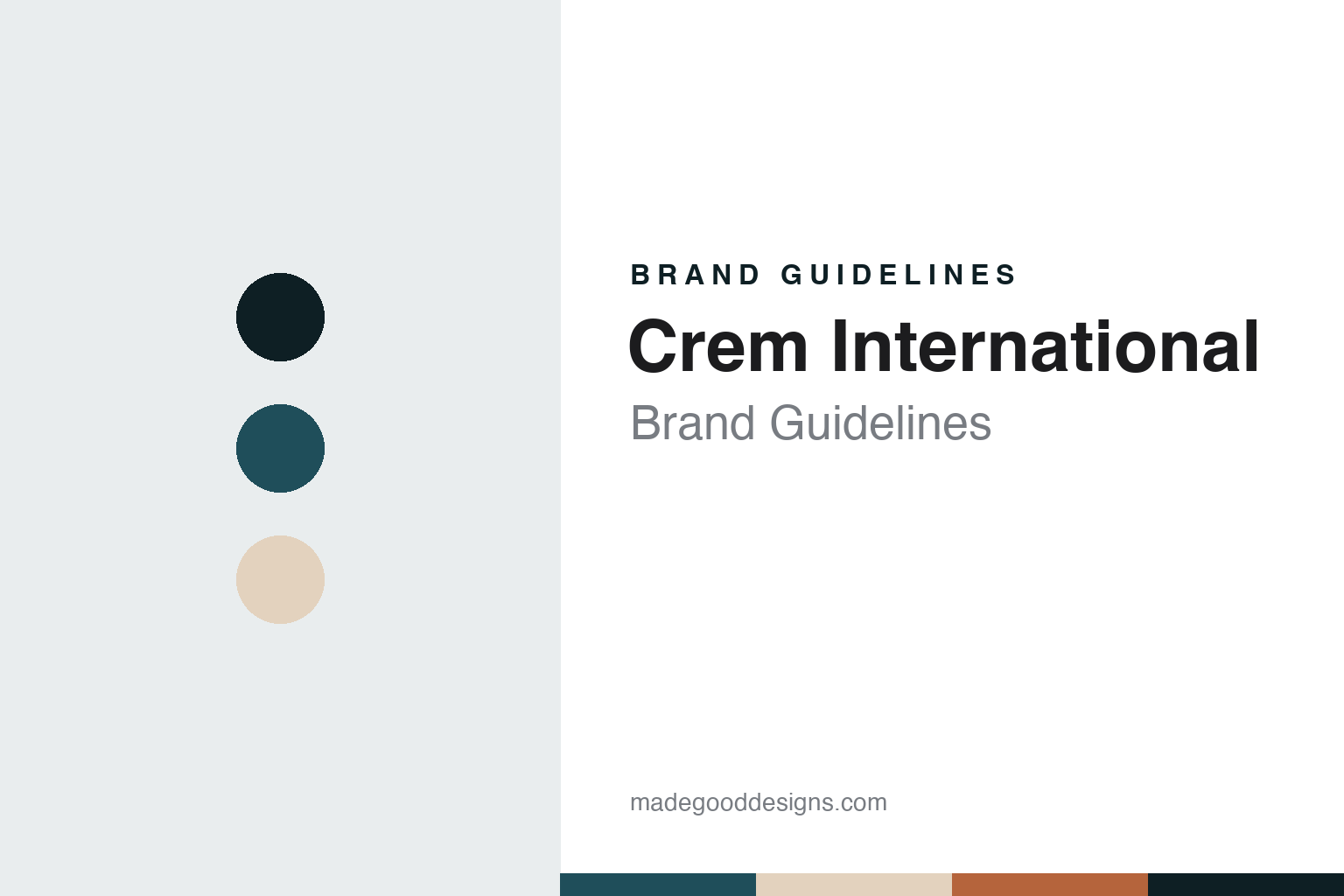
Crem International Brand Guidelines
A Spanish espresso maker and a Swedish brewer, merged into one house of coffee machines.
Aa
Two constants: a fjord teal, oat and Valencia clay palette and a rounded geometric sans register. Abstract homage — not a Crem product or mark; no machine, logo or nameplate is reproduced.
Two companies
An espresso maker in Spain and a brewer maker in Sweden.
Crem International is the product of a merger between two coffee machine businesses at opposite ends of Europe. On the Spanish side, the Ali Group, which owns Crem today, says in a July 2026 profile that Crem was born as Expobar in Spain in 1985, and that by 1993 the company operated as Crem Aparatos S.L., building espresso machines. Expobar remains one of its brand names. On the Swedish side was Coffee Queen, a maker of coffee brewers; the company’s own history says Coffee Queen expanded into Asia in 2007.
Sources differ on when the two came together. The company’s website and the Ali Group both say the merger that created Crem International took place in 2008. Daily Coffee News, reporting on the company in February 2018, wrote that Crem International “came about in 2011” with the merger of Coffee Queen and Crem Aparatos. We give both dates.
The company has described the merger as joining Expobar, from Spain, and Coffee Queen, from Sweden, and both countries still appear in its addresses. The Ali Group’s brand page lists two headquarters for Crem: one at Gandía, in the province of Valencia, for the hospitality trade, and one at Åmotfors, in western Sweden, for office coffee. In 2018 the trade journal Foodservice Equipment & Supplies gave the head office as Solna, near Stockholm, with manufacturing at Åmotfors, Gandía and Shanghai.
Colour
Spengler, private equity and a wider range.
After the merger, the company says, it spent several years building its brands in export markets and enlarging its sales organisation. According to Daily Coffee News, the private equity firms Priveq Investment Fund and SEB Venture Capital took majority ownership of Crem in 2012, holding it through a company called Avaj International Holding AB.
In 2015 Crem bought Spengler GmbH, a German maker of fully automatic coffee machines. The company calls it a strategic purchase that brought decades of experience in office coffee and technology for further automatic machines. Planet Vending, the British vending trade site, reported in October 2018 that Spengler’s previous owner, Maas, had held the brand for seven years before selling it to Crem, and that the Spengler machines were made at Åmotfors and designed by an engineering team spread across Spain, Germany and China.
By early 2018 the group sold coffee machines under three names — Coffee Queen, Expobar and Spengler — for offices, restaurants, cafés and coffee shops, catering and convenience stores, Foodservice Equipment & Supplies reported, adding that it had three research and development centres and six sales offices. Daily Coffee News said Crem had historically focused on European and Asian markets and showed its machines at trade fairs such as the Seoul International Cafe Show and Host Milano. In September 2018 Planet Vending reported the company’s own description of a range that covered manual and automatic espresso, filter, instant and liquid coffee machines, sold in more than 80 countries.
The company now says it has “the most extensive product range” in its industry, a claim we give as its own. Its current website groups the range into automatic machines, traditional espresso machines, filter brewers and grinders, with names such as Diamant Pro, EX3, Unity1+ and Mega Gold. The Ali Group says the EX3, launched in 2020, has since won four international design awards.
Typography
Machines for cafés, offices and stores.
Commercial coffee machine makers sell mainly to businesses rather than to homes. Their customers are hotel groups, coffee-shop chains, office caterers and restaurants, and their products sit on hotel breakfast buffets, office counters, convenience-store shelves and behind café bars. Some build fully automatic machines that grind, dose, brew and froth milk at the touch of a screen; others build large batch brewers that fill urns and airpots for a busy service.
Much of the trade grew from a practical problem. SWI swissinfo.ch reported in 2024 that Swiss restaurants in the 1970s faced higher wage costs and fewer staff behind the buffet, and the historian Jonathan Morris told the publication that Swiss automatic machines set out to make coffee and milk drinks simpler for staff without barista training. Switzerland remains a centre of that business, with makers in Weggis, Zuchwil and elsewhere.
The machines now present themselves through screens and options as much as through steel. In 2025 TOP HOTEL Projects described one fully automatic model offered with touchscreens of two sizes, modes for staff service, self-service and office use, and interchangeable panels in a customer’s chosen colour. Milk systems, cleaning routines and service networks also feature in how these makers describe what they offer.
Launches tend to happen at trade fairs rather than in shops. HOST Milano, the hospitality fair held in Milan, is one such stage; specialty-coffee events such as World of Coffee are another. This guide sets out what can be checked about each maker — who founded it, who owns it, and what it says about where its machines are made — and marks clearly what rests only on the company’s own word.
Aa
A rounded geometric sans for a group with Spanish and Swedish roots. (Specimen set in Figtree, a sans STAND-IN; NOT the Crem logo.)
Crem International
From Welbilt to the Ali Group Coffee Division.
Crem has changed hands twice since 2018. In February that year the American foodservice equipment maker Welbilt, then based in Florida, agreed to buy all the shares of Avaj International Holding AB, the company behind Crem International, from its private equity owners, Foodservice Equipment & Supplies and Daily Coffee News reported. Planet Vending reported that the purchase was completed in March 2018, and Welbilt’s chief executive said at the time that Crem added hot coffee to its range of beverage equipment.
The second change came with a larger deal. In 2022 the Italian Ali Group acquired Welbilt, and Crem came with it. The company says that in 2023 and 2024 Crem was separated from Welbilt to operate more independently and to work closely with Rancilio Group, the Italian espresso machine maker that is also part of the Ali Group. Together they form the Ali Group’s Coffee Division, which the company lists as including Rancilio, Crem, Egro, Spengler, Rancilio Specialty, Expobar, Coffee Queen and Promac. In November 2024 World Coffee Portal reported that Rancilio Group and Crem International had opened a joint branch at Letchworth Garden City to serve the United Kingdom and Ireland, promoting the Rancilio, Crem, Egro, Rancilio Specialty, Coffee Queen and Spengler brands.
Today the company presents itself simply as Crem, with the line “Crafted for Every Taste.” The Ali Group says it sells in more than 90 countries. In July 2026 the group published a profile of a Philippine café chain that uses the Crem EX3 as its standard machine, part of a series of customer stories rather than an independent review.
For designers, Crem is a case of a group that has kept several older names in use while building a newer one on top. Expobar and Coffee Queen predate Crem International and Spengler joined later, yet all three still appear in the group’s brand lists, while the Ali Group refers to machines such as the EX3 under the Crem name.
For a design guide, Crem International shows how a merger of two national makers can grow into one brand without dropping the older names. Compare Wittenborg, another Nordic coffee machine name, and Bravilor Bonamat, a European maker of filter coffee machines. For this guide we use a deep teal, a pale oat and a clay red with a sans, an unofficial interpretation; no product or logo is reproduced.
Explore & save
Keep Crem International’s identity on hand — save it to a board in the Made Good inspiration library.
Crem identity set
Pin the Crem fjord teal, oat and Valencia clay palette and the rounded geometric sans register to your own board.