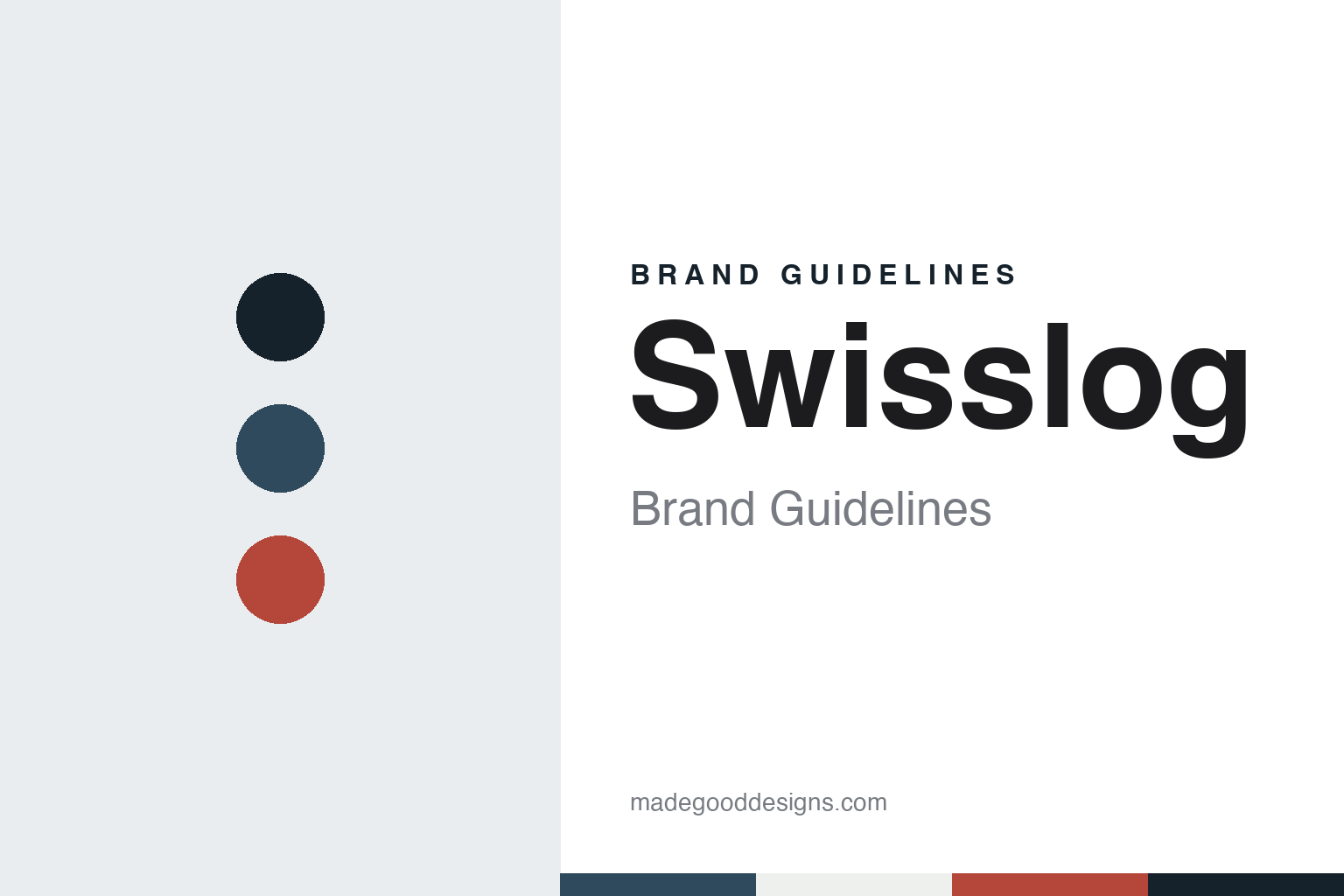
Swisslog Brand Guidelines
The Aarau electrical firm that became a warehouse-automation integrator.
Aa
Two constants: a slate, white and brick palette and an engineering sans register. Abstract homage — not a Swisslog product or mark; no system, logo or nameplate is reproduced.
Sprecher + Schuh
An electrical workshop in Aarau.
Swisslog’s story starts long before warehouses and robots. German Wikipedia, which lists the Historisches Lexikon der Schweiz and a 1987 study in the Aarauer Neujahrsblätter among its literature, says the company goes back to a business for electrical apparatus founded in Aarau in 1900 by Carl Sprecher and the merchant Hans Fretz. Heinrich Schuh joined as a partner in 1902, when the firm was called Sprecher, Fretz & Co.; after Fretz left in 1903 it carried on as Sprecher + Schuh.
For most of the twentieth century Sprecher + Schuh was an electrical-engineering company. Its first products were equipment for distributing electric power. The change came from the mid-1980s, according to English and German Wikipedia: the company sold its high- and medium-voltage business to Alstom and later its low-voltage business to Rockwell/Allen-Bradley, while it built up an automation arm by buying Translift, Digitron and OWL.
In 1994 the slimmed-down group was renamed Swisslog. Swisslog Holding was listed on the SIX Swiss Exchange until 2015, and its registered office sat in Buchs, next to Aarau, until August 2026, when it moved to Aarau, English Wikipedia says.
Its business became planning, building and servicing automated material-handling systems, and that is still how it describes itself: the company calls Swisslog “a global warehouse automation integrator headquartered in Aarau, Switzerland, with Swiss roots.”
Colour
Shuttles, cranes, monorails and software.
Swisslog is a systems integrator: it designs, makes and installs automated storage and retrieval systems, conveyors and other transport systems, robotic picking and palletising, and the warehouse software that runs them, then maintains them for the customer, English Wikipedia says. The systems move pallets as well as small loads such as cartons, trays and totes, using stacker cranes, shuttles, monorails, conveyors and autonomous mobile robots.
Its product names read like a catalogue of that work. On its website the company lists PowerStore, a pallet shuttle system; Vectura, a pallet stacker crane for high-bay warehouses; CycloneCarrier, a shuttle for small loads; and CarryPick, an order-picking system built on mobile robots. PowerStore came from Power Automation Systems, which Swisslog bought in 2016, and in 2026 the range gained a four-way pallet shuttle, now listed as AgileStore.
Software is the thread that ties these together. Swisslog’s own platform is called SynQ, which English Wikipedia describes as combining a warehouse management system, a warehouse control system, material-flow control and supervisory control; the company also implements SAP’s extended warehouse management software for its customers.
Not everything Swisslog installs is its own design. It is an integrator for the cube-shaped storage grid made by the Norwegian company AutoStore, and English Wikipedia says some of its picking and palletising systems use KUKA industrial robots. Its references include fashion, grocery, food and drink, pharmaceutical and e-commerce warehouses; English Wikipedia names a Varner distribution centre in Vänersborg, Sweden, and an AutoStore system for the fulfilment company Active Ants.
The hospital business took a separate path. In October 2014 The Robot Report’s Frank Tobe described Swisslog as having two robotics-related activities, healthcare and warehouse and distribution, and noted its pneumatic-tube business. Since 2019, German Wikipedia says, Swisslog Healthcare has traded as its own brand for hospitals, and KUKA reports it as a separate segment.
Typography
Warehouse automation and its makers.
Warehouse automation is an industry that mostly sells to other businesses, and its companies present themselves through the machines they install. The images are familiar across the sector: a dense block of stacked storage bins with robots running across the top, a swarm of small mobile robots moving under or up tall racks, or long shuttle aisles feeding a line of conveyors and sorters inside a distribution centre.
Those images do a job that a product catalogue cannot. A storage grid or a robot fleet is usually built to fit one building, so the companies show finished sites, walk-through videos and case studies named after their customers. Many also describe themselves as software companies as much as machine builders, and show control-room screens and dashboards that track robots, orders and stock in real time.
Trade fairs are where the sector meets its buyers. LogiMAT in Germany, ProMat in the United States and CeMAT are among the logistics shows where makers build working demonstration systems on their stands, and where new robots and workstations are often launched. Many of the companies also sell through partners and system integrators, so the same system can appear under more than one name on a show floor.
This guide sets out what can be checked about each company — who founded it, who owns it, where it says its equipment is made, and what has happened to it — and marks clearly what rests only on the company’s own word. The palettes and typefaces shown are our own interpretation, not the companies’ official colours or logos.
Aa
An engineering sans for a company that grew out of switchgear. (Specimen set in Archivo, a sans STAND-IN; NOT the Swisslog logo.)
Swisslog
From the Swiss exchange to KUKA and Midea.
Swisslog stopped being independent in 2014. In late September that year the Augsburg robot maker KUKA made a public offer for the shares, and Swisslog’s board recommended that shareholders accept it, The Robot Report reported on 20 October 2014; at that point the German family-owned Grenzebach group held about 30 percent of Swisslog, and KUKA said Swisslog’s brand and facilities would not be affected. KUKA completed the purchase in December 2014, English Wikipedia says, and Swisslog’s shares were delisted from the SIX Swiss Exchange on 31 July 2015.
Under KUKA, Swisslog grew in North America. In April 2015 it bought the US warehouse-automation company Forte Industries, and in 2016 Power Automation Systems; both were folded into the Swisslog brand in January 2017, English Wikipedia says. In 2024 the company opened a regional headquarters for the Americas in Atlanta, Georgia, and an office in Mississauga, Ontario.
The ownership changed again one level up. The Chinese appliance group Midea bid for KUKA in 2016, and after US authorities cleared the deal on 29 December 2016, Germany’s markets regulator approved the settlement that let Midea control a 94.55 percent voting stake from January 2017, Reuters reported in a story carried by China Daily on 3 January 2017. Swisslog has therefore been a wholly owned part of a German group that is itself owned by Midea. The company’s own website says simply that Swisslog “is part of the KUKA Group.”
Through all of this the name has stayed the same. Swisslog still presents itself under the brand it took in 1994, with an Aarau headquarters, Swiss roots and offices in more than 30 locations, English Wikipedia says, and the hospital arm carries the same name with “Healthcare” added.
For a design guide, Swisslog shows how an engineering company can keep a place-name brand while its owners change above it. Compare KUKA, the Augsburg robot maker that owns it, and AutoStore, whose storage grid it installs. For this guide we use a slate blue, white and a brick red with a sans, an unofficial interpretation; no product or logo is reproduced.
Explore & save
Keep Swisslog’s identity on hand — save it to a board in the Made Good inspiration library.
Swisslog identity set
Pin the Swisslog slate, white and brick palette and the engineering sans register to your own board.