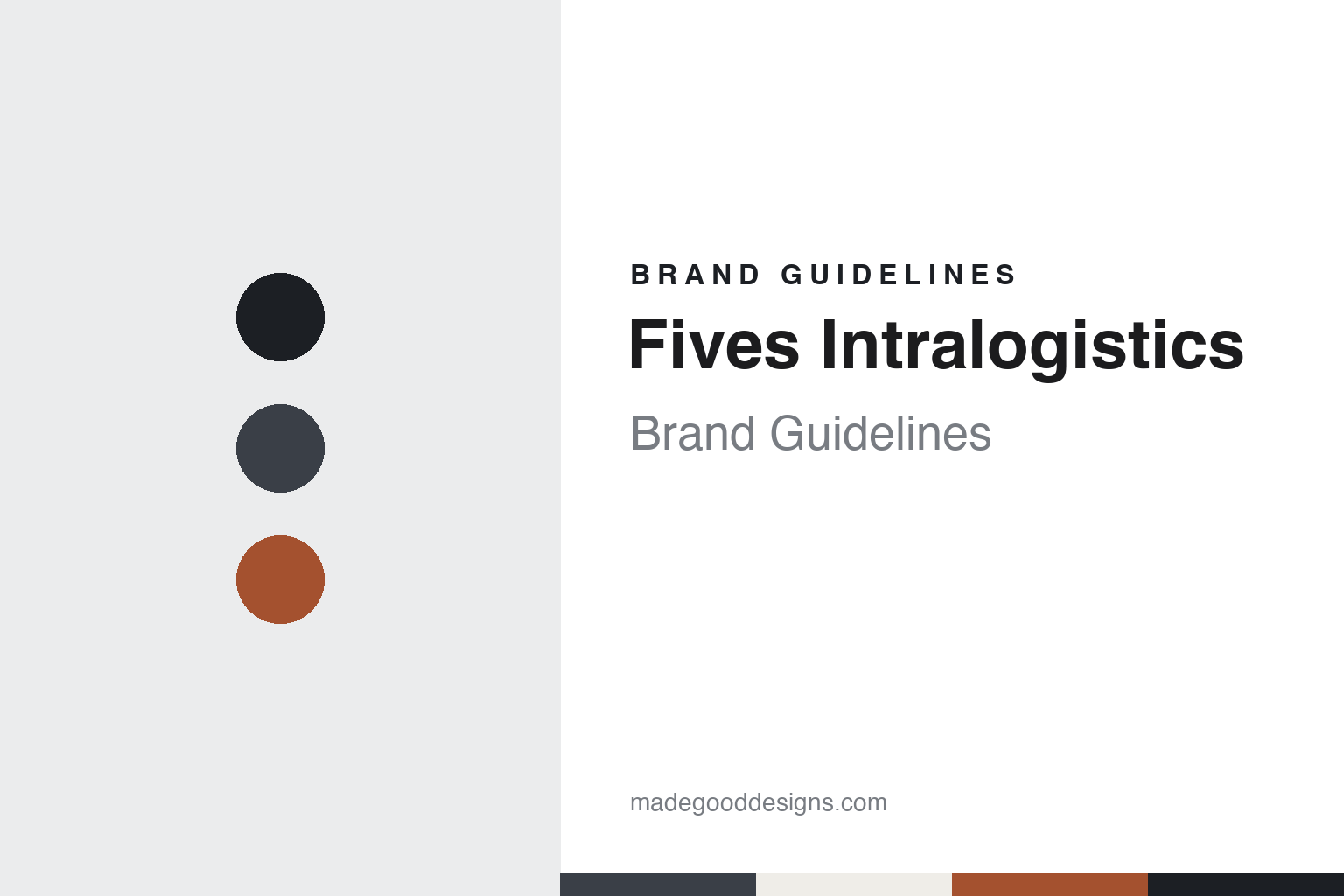
Fives Intralogistics Brand Guidelines
The sorting arm of a Lille engineering group with roots in 1812.
Aa
Two constants: an iron, white and copper palette and an industrial sans register. Abstract homage — not a Fives product or mark; no sorter, logo or nameplate is reproduced.
Fives-Lille
A railway works in a Lille suburb.
Fives Intralogistics is the youngest part of a very old company. Its parent, the engineering group Fives, says its origins go back to 1812, and takes its name from Fives, a suburb of Lille in the north of France. French Wikipedia traces two lines: the Paris workshop that the chemist Charles Derosne opened in 1812 to make distilling equipment, which Jean-François Cail joined and later ran as Cail; and Parent, Schaken, Caillet et Cie, founded on 6 October 1861 by Basile Parent and Pierre Schaken to build railway lines and locomotives, with works at Fives and at Givors near Lyon. It became the Compagnie de Fives-Lille in 1865.
Both firms worked on landmark structures in Paris. The group itself lists the lifts of the Eiffel Tower, the metal frame of the Orsay railway station and the Pont Alexandre-III among its early work, alongside steam locomotives.
Fives-Lille’s northern works sat in occupied territory in both world wars. In a 2020 summary of her École des chartes thesis on the company, published in Chroniques chartistes, the historian Clémence Becquet writes that during the First World War, with the northern factories occupied, all production was concentrated at Givors and taken up by the war effort, and that the Second World War brought the company’s restructuring to a halt. French Wikipedia, citing La Voix du Nord and Le Monde, says the Lille plant was requisitioned by the German occupier during the Second World War, became an Allied target because of the railway equipment it made for the Germans, and was paralysed for two months after a sabotage operation in June 1943 organised by the Resistance agent known as Captain Michel.
After the war the two lines merged as Fives-Lille-Cail in 1958, joined with Babcock-Atlantique as Fives-Cail-Babcock in 1973, and took back the name Compagnie de Fives-Lille in 1980. The group adopted the short name Fives in 2007 and added it to the names of all its subsidiaries, the company says.
Colour
Cinetic, Sandvik and a Louisville shop.
The logistics business was assembled through purchases. In 1997, French Wikipedia says, Fives-Lille bought Cinetic Industries, a maker of integrated handling systems. Ten years later Cinetic became the buyer of a sorting specialist: on 15 May 2007 the Swedish group Sandvik announced that it had agreed to sell Sandvik Sorting Systems to Cinetic Industries, “a subsidiary to the industrial group Compagnie de Fives-Lille.” Sandvik said the unit had operations in Italy, the United States and Japan, made sorting systems for postal, parcel and baggage handling, and already worked with Fives-Lille on the French market. Stainless Steel World reported in June 2007 that the business, whose US headquarters was in Louisville, Kentucky, would be renamed Cinetic Sorting once the deal closed.
Louisville remains the North American base. When Fives Intralogistics opened a new headquarters and innovation centre there on 12 February 2020, Modern Materials Handling reported that the North American business had started in Louisville in 1956 as a local company, SeamCo, making handling equipment for the car industry, and that Fives bought it in 2012. The new site combined a manufacturing shop, a simulation and emulation lab and four conveyor test loops. The magazine put the group’s intralogistics teams in France, Italy, China, Japan, Korea and the United States, serving postal and courier companies, distribution centres and airport baggage handling.
The product name that recurs in trade reports is the GENI-Belt, a cross-belt sorter. In June 2024 Robotics & Automation News reported that Fives had automated the order-picking platform Carrefour opened in Bourges in May 2024, using a GENI-Belt sorter fed by three injection lines, with warehouse software of its own. The project was run by Fives Syleps, an automation company the group bought in 2017, French Wikipedia says; its general manager described the work as “made in Fives and made in France.”
In France, French Wikipedia says, Fives Intralogistics SAS left its sites at Grigny and Chaponost for Chasse-sur-Rhône, south of Lyon, in 2020, and the group also lists an Italian company, Fives Intralogistics S.p.A.
Typography
Warehouse automation and its makers.
Warehouse automation is an industry that mostly sells to other businesses, and its companies present themselves through the machines they install. The images are familiar across the sector: a dense block of stacked storage bins with robots running across the top, a swarm of small mobile robots moving under or up tall racks, or long shuttle aisles feeding a line of conveyors and sorters inside a distribution centre.
Those images do a job that a product catalogue cannot. A storage grid or a robot fleet is usually built to fit one building, so the companies show finished sites, walk-through videos and case studies named after their customers. Many also describe themselves as software companies as much as machine builders, and show control-room screens and dashboards that track robots, orders and stock in real time.
Trade fairs are where the sector meets its buyers. LogiMAT in Germany, ProMat in the United States and CeMAT are among the logistics shows where makers build working demonstration systems on their stands, and where new robots and workstations are often launched. Many of the companies also sell through partners and system integrators, so the same system can appear under more than one name on a show floor.
This guide sets out what can be checked about each company — who founded it, who owns it, where it says its equipment is made, and what has happened to it — and marks clearly what rests only on the company’s own word. The palettes and typefaces shown are our own interpretation, not the companies’ official colours or logos.
Aa
An industrial sans for a group that has built locomotives, lifts and sorters. (Specimen set in Barlow, a sans STAND-IN; NOT the Fives logo.)
Fives Intralogistics
One name across many subsidiaries.
Fives Intralogistics is not a separate company with its own shareholders. It is a business line of the Fives group, which has its head office in Paris and organises its work into three areas, one of them called Smart Automation Solutions, the company says. French Wikipedia lists the group’s logistics work under conveying and automated handling, with Fives Intralogistics and Fives Syleps named as its intralogistics companies.
The group itself changed owners several times after leaving the stock market. French Wikipedia, citing Les Échos, says Paribas sold its shares in Compagnie de Fives-Lille to the Swedish fund Industri Kapital in 2001, when the company was delisted; Barclays Private Equity took over in 2004, and Charterhouse acquired a majority in 2006, with management holding a large minority.
The naming tells the story of how the group sees its subsidiaries. Since 2007 every company it controls carries the Fives name first: Fives Cinetic, Fives Syleps, Fives Intralogistics. The older brand names, from Cinetic to Sandvik Sorting Systems, survive only in the group’s history. In 2020, at the Louisville opening, the group launched a new signature, “Industry Can Do It,” which Modern Materials Handling reported Sanchez describing as the conviction that industry is the answer to environmental, technological, societal and economic challenges; it still appears on the group’s website.
The group also leans on its history in its own telling. Its website asks who built the Eiffel Tower’s lifts, and it published a book for its bicentenary in 2012.
For a design guide, Fives Intralogistics shows how a group-wide prefix can absorb the names of the businesses it buys. Compare Exotec, the French warehouse-robot maker, and KNAPP, the Austrian automation group. For this guide we use an iron grey, white and a copper with a sans, an unofficial interpretation; no product or logo is reproduced.
Explore & save
Keep Fives Intralogistics’s identity on hand — save it to a board in the Made Good inspiration library.
Fives Intralogistics identity set
Pin the Fives Intralogistics iron, white and copper palette and the industrial sans register to your own board.