Locus Robotics Brand Guidelines
A warehouse’s answer to losing its robots, turned into a robot company.
Aa
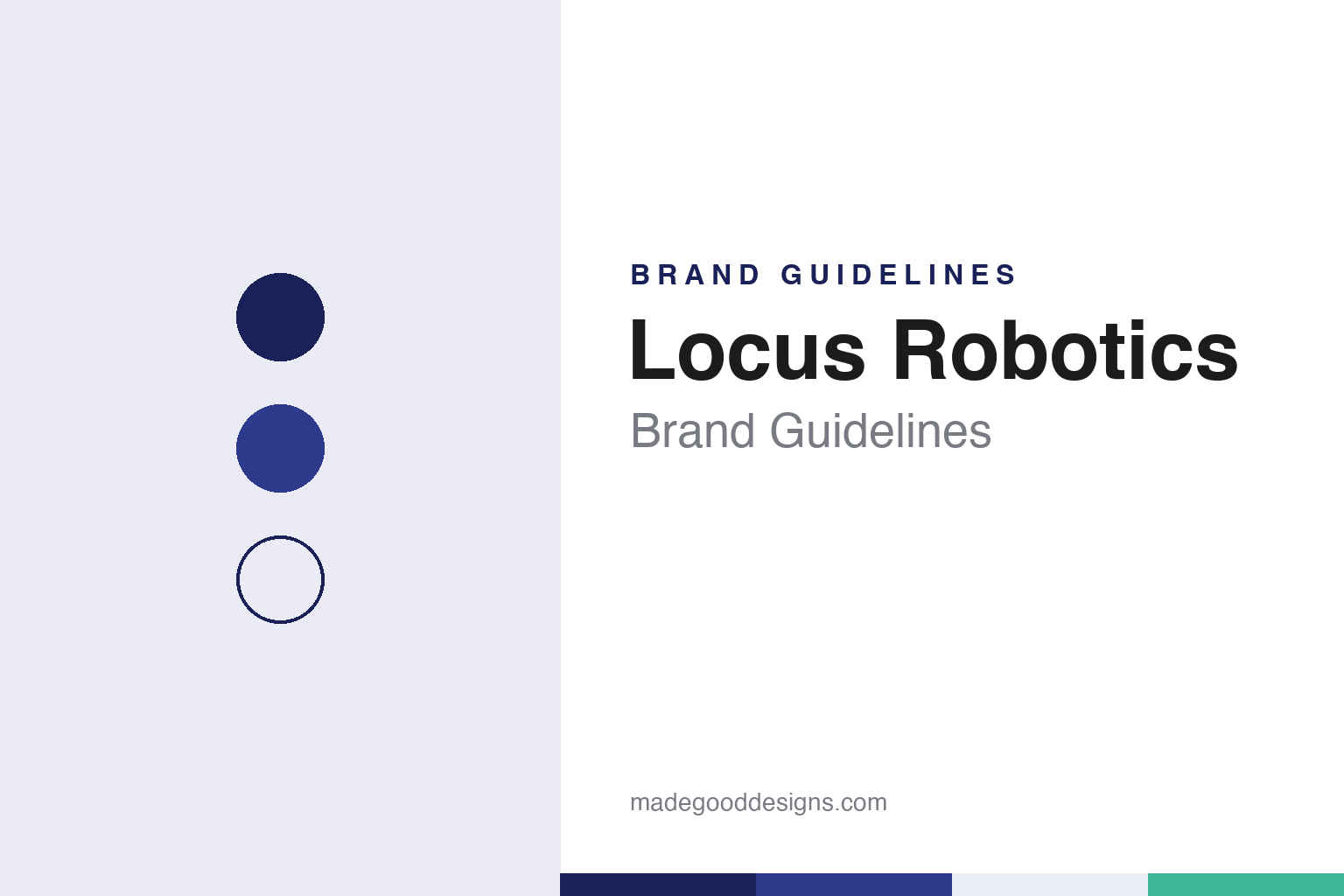
Two constants: an indigo, blue and teal palette and a grotesque sans register. Abstract homage — not a Locus Robotics product or mark; no robot, logo or nameplate is reproduced.
Born on the warehouse floor
A Kiva customer builds its own robot.
Locus Robotics began as a problem inside a warehouse. Its parent was Quiet Logistics, a third-party fulfilment company that English Wikipedia says was co-founded in 2009 by Bruce Welty and Michael Johnson, and which became the first third-party logistics company to use the warehouse robots of Kiva Systems.
That arrangement did not last. Amazon bought Kiva in 2012, and, according to English Wikipedia, in 2014 it told Quiet that the system would be limited to Amazon’s own operations and that Quiet’s contract would not be renewed. Unable to find a replacement it liked, Quiet designed and built its own robot, one directed by software but able to work alongside the people picking orders across the storage areas, and tied it into its warehouse management system.
TechCrunch put it plainly in 2024: “Locus’ founding was a direct result of Amazon’s 2012 Kiva Systems acquisition.” The magazine reported that Quiet began its own robotics division in 2014 and spun out Locus the following year. English Wikipedia also dates the spin-off to 2015 and places the new company in Wilmington, Massachusetts. Locus itself gives 2014 as its founding year and says it was founded by the team behind Quiet Logistics, “born on the warehouse floor.”
The company’s own timeline gives 2016 for its first enterprise deployments, 2017 for wider adoption across North America and 2021 for the opening of a European headquarters in Amsterdam. Quiet Logistics itself took a separate path: English Wikipedia says American Eagle Outfitters completed its purchase of Quiet at the end of 2021.
Colour
Robots that come to the picker.
Locus makes autonomous mobile robots, wheeled machines that carry totes around a warehouse and work alongside human pickers in the aisles. TechCrunch wrote in 2024 that “tote-transporting AMRs are still at the center of everything Locus does,” and that each new robot was in essence an iteration of the core product.
The current range, on the company’s website, has three robots. Locus Origin is the tote-carrying picking robot. Locus Vector, which the company dates to 2023, extends the system into transport and movement work; TechCrunch noted its wheels let it drift sideways in tight spaces. Locus Array is a fully autonomous “robots-to-goods” system that picks items itself. A software layer, LocusONE, coordinates robots, people, inventory and tasks, and the company sells its fleets on a Robots-as-a-Service basis rather than only as equipment purchases. Locus says it has deployed more than 22,000 robots at more than 360 sites.
Array marks a change of direction. In March 2024 TechCrunch reported that Locus did not make a mobile manipulator, so people still moved totes on and off its robots; chief executive Rick Faulk said the company would build one. The Robot Report reported in May 2026 that Locus had launched the Array mobile manipulator the previous month, and that Array had won a 2026 RBR50 Robotics Innovation Award from that publication.
The same report covered Locus’s purchase of Nexera Robotics, of Vancouver, announced on 19 May 2026. Nexera’s patented NeuraGrasp gripper, which combines a soft, compliant membrane with onboard sensing, computer vision and artificial intelligence, was to replace the suction cup on Array. Locus’s chief strategy officer told the publication the aim was one gripper for a wide range of goods, from polybags to cloth items.
Typography
Who builds the automated warehouse.
Warehouse automation is an industry that mostly sells to other businesses, and its companies present themselves through the machines they install. The images are familiar across the sector: a dense block of stacked storage bins with robots running across the top, a swarm of small mobile robots moving under or up tall racks, or long shuttle aisles feeding a line of conveyors and sorters inside a distribution centre.
Those images do a job that a product catalogue cannot. A storage grid or a robot fleet is usually built to fit one building, so the companies show finished sites, walk-through videos and case studies named after their customers. Many also describe themselves as software companies as much as machine builders, and show control-room screens and dashboards that track robots, orders and stock in real time.
Trade fairs are where the sector meets its buyers. LogiMAT in Germany, ProMat in the United States and CeMAT are among the logistics shows where makers build working demonstration systems on their stands, and where new robots and workstations are often launched. Many of the companies also sell through partners and system integrators, so the same system can appear under more than one name on a show floor.
This guide sets out what can be checked about each company — who founded it, who owns it, where it says its equipment is made, and what has happened to it — and marks clearly what rests only on the company’s own word. The palettes and typefaces shown are our own interpretation, not the companies’ official colours or logos.
Aa
A grotesque sans for a fleet of small machines. (Specimen set in Space Grotesk, a sans STAND-IN; NOT the Locus Robotics logo.)
Locus Robotics
A robot maker shaped by its customers.
Locus’s story is tied to the wider growth of warehouse robots after the Kiva sale. TechCrunch noted in 2024 that the Kiva acquisition was a catalyst for the whole category: former Kiva executives founded 6 River Systems, later sold by Shopify to the UK grocery technology group Ocado, while Fetch Robotics, founded in 2014, was bought by Zebra in 2021.
The pandemic years brought heavy investment in warehouse automation, and then a correction. TechCrunch reported that in January 2024 Locus laid off an undisclosed small number of staff, which Faulk attributed to over-hiring on the go-to-market side after COVID, with engineering untouched.
English Wikipedia places the company in Wilmington, Massachusetts, and The Robot Report still named Faulk as chief executive in May 2026. Its website now describes the business in terms of “Physical AI,” mobile manipulation and a “flexibility-first” approach, arguing that much earlier automation was built around predictable demand while Locus aims to let operators add work without fixed infrastructure. Those are the company’s own descriptions. Its website lists the industries it serves as including third-party logistics, apparel and fashion, beauty, grocery, healthcare and pharmaceuticals, and industrial supply.
The brand’s origin also explains its language. Locus presents its robots as working beside people in existing buildings rather than replacing the building, a framing that follows directly from a fulfilment company that once needed robots for its own aisles.
For a design guide, Locus Robotics shows how a company born inside a customer’s warehouse can turn that origin into its whole story. Compare Ocado, the grocery technology group that bought 6 River Systems, and Geek+, another maker of warehouse mobile robots. For this guide we use indigo, a mid blue and a teal with a sans, an unofficial interpretation; no product or logo is reproduced.
Explore & save
Keep Locus Robotics’s identity on hand — save it to a board in the Made Good inspiration library.
Locus Robotics identity set
Pin the Locus Robotics indigo, blue and teal palette and the grotesque sans register to your own board.