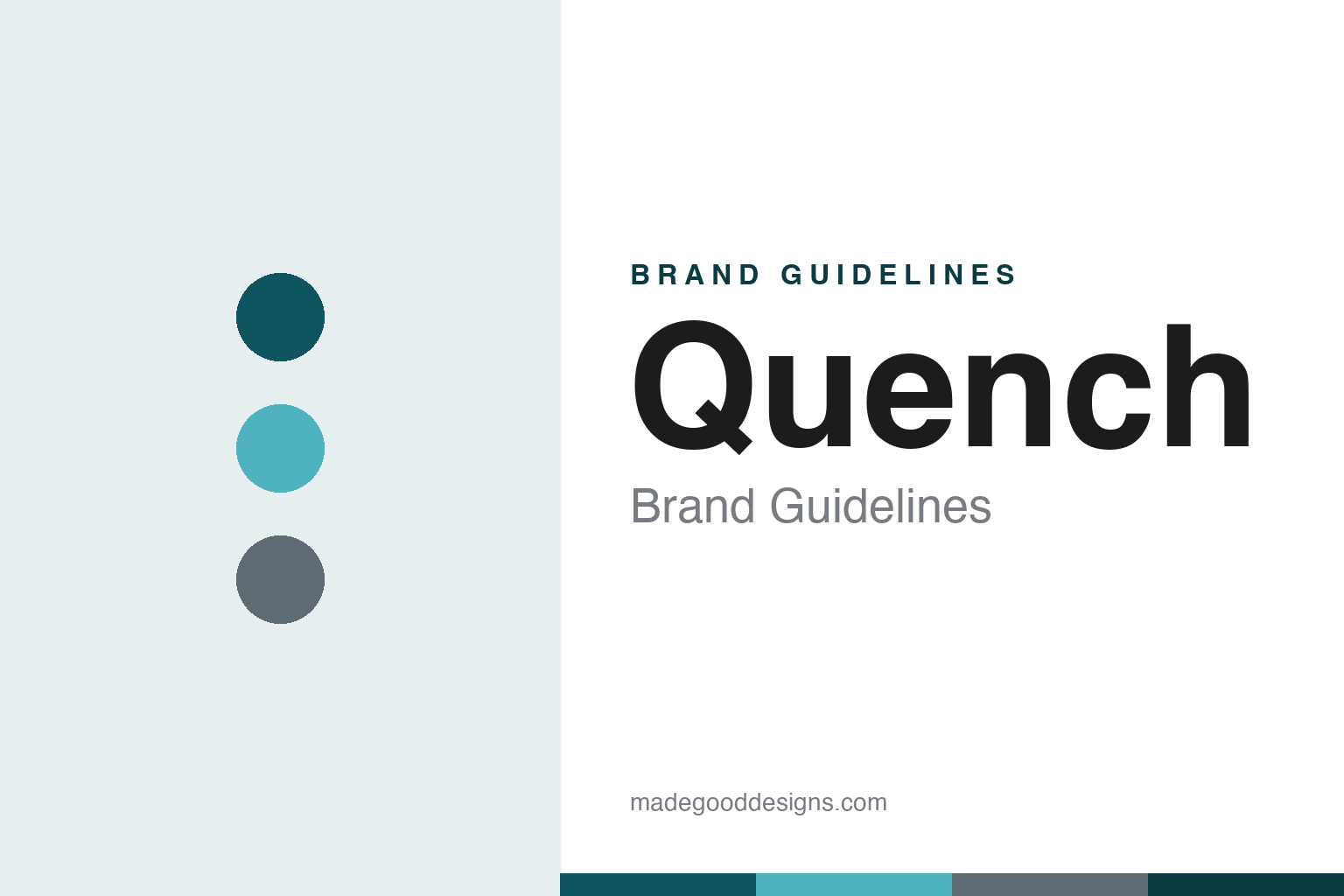
Quench Brand Guidelines
The bottle-free cooler company now called Culligan Quench.
Aa
Two constants: a teal, aqua and slate palette and a friendly sans register. Abstract homage — not a Quench product or mark; no cooler, logo or nameplate is reproduced.
Five distributors
A roll-up of regional cooler dealers.
Quench rents and services filtered, bottle-free water coolers for workplaces in the United States and Canada, and since 2025 has traded as Culligan Quench. Its own timeline says Quench was founded in 1997. A Yale School of Management teaching case by Chris Gates and A.J. Wasserstein, dated June 2020, gives a fuller account: it says Quench USA was formed in 2005 through the merger of five point-of-use water cooler distributors, in New York City, Philadelphia, Cincinnati, Atlanta and Jacksonville, which together had about 15,000 machines installed and hoped to gain buying power as one company.
The case describes a slow start. The merged business grew slowly from 2005 to 2007, the five former companies kept operating separately, and the business put itself up for sale. Shortly before the financial crisis, in early 2008, Element Partners, a private equity firm in Radnor, Pennsylvania, recapitalised it. Tony Ibargüen became chief executive in 2010; he consolidated the five facilities into one site for back office, distribution and warehousing, leaving field teams in their original cities, and in October 2011 the company raised new financing from existing and new investors, the case says. A news item reproduced in the case lists Element Partners, Virgin Green Fund and Douglas Brown among the existing backers in that round, joined by new investors including ORIX Venture Finance, Advent-Morro Equity Partners, Potomac Energy Fund and The Pohlad Companies.
The case sets that history against a crowded market. It describes the point-of-use cooler trade as highly fragmented, spread across hundreds of small local providers, each typically managing between 500 and 1,000 rental or maintenance contracts, and says Quench expected to have about 46,000 coolers in place by the end of 2012, with the goal of reaching several hundred thousand through acquisitions. Buying up local dealers became the strategy that followed.
Quench is based in King of Prussia, Pennsylvania, outside Philadelphia. Its press releases carried that dateline in 2015, and Culligan Quench still used it in 2025.
Colour
Water as a service.
The business model is rental and service rather than delivered bottles. Quench’s machines are connected to a building’s existing water supply and filter it at the point of use. In a July 2015 release the company called this “Water-as-a-Service” and listed bottle-free coolers, ice machines, sparkling water dispensers and coffee brewers among its products, sold to government, education, medical, manufacturing, hospitality and commercial customers; it said those included more than half of the Fortune 500.
Growth came largely through acquisition. In the same release Quench announced that it had bought Region-X, a firm in Taunton, Massachusetts, that regenerated deionisation resin and cleaned reverse osmosis membranes, to add to its Atlas High Purity Solutions business. In December 2019 the Tampa Bay Times reported that AquaVenture Holdings’ purchase of Quench in 2014 had set off a run of 22 acquisitions in five years, and that Quench served about 55,000 commercial and institutional customers in more than 300 metro areas across the United States and Canada. In February 2025 Culligan Quench announced the purchase of Stonybrook Water, a supplier of water and ice equipment in Manchester-by-the-Sea, Massachusetts, the coffee trade site Comunicaffe reported.
Today the range runs from freestanding and countertop bottle-free coolers to coolers with ice makers, sparkling and flavoured water dispensers such as the Twist, commercial ice machines and coffee machines, with bottled-water delivery offered as well, according to the company’s website. Its timeline says it added sparkling water and “on-demand chilling” coolers in 2013.
Typography
Water on tap.
Water dispenser makers sell into rooms that most people pass through without noticing: the office kitchen, the staff room, the school corridor, the gym lobby and the hotel back-of-house. Their brands have to work for two audiences at once. One is the person who fills a glass or a bottle several times a day; the other is the facilities manager, architect or procurement team who chooses the equipment, signs a rental or service contract and answers for it afterwards.
The product types shape how these companies present themselves. A freestanding or countertop cooler fed from the mains is usually shown as a tidy appliance in a bright workspace, often next to a choice of still, sparkling, hot or chilled water. An under-sink system is a different kind of sell: the boiler, chiller and filter sit out of sight in the cabinet, so the visible part of the brand is a slim tap on the bench, and the photographs tend to concentrate on its finish and profile.
Bottle-filling stations and drinking fountains bring the category into schools, universities, gyms and public spaces, where the language turns to refills, durability and easy cleaning. Here the brand appears on a sturdy wall unit rather than a kitchen fitting, and the messaging is aimed as much at the people who maintain it as at the people who use it.
Much of the selling still happens in person, at facility-management, building and hospitality trade fairs, in showrooms and through dealer and distributor networks. Many of the names in this field have also changed hands through mergers and acquisitions, so a brand’s history often runs through several owners, and its identity has to stay recognisable across catalogues, service vans and installer manuals in many countries.
Aa
A friendly sans for a service brand. (Specimen set in Figtree, a sans STAND-IN; NOT the Quench logo.)
Culligan Quench
From AquaVenture to Culligan.
From 2014 Quench’s parent was AquaVenture Holdings. The Tampa Bay Times reported that AquaVenture was founded in 2006 by Douglas R. Brown with former colleagues from the water company Ionics, ran two businesses, Seven Seas Water, which operated desalination plants, and Quench, and went public in 2016. A 2015 Quench release described the cooler business as an independent operating company of AquaVenture.
On 31 December 2019 the newspaper reported that Culligan, the Illinois water treatment company then owned by the private equity firm Advent International, had agreed to buy AquaVenture. Culligan announced on 30 March 2020 that the deal was complete, that it had sold Seven Seas Water to Morgan Stanley Infrastructure Partners, and that it would keep Quench.
Two further changes followed. After Culligan combined with Waterlogic Group Holdings, Waterlogic’s US and Canadian operations were folded into Quench, with the integration beginning in November 2022, according to Culligan Quench; Waterlogic’s WL7 still and sparkling coolers were renamed the Q9 and Q10, while Waterlogic continues as a brand in other markets. Then, the company says, Quench and Culligan came together under one name in 2025 as Culligan Quench.
For a design guide, Quench shows a service brand built by stitching regional dealers into one national name, and then folding that name into its parent’s. Compare Culligan, its owner since 2020, and Waterlogic, whose North American business it absorbed. For this guide we use a deep teal, a fresh aqua and a cool slate with a sans, an unofficial interpretation; no product or logo is reproduced.
Explore & save
Keep Quench’s identity on hand — save it to a board in the Made Good inspiration library.
Quench identity set
Pin the Quench teal, aqua and slate palette and the friendly sans register to your own board.